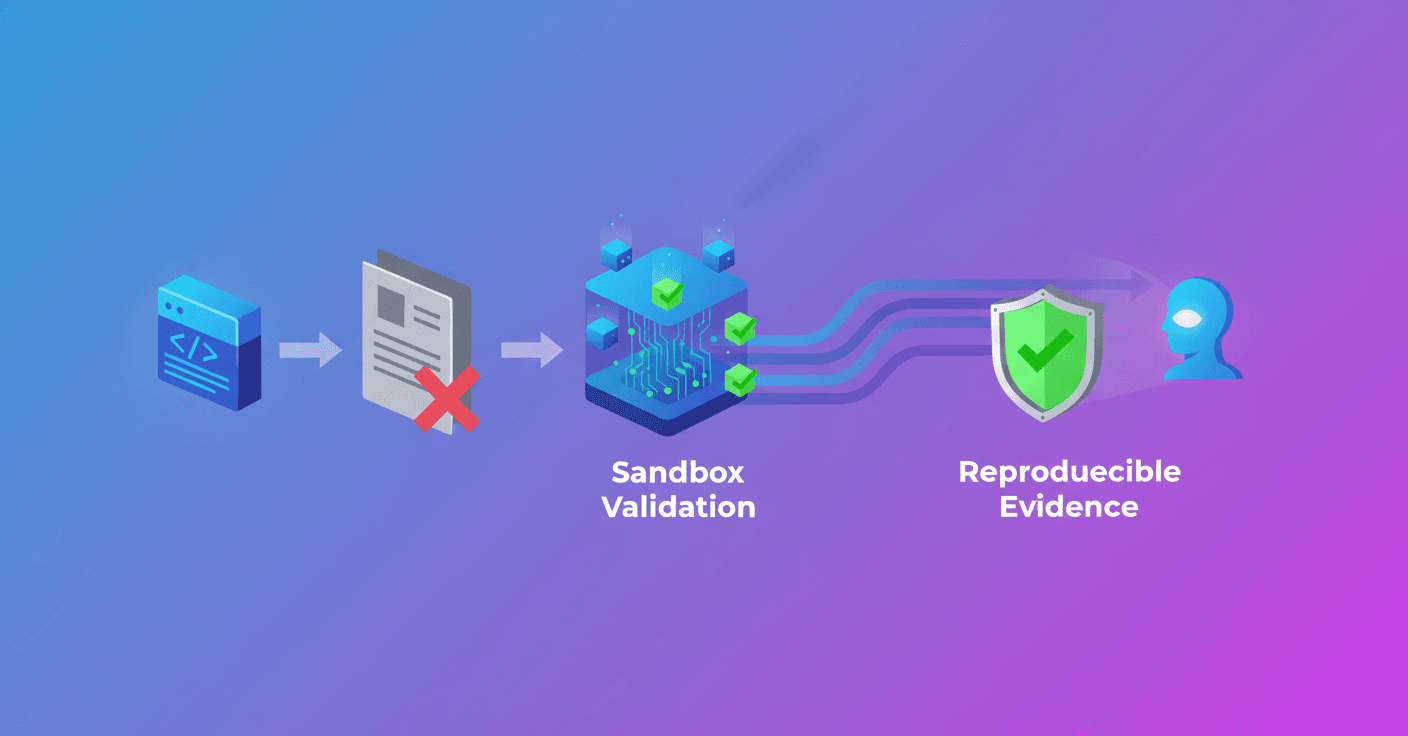
When you read that a security tool doesn't start with a SAST report it can sound odd: isn't SAST the classic way to scale code reviews? Codex Security made that decision on purpose because the reality of practical vulnerabilities is often more subtle than a simple data flow.
The root of the problem: validate intent, not just the flow
SAST does one very useful thing: it traces an untrusted input to a sensitive sink and marks the path. It's elegant and catches many mistakes. But is that enough to decide whether the system is actually secure?
The key point is that many failures are not just data flow issues. They're about intent and how checks hold up after transformations, decodings or normalizations. In other words: it's not enough to see that the code calls sanitize_html(); you need to prove that call preserves the invariant the system requires.
Sound familiar? A common case: you receive a redirect_url, apply a regex to allow only certain destinations, do a URL decode and then redirect. A source-to-sink report can show the route: input → regex → decode → redirect. But the real question is this: is the validation applied to the value that the redirect handler ultimately interprets? If the regex runs before the decode, the check might not restrict what is really interpreted afterwards.
Why starting from the repository changes the game
Codex Security starts from the code and the system design: architecture, trust boundaries and expected behavior. It doesn't stop at a list of findings; it seeks to validate. That means more automated work, but stronger evidence before interrupting a human.
In practice that involves several strategies:
- Read the relevant path with the repo context, just like a human investigator would. Comments help, but they don't convince the model if the code is wrong.
- Isolate the minimal slice that matters (for example, the chain of transformations on an input) and generate micro-fuzzers to test hypotheses.
- Reason about how restrictions propagate across transformations, and formalize the problem when it helps (for example, using a solver) for complex cases like overflows in non-standard architectures.
- Run tests in a sandboxed environment to verify that a hypothesis fails end-to-end; an executable PoC is often the best evidence.
The idea is not to dismiss SAST. It's that, for an agent that must discover and validate vulnerabilities in context, starting from a SAST report can anchor its reasoning on the wrong assumptions.
Three predictable failures if you start with SAST
If you begin with an external list of findings, three common failure modes appear:
- Premature focus: the report is a map of what the tool already looked at. If you take it as the starting point, the agent can spend effort confirming the obvious and miss other areas.
- Implicit judgments that are hard to undo: many findings carry assumptions about sanitization or trust boundaries. If the agent inherits those assumptions, it moves from investigating to confirming or dismissing without questioning the basis.
- Opaque evaluation of reasoning: if the pipeline starts with SAST output, it becomes hard to measure what the agent discovered on its own versus what it inherited, which makes improving the system difficult.
What does this bring to security teams?
SAST is still valuable: apply secure coding rules, detect known patterns and cover simple cases at scale. Codex Security's approach doesn't aim to replace those tools, but to complement them with a layer that explains why something is truly problematic and how to test it.
For teams with little time, the difference is practical: move from "this looks suspicious" to "this fails like this, here is a PoC and a fix that respects the system's intent." That's what consumes the most human resources in real reviews.
Final reflection
The lesson is that security is not just tracing values. It's understanding intentions, transformations and their real impact on system behavior. Codex Security bets on raising confidence before notifying a person, building reproducible evidence instead of relying on a precomputed list of warnings.
Original source
https://openai.com/index/why-codex-security-doesnt-include-sast