Waypoint-1.5 arrives to bring interactive generative worlds to the GPU you have at home. It's not just prettier video: it's responsiveness, coherence and the ability to explore in real time without relying on cloud clusters.
Qué es Waypoint-1.5 y por qué importa
Waypoint-1.5 is the new version of Overworld's real-time video model, built to generate interactive worlds on consumer hardware. If Waypoint-1 proved it was possible, Waypoint-1.5 wants to make it usable: higher visual fidelity, better motion coherence and, above all, more accessibility.
What changes compared to the first version? Mainly three things: higher visual quality, training at a much larger scale, and optimizations so the model runs locally on more machines.
Rendimiento y niveles de ejecución
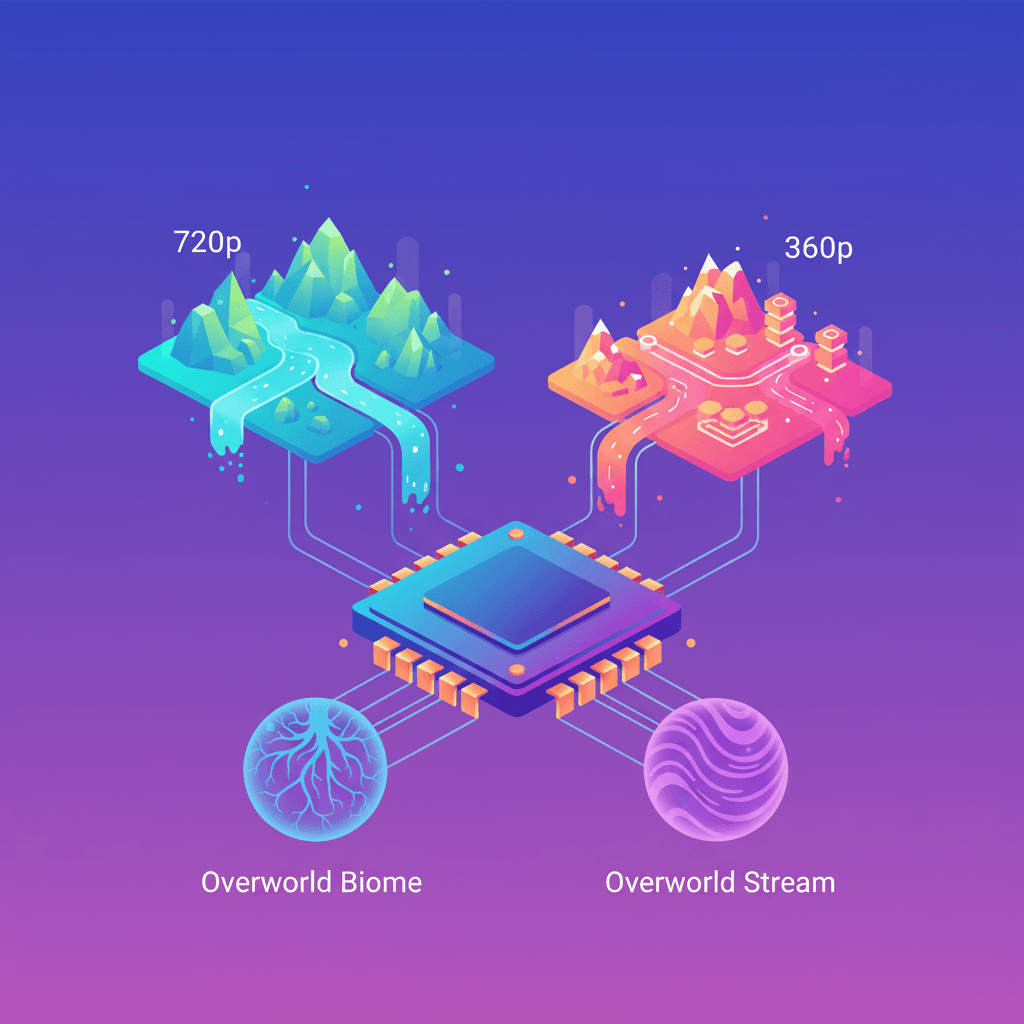
The release presents two tiers aimed at different hardware profiles:
720pat up to 60 FPS for higher-end desktop GPUs (examples mentioned: RTX 3090 up to 5090).360poptimized for a broader range of consumer hardware, including gaming laptops and soon Macs with Apple Silicon.
The idea is simple: not just make pretty video, but ensure the experience is interactive and responds in real time. In interactive contexts what sticks with you isn't resolution, but latency and how coherent the world feels when you move.
Entrenamiento y datos
Waypoint-1.5 was trained with almost 100 times more data than Waypoint-1. That's not a small number: more data usually translates into more coherent environments, better temporal continuity and fewer artifacts when you explore long scenes.
Practically speaking, that data increase helps the model keep apparent geometry consistent, maintain lighting, and make motion behave sensibly as you navigate the world.
Optimización: menos cómputo redundante, más respuesta
A key piece of the improvement is adopting more efficient video modeling techniques to cut redundant computation between frames. What does that mean in plain terms?
- Reuse representations: instead of processing each frame from scratch, the system can hold and update intermediate states.
- Keyframe-like strategies or temporal compression: prioritize compute where real changes happen and save on what stays the same.
The result: less load per frame, smoother motion and lower interaction latency. And remember: in real-time systems, the feeling of immediacy matters more than a few extra pixels per frame.
Librerías y formas de uso
Waypoint-1.5 is offered in two main ways:
- Locally, through
Overworld Biome. The updated runtime aims to make local setup easier: a new installer and flow that take you from download to run in minutes. - Instantly, with
Overworld Stream— a browser demo to try without installing anything.
Plus, Overworld publishes World Engine, the inference library that powers their official clients and already includes support for nearly a dozen third-party clients and libraries. That makes it easier for developers and creators to integrate Waypoint-1.5 into their own tools and projects.
¿Qué significa esto para desarrolladores, creativos y jugadores?
If you're a developer, Waypoint-1.5 opens a way to build interactive environments with local inference, reducing cloud dependence and associated costs.
If you're a creator or artist, it's a tool to prototype explorable worlds more directly: you download the model, try it and see how it responds in real time.
For the end user or player, the promise is simple: explorable experiences that feel immediate, not just pre-rendered videos.
Riesgos, límites y lo que falta por ver
Even though Waypoint-1.5 improves accessibility and fidelity, important challenges remain: scalability in very large spaces, fine-grained quality comparable to traditional rendering in all scenarios, and complete support across the hardware ecosystem.
It's also important to evaluate power and thermal consumption on laptops, as well as integration with existing interactive pipelines in games or simulators.
Waypoint-1.5 doesn't close the gap completely, but it reduces it in a tangible way.
The direction is clear: models that don't just render scenes but let you inhabit them.
Reflexión final
We're at an interesting point: the difference between watching and being inside an AI-generated world stops being theoretical. Waypoint-1.5 bets on making the experience local, reactive and practical. Can you imagine prototyping a game or a narrative experience on your laptop and having it respond like a real world? That's what this aims to bring closer.