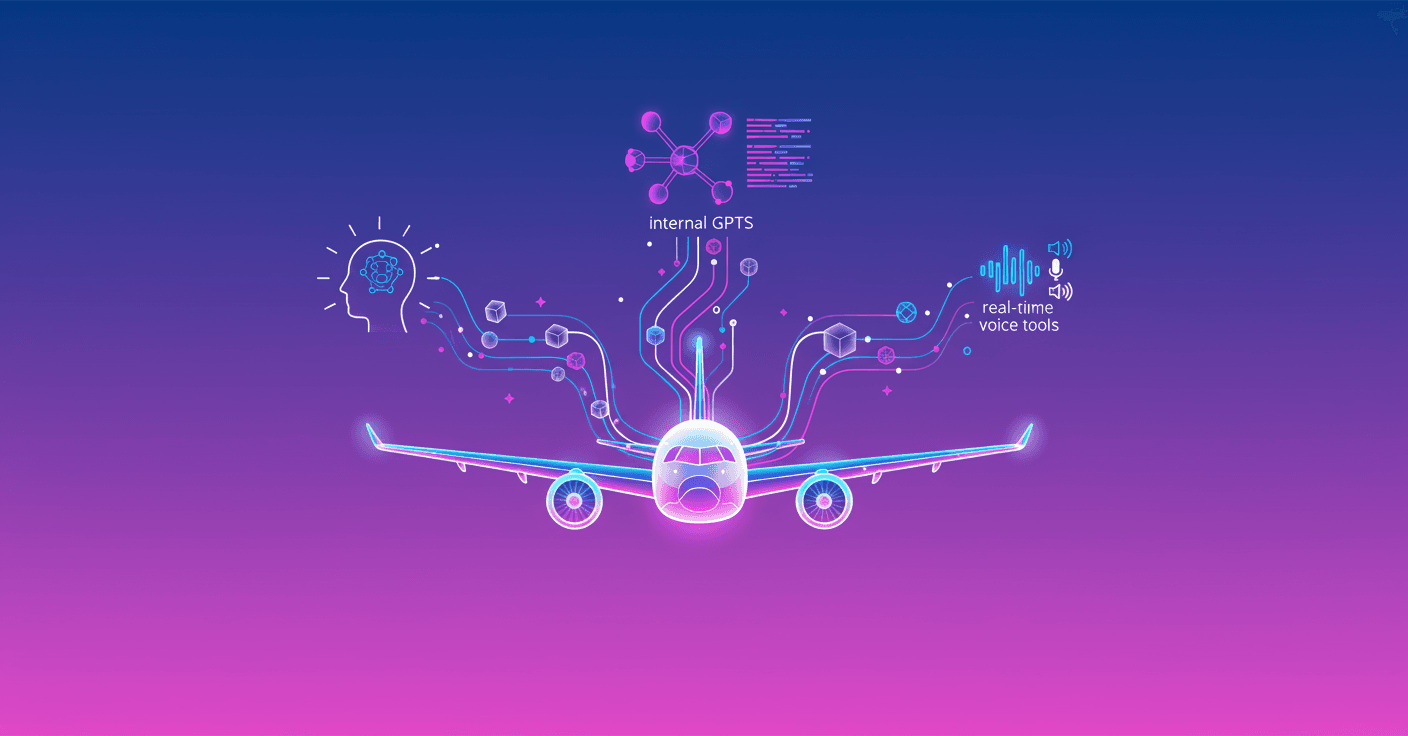
Virgin Atlantic has always positioned itself as a 'challenger' airline: bold, focused on experience, and looking for advantages even when size isn't on its side. Curious how they keep up? Their latest bet is artificial intelligence to speed up processes, improve products, and keep people at the center of service.
How Virgin Atlantic is using AI today
The airline did broad exploration, tested, learned, and then focused. They chose key partners, including OpenAI, and moved from small experiments to scaled programs like ChatGPT Enterprise and Codex. The results aren't promises: they're concrete improvements in productivity and passenger experience.
-
Development of software: with AI-assisted tools they write and test code faster, which reduces cycles and lets them launch app features and check-in processes more quickly.
-
Digital concierge: a central guide for inspiration, managing bookings, answering questions and loyalty benefits, designed to sound like the brand: warm, witty and human. It handles routine queries and hands you off smoothly to agents when a case is complex.
-
People and finance teams: hundreds of internal GPTs that act as self-service for HR policies, generate first drafts of financial narratives and analyze data in real time to meet regulations and speed decision-making.
-
Real-time voice: they use OpenAI's real-time voice API to power the concierge's voice interaction, making customer contact feel more natural.
Culture, governance and adoption: the operational secret
Virgin Atlantic didn't leave AI to chance. They built a culture supported by four pillars: education, community, guardrails and iteration.
-
Education: guides and playbooks on prompts and creating GPTs; training with their tech partner.
-
Community: a network of internal champions who experiment and share learnings; plus learning programs like the collaboration with Cambridge Spark to bring in AI apprentices.
-
Guardrails: clear policies on privacy, model use and access control to protect sensitive areas without stifling experimentation.
-
Iteration: continuous measurement: what works, what doesn't and how to improve. It's a living framework that evolves with the technology and the people.
'The idea is to empower teams, not replace them'. When AI hits its limits, the system passes the interaction to a person in seconds.
How they measure value (practical ROI)
Virgin Atlantic measures on two levels: short-term productivity gains and long-term strategic impact.
-
Small cases: metrics like number of marketing assets produced, time to create content and hours saved.
-
Large-scale initiatives: outcome-oriented metrics, for example reductions in call center wait times, increases in self-service rates and revenue growth when the experience improves.
The logic is simple: start with the result you want and design the solution around that goal, not the other way around.
Practical lessons you can apply today
Want to take ideas for your team? Three clear recommendations from Virgin Atlantic:
-
Be ambitious: think three years ahead. Technology moves fast and the vision should be broad.
-
Start from outcomes: define what success looks like before choosing tools.
-
Balance ambition and control: set governance to manage risk without killing innovation.
If you work in a regulated company, like an airline, these decisions aren't optional: they're essential to scale without surprises.
Final reflection
Virgin Atlantic shows how AI can be both an operational lever and a tool to reinforce brand identity. It's not just about automating tasks, but about keeping the customer experience human and consistent with what the brand promises. The recipe? Decisions focused on results, a culture that supports change, and clear rules that let you experiment safely.