Today I tell you about TutorMoments, a framework for measuring whether large language models can decide at the right moment: should I help the student or let them think more?
What TutorMoments looks for
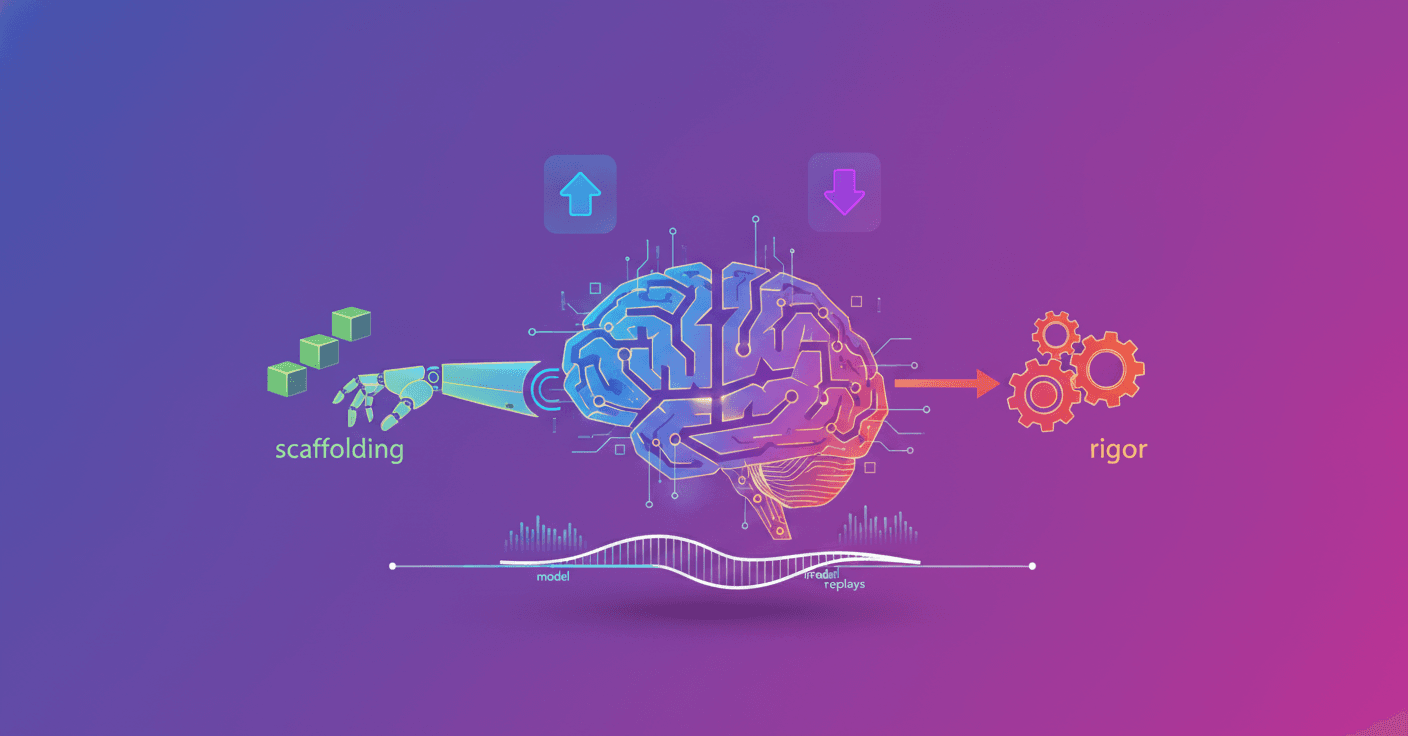
Have you ever had a tutor solve the problem for you and ended up not understanding why? That’s exactly the tension TutorMoments wants to capture: the distinction between scaffolding (making the problem more accessible) and pushing the student toward more rigor (making them do more of the reasoning). In education, timing matters as much as technique.
TutorMoments doesn’t invent scenarios: it works with real one-on-one math tutoring sessions. Expert teachers marked the points where the human tutor had to choose between giving more help or asking for more effort. Then the system pauses at that point and lets an LLM take the tutor’s role in a simulation.
How it works technically (replay-based evaluation)
-
Dataset: they publish
TutorMoments-Preview, with 462 deidentified tutoring transcripts in text (grades 2–7), over 1,500 key moments annotated, and several thousand free-form annotations from 27 teachers. -
Annotations: each key moment indicates whether the human tutor should have done scaffolding or pushed for rigor. When there’s disagreement, the majority label is used.
-
Replay: the system pauses the transcript at the marked moment and gives control to a model that acts as the tutor for five turns. The student in the simulation is another model. Each generated continuation is a
replay. -
Scoring pipeline: an automatic pipeline evaluates each replay on three dimensions: (1) whether the model scaffolds when needed, (2) whether it pushes for rigor when appropriate, and (3) whether it avoids over-scaffolding (reducing the challenge too much). To determine if the tutor’s action matches teacher expectations, they use a classifier based on LMs validated against the teachers’ annotations.
Preliminary results and technical findings
You might be surprised, but models tend to over-help. With a plain prompt that just says “tutor well,” models frequently provide more support than necessary and rarely push for deep thinking.
They tested seven models (including Gemini 2.5 Pro, Gemini 3.5 Flash, Claude Opus 4.8, Claude Sonnet 4.6, GPT 5.5, GPT 5.4 mini, and DeepSeek V4 Pro) under two prompt conditions: plain prompt and evaluation-aware prompt (which makes the trade-off between scaffolding and rigor explicit).
The clear pattern is that the evaluation-aware prompt improves all models compared to the plain prompt. However, even with that improved prompt, models vary widely and none close the gap in the variety and finesse of strategies human tutors use.
Some useful numbers the study provides:
- Moments: 738 labeled as scaffolding and 260 as rigor.
- Human baselines (measured with the same pipeline): 0.458 appropriate on scaffolding, 0.182 appropriate on rigor, and 0.496 on avoiding over-scaffolding.
Additional technical observations:
-
The metrics measure tutor behavior at the decision point, not real student learning. Replays use simulated students, so the numbers are signals of behavior, not direct proxies for learning gains.
-
Detecting pushes for rigor is noisier than detecting scaffolding: there are fewer examples and the automatic classifier is less reliable for rigor.
-
Under prompting, models tend to repeat a small set of strategies (for example, asking the student to explain their answer) instead of the variety teachers use.
Technical and design limitations
TutorMoments is useful but has clear limits:
-
Simulated evaluation: the automatic pipeline and simulated students don’t replace studies with real students and learning measurements.
-
Domain bias: data mostly from the U.S., elementary and middle-school math, and annotators from a single group. We don’t know how it generalizes to other subjects, levels, or cultural contexts.
-
Annotation and noise: fewer rigor moments and less reliable detection complicate conclusions in that dimension.
Implications for teams building AI tutors
If you work in product or educational research, there are practical lessons:
-
The prompt matters: specifying the pedagogical tension improves behavior, but it doesn’t solve everything. You need decision policies that are moment-aware, not just a better prompt.
-
Student modeling: replacing the student with a more realistic agent or running pilots with real students is critical to move from behavior to learning impact.
-
Diversity of strategies: training or fine-tuning models to handle a richer repertoire of interventions (pause, guided question, ask for justification, give stepped hints) can bring them closer to human practice.
-
Broader, multimodal data: extending the dataset to other subjects, levels, and formats (voice, whiteboard, images) will help build more robust tutors.
Next steps and openness of the research
AllenAI publishes the deidentified dataset, the replay pipeline code, and model replays for reproducibility. They seek feedback to expand the framework: a larger multimodal dataset, a stronger scoring pipeline, and deeper analyses.
The invitation is clear: this isn’t a final benchmark but a tool to ask better questions about how LLMs make pedagogical decisions.
Think of this as a compass, not the full map. TutorMoments aims for AIs that aren’t just “useful” but pedagogically appropriate for the student’s moment.
Final reflection
If you build or integrate AI tutors, the key question isn’t only how much they help, but when they help. TutorMoments gives you a technical, reproducible way to measure that intuition, with all the strengths and limits an automated evaluation can offer today.
Research continues, and responsibility is shared: educators, researchers, and developers must collaborate so tutoring AIs foster learning rather than replace the effort that produces it.