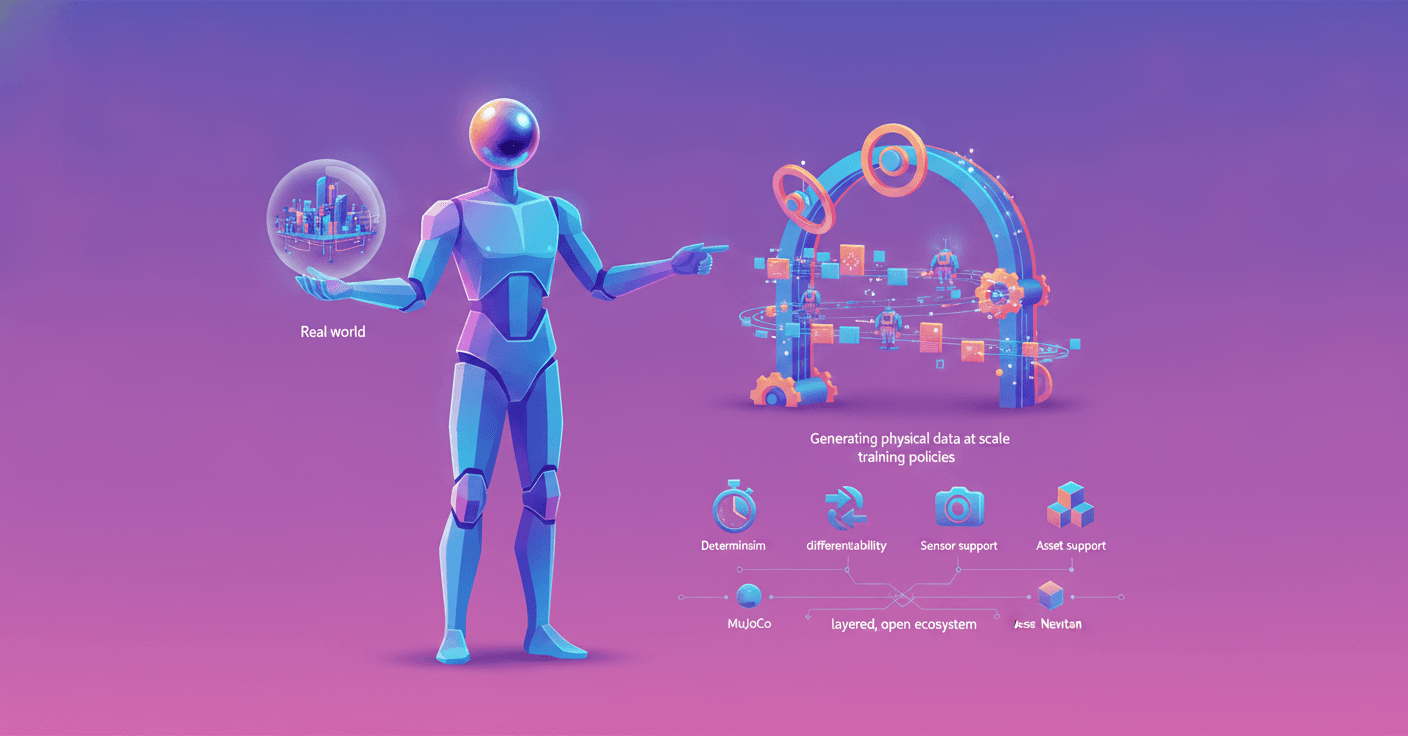
Simulation is no longer an accessory for debugging models: it’s the training ground where physical policies are born and the data that lets robots learn to interact with the world. In 2026 the simulation stack fragments and recombines, and that changes how you design, train, and deploy Physical AI systems.
Why simulation is central today
The number one problem in Physical AI is data availability. Language and vision models feed on the internet, but a robot needs to experience physical consequences: what happens when a glass slips, when a cable bends, or when a gripper grabs at the wrong angle?
Collecting that in the real world is slow, expensive, and sometimes dangerous. Simulation offers a bridge: you teleoperate virtual robots, generate synthetic sensors, and with GPU parallelism turn hours of trial into terabytes of experience at a fraction of the cost.
Today teams use simulation for much more than watching animations: they generate datasets for perception, train policies with reinforcement learning, collect demonstrations, augment real data, benchmark models, and test rare or adversarial scenarios.
Simulation stopped being an engineering hobby and became research and product infrastructure.
The three-computer paradigm: how the workloads are organized
Think of three roles that rarely mix:
- Training computer: large GPU clusters that process data and train foundational models.
- Simulation computer: workstations or clusters with GPU-accelerated physics and RTX rendering that generate experiences, sensors, and scenes.
- On-robot computer: an edge device, like a Jetson AGX Thor, that runs the policy in production.
Each has different requirements for latency, throughput, and precision. For example, at-scale RL needs massive throughput in simulation; real-time control on the robot requires latency and determinism.
Which simulation engine to choose? Practical questions
Before deciding, answer these questions:
- Do you need to generate synthetic data at large scale?
- Will you use batched reinforcement learning?
- What sensors do you require: cameras, lidar, radar, depth?
- What asset formats will you ingest: CAD, URDF, MJCF, USD?
- Do you need photoreal fidelity or do you prioritize throughput?
These answers guide the technical choice: there’s no single engine for everything.
Technical landscape of relevant engines
MuJoCo
MuJoCo is the reference for articulated dynamics and contacts. It was built for accuracy, determinism, and model-based optimization. Ideal when physical correctness and contact modeling matter more than photoreal rendering.
MuJoCo Warp (MJWarp)
MuJoCo Warp brings the MuJoCo style to the GPU with NVIDIA Warp. Its advantage is batched simulation: simulating thousands of worlds in parallel to train reinforcement learning policies at scale. It’s designed for throughput rather than single-step latency.
Isaac Sim and Isaac Lab
Isaac Sim builds on Omniverse and OpenUSD, combining PhysX for physics and RTX for rendering. It supports rich sensors and photoreal data pipelines, and accepts assets from CAD to real-world reconstructions.
Isaac Lab is an agent-ready framework for training and evaluation at scale. Version 3.0 separates backend and API, letting you choose between PhysX with RTX or lightweight engines for headless high-throughput. That makes it easier to move from a visual prototype to massive RL.
Newton and the solver ecosystem
Newton is an open, GPU-accelerated, differentiable physics engine managed from the Linux Foundation. It integrates varied solvers:
- MuJoCo-style and Featherstone solvers: generalized coordinates for rigid-body joints.
- XPBD, Kamino solvers: maximal-coordinate formulations useful for deformables and dense contacts.
- SolverVBD and ImplicitMPM: for particles, cloth, and continuous materials.
The idea is there isn’t a single numerical method for everything; you choose the solver depending on joints, deformables, differentiation needs, or contact complexity.
Other engines
PyBullet is still useful for quick CPU prototyping. Drake is the choice when you need trajectory optimization with rigorous numerics. Each tool has its niche; none solves everything.
Technical trade-offs you should know
- Fidelity vs throughput: photorealism and rich sensors penalize throughput. For large-scale RL prioritize GPU-batched engines.
- Determinism: necessary for reproducibility and debugging control.
- Differentiability: important if you plan to do gradient-based learning through physics.
- Integration with pipelines: USD/URDF formats and asset support speed up the workflow.
Practical example: if you teleoperate 1,000 virtual robots to collect tactile and visual data, MuJoCo Warp or Newton with batched solvers will give you the throughput. If you need photoreal data to train an object detector with complex reflections, Isaac Sim with RTX will be the choice.
The near future: shared layers and open source
Instead of competing for a monolithic engine, the ecosystem organizes into layers: physics solvers, GPU backends, scene formats like OpenUSD, and training frameworks that interconnect.
The promising part is much of this is happening in the open. Projects with open governance and accessible with a consumer GPU are lowering the barrier to entry and speeding iteration. That means more replicable experiments and tools accessible to small teams.
Practical view for teams and founders
- Prototype in PyBullet or MuJoCo to validate ideas quickly.
- If you scale RL, consider MuJoCo Warp or Newton with batched GPU solvers.
- For photoreal data pipelines and sim-to-real with complex sensors, use Isaac Sim + Isaac Lab.
- Invest time in defining which sensors and formats you need: that avoids costly rework.
Not sure where to start? Try a small experiment: create a simple manipulation task in a headless environment, train a policy in batch, and evaluate transfer to a real robot. That quickly reveals bottlenecks in physics, sensors, and assets.
Simulation has become critical infrastructure. The question is no longer only which engine is fastest, but which pieces of the stack will become common layers that enable interoperability and scaling.
Follow the series to dive deeper into Warp and MuJoCo Warp, and to see an end-to-end GPU-trained example using the stack described in this article.
Original source
https://huggingface.co/blog/nvidia/state-of-simulation-for-physical-ai
Summary: Simulation moved from a debugging tool to a central layer for Physical AI: it enables generating physical data at scale, training policies, and testing hard scenarios. Choosing an engine depends on trade-offs between fidelity, throughput, determinism, and sensor support, with options like MuJoCo, MuJoCo Warp, Isaac Sim, Isaac Lab, and the Newton engine leading the open evolution.