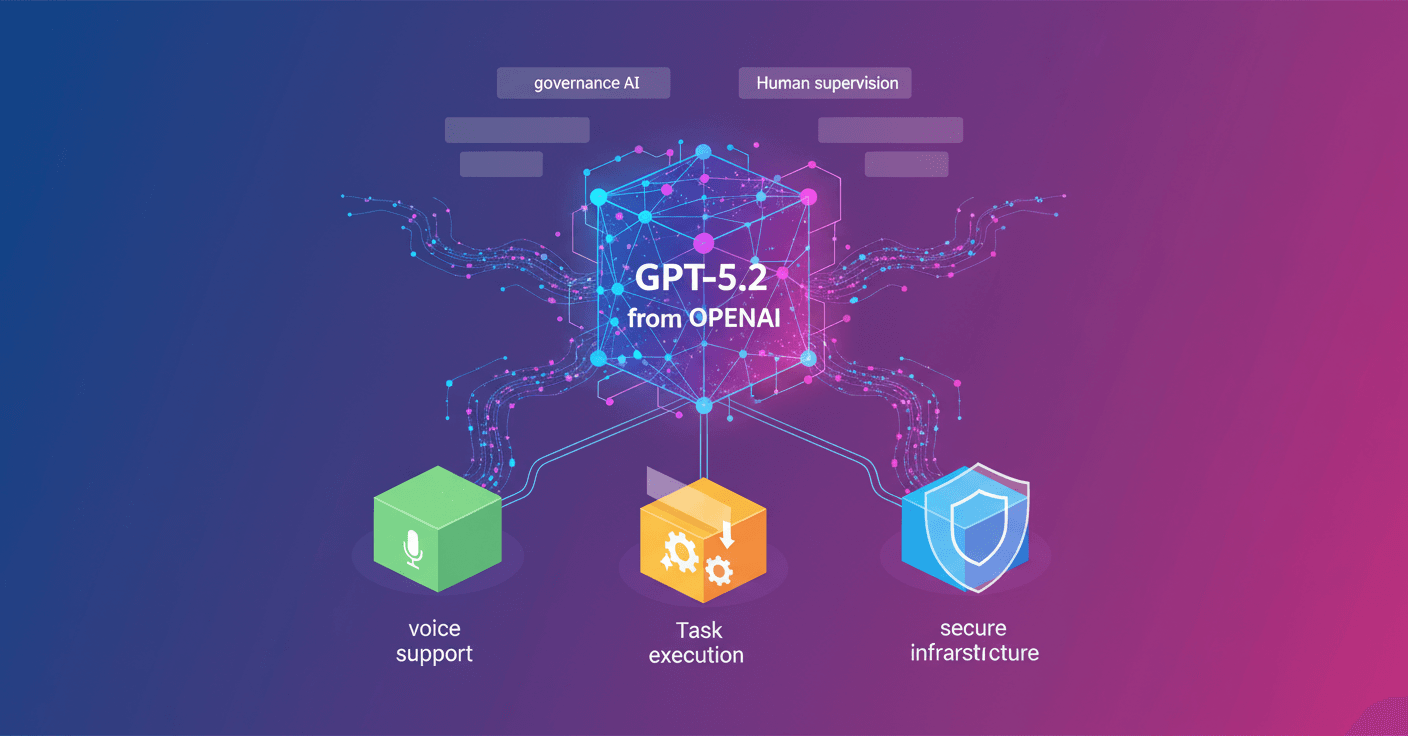
ServiceNow and OpenAI announce a partnership that embeds frontier models like GPT-5.2 directly into enterprise workflows. What changes for you and your company? AI no longer just answers questions: it can decide, act, and move work through real processes while respecting permissions and governance.
The essentials
- Multi-year agreement that expands ServiceNow customers' access to OpenAI models.
- OpenAI will be a preferred AI capability for companies running more than 80 billion workflows a year on ServiceNow.
- Support for speech-to-speech and native voice technology, opening the door to more natural interactions.
What it brings to daily operations
In complex environments where systems and teams are scattered, ServiceNow already acts like a control tower for workflows. With GPT-5.2 integrated, that evolves into practical automation you can rely on.
- Actionable answers based on real company data: employees ask in natural language and get not just an answer, but a possible action.
- Summarization and content generation for incidents, cases, or knowledge articles: less manual writing, more resolution.
- Tools for developers and admins that turn intent into workflows and automations faster.
- Smart search that finds the right information when you need it.
Concrete example: you type "I need to see my benefits" or "this customer issue must be escalated." With GPT-5.2 integrated, the system does more than reply: it checks permissions, prepares the request, sends it through the approval flow, and updates the status until completion. For the user it feels like talking to a very efficient colleague.
Voice, multimodality and reach
The integration includes support for speech-to-speech and native voice, which opens scenarios where interactions are voice-based or combine text and visuals. Imagine a field technician dictating a report and watching the AI create the ticket, assign resources, and suggest resolution steps.
ServiceNow also highlights that this is aimed at large enterprises: banks, retail, and tech firms that already handle billions of interactions and need scale, security, and governance.
Security, governance and control
A key point: this isn't AI in a sandbox, it's AI that acts within the customer's secure infrastructure. That means:
- Data access subject to company permissions and policies.
- Ability to audit actions and keep records of automated decisions.
- Integration with existing IT and compliance controls.
Does this mean everything will be perfect from day one? No. Companies will need to design clear policies, review outputs, and keep human oversight on critical processes.
Risks and practical recommendations
- Verify priority use cases: start with high-impact, low-risk workflows.
- Keep humans in the loop for critical approvals and output reviews.
- Monitor metrics: accuracy, resolution times, escalation rates, and user satisfaction.
- Define access controls and data retention from the start.
Why it matters now
Because the news isn't just that ServiceNow is using advanced models: it's that the reasoning power of models like GPT-5.2 is being combined with enterprise process orchestration. That speeds the move from isolated experiments to deployments that deliver measurable results.
Are you in IT, operations, finance, or HR? This can change how routine tasks run and how processes are designed. But change also needs strategy: pilots, governance, and clear metrics.
Original source
https://openai.com/index/servicenow-powers-actionable-enterprise-ai-with-openai