Safetensors was born at Hugging Face to solve a concrete problem: how to share model weights without the risk of running arbitrary code. Instead of relying on formats based on pickle, which could hide malicious code, a simple and safe alternative was designed that today dominates model distribution in the open community.
What is safetensors and why it matters
The format is intentionally simple: a JSON header (with a 100MB limit) that describes the tensor metadata, followed by the raw tensor data. This gives you several key practical advantages:
- Zero-copy loading: tensors can be mapped directly from disk without copying unnecessary data into memory. Think of
mmapapplied to model weights. - Lazy loading: you can read individual weights without deserializing an entire checkpoint, useful for transfer learning or selective loading in clusters.
- Security: by not executing code during deserialization, the main attack vector present in
pickleis removed.
These features explain why safetensors became the default format on the Hugging Face Hub and in many other projects: it’s fast, safe, and simple.
The move to the PyTorch Foundation: what changes
The essential bit: safetensors now has a neutral home under the PyTorch Foundation, part of the Linux Foundation. What does that mean in practice?
- Neutral governance: the brand, the repository and the governance are now in a vendor-neutral structure, not controlled by a single company.
- Principal maintainers: Luc and Daniel, the key maintainers from Hugging Face, remain on the Technical Steering Committee and will keep leading the day-to-day work.
- Contributor transparency: the path to become a maintainer is documented in
GOVERNANCE.mdandMAINTAINERS.md.
For most users nothing changes: the format and the APIs stay the same, and models already stored in safetensors will continue to work without changes.
Technical roadmap and priorities
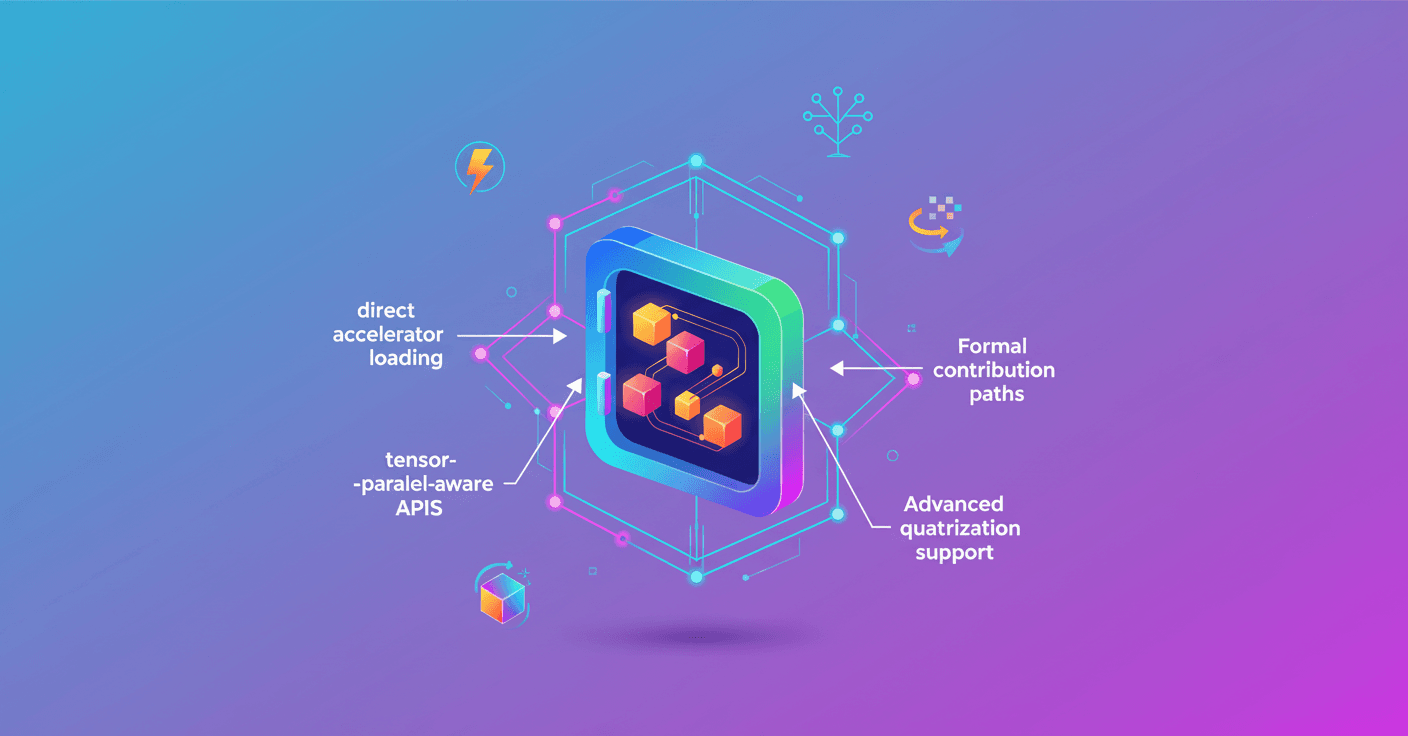
Being part of the PyTorch Foundation opens direct collaboration with projects facing the same challenges. Among the announced technical goals are:
- Device-aware load and save: letting tensors be loaded straight into
CUDA,ROCmand other accelerators without unnecessary CPU stages. - APIs-first for Tensor Parallel and Pipeline Parallel: so each rank or stage loads only the weights it needs, reducing I/O and memory.
- Formal support for new quantization options:
FP8, block-quantized formats likeGPTQandAWQ, and sub-byte integer types. - Evaluate integration as a serialization system for
torchmodels in the PyTorch core.
These are the kinds of problems where community collaboration speeds up robust solutions that work across frameworks and hardware.
And if you want to contribute or integrate safetensors?
If you’re a developer, researcher, or organization that depends on safetensors, you now have clear routes to participate:
- Report bugs or open discussions in the repository.
- Propose API improvements or new technical features.
- Join governance by following
GOVERNANCE.md.
Useful links to get started:
- GitHub: https://github.com/huggingface/safetensors
- Documentation: https://huggingface.co/docs/safetensors
- PyTorch Foundation: https://pytorch.org/foundation
Final reflection
Moving safetensors to the PyTorch Foundation isn’t just an administrative change: it’s a bet on sustainability, neutrality, and open collaboration. Why does this matter? Because when a critical model format is managed by the community, technical decisions tend to prioritize interoperability, security, and long-term support on diverse hardware.
If you work with models at scale, this can mean less friction and more options when deploying and optimizing weights.
Original source
https://huggingface.co/blog/safetensors-joins-pytorch-foundation