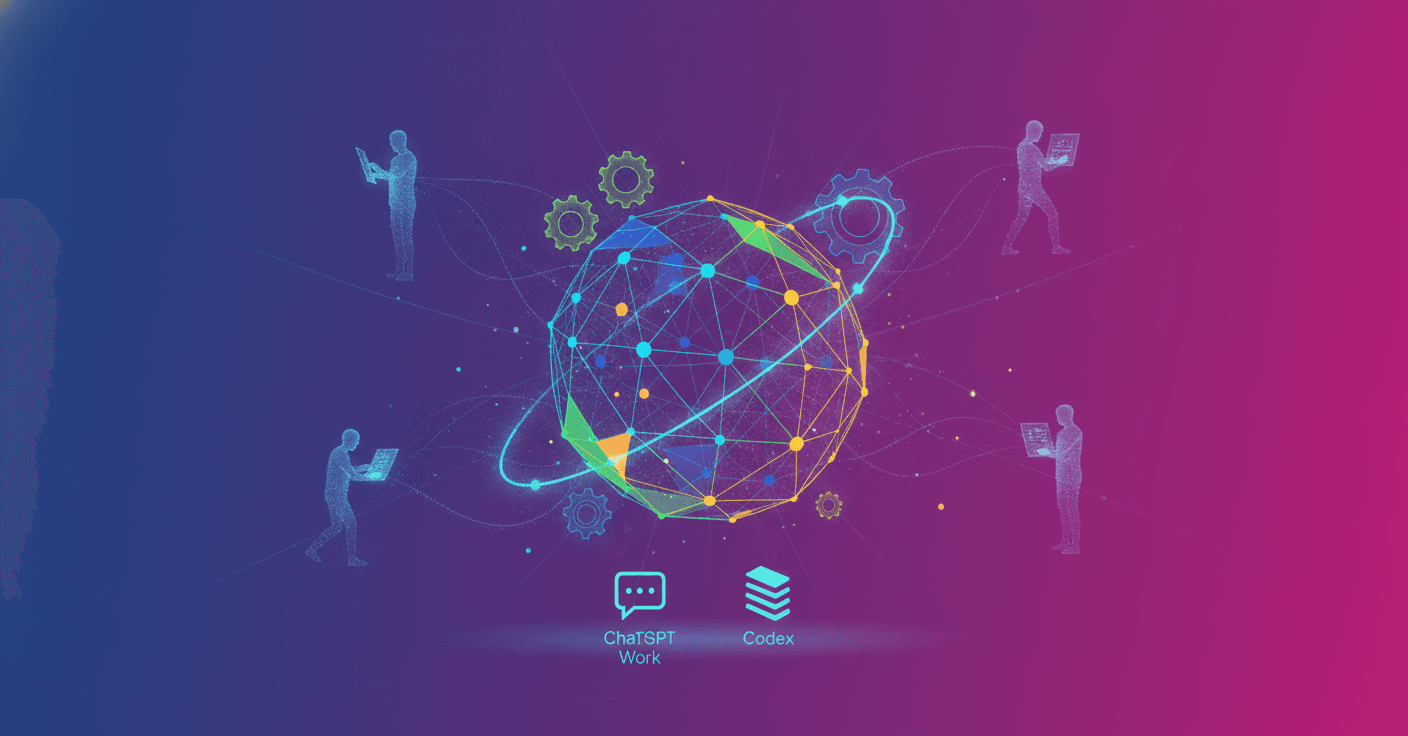
RingCentral is taking artificial intelligence beyond engineering teams. The company, with nearly three decades of experience in business communications and more than $2.6 billion in annual revenue, is giving its employees access to ChatGPT Work and Codex to transform how it creates products and operates internally.
The idea is simple but powerful: if anyone can turn an idea into a working project, the distance between imagining a solution and putting it into action shrinks dramatically. What happens when that possibility reaches thousands of employees, including people without technical experience and executives?
A challenge built around learning by doing
RingCentral’s CEO Office organized the AI-Native Challenge, an initiative in which every participant received access to ChatGPT Work and Codex. There was no mandatory workflow or recipe to follow. The challenge was to build a complete project from start to finish.
Participants had to go through every usual stage of a project: planning, implementation, testing, documentation, continuous integration, and improvement. The result was significant: nearly everyone created a functional repository, and thousands of employees delivered projects that could actually be used.
More than a programming contest, the initiative aimed to show that AI-supported development does not belong exclusively to engineers. Someone in operations, project management, or customer service can also build useful tools if they understand the problem and have the right tools.
AI does not eliminate the need for human judgment. It accelerates the work while people continue to define the goals, context, and important decisions.
From an idea to a customer-facing feature
RingCentral is applying this approach within its own portfolio of artificial intelligence products. These include RingCentral AI Receptionist, known as AIR, AI Virtual Assistant, or AVA, and AI Conversation Expert, or ACE.
The goal is to shorten the path between identifying a need and making a feature available to customers. Codex can help prepare code, organize tasks, and speed up iterations, but human teams continue to validate the results, review the architecture, and verify that the product works as expected.
This distinction matters. Calling a company “AI-native” does not mean employees stop participating in development. It means AI is integrated from the beginning into how a solution is researched, planned, built, tested, and improved.
AI also reorganizes operations
The experiment did not stop with engineering. The program management office, known as the PMO, is using ChatGPT Work to create workflows that bring together scattered information from Jira, Google Sheets, CRM systems, and other tools.
In the past, preparing a report could involve reviewing notes, conversations, and multiple dashboards. Now, these workflows can generate notifications and reports with relevant changes, blockers, responsible people, and pending actions.
The difference is especially noticeable in meetings. Instead of arriving and asking what has changed since the last update, teams can begin with a clearer view of the problems and decisions that need attention.
According to RingCentral, this system works like a kind of operating system for program management. By reducing manual coordination, the PMO can manage more projects with greater consistency and accuracy.
What other companies can learn
RingCentral’s experience offers several practical lessons for organizations that are still exploring AI:
- Experimentation needs room to grow. An open-ended challenge can reveal uses that do not appear in traditional digital transformation plans.
- Training works better with real projects. People learn more when they have to solve a concrete problem and deliver a result.
- AI is not only for programming. It can also help with reporting, tracking, documentation, coordination, and knowledge transfer.
- Human oversight remains essential. AI can speed up a task, but it does not replace business context or responsibility for the outcome.
- Benefits grow when teams are connected. What engineering learns can improve operations, and operational problems can inspire new products.
RingCentral’s story shows that adopting AI is not simply about buying a tool or creating an internal chatbot. The deeper change appears when a company allows its employees to experiment, turn ideas into solutions, and share what they learn.
In this case, artificial intelligence is not presented as a futuristic promise. It is already working as a layer that connects development, management, and operations. The question for other organizations is not whether their employees will use AI, but how they will create the conditions for that use to generate real, verifiable value.