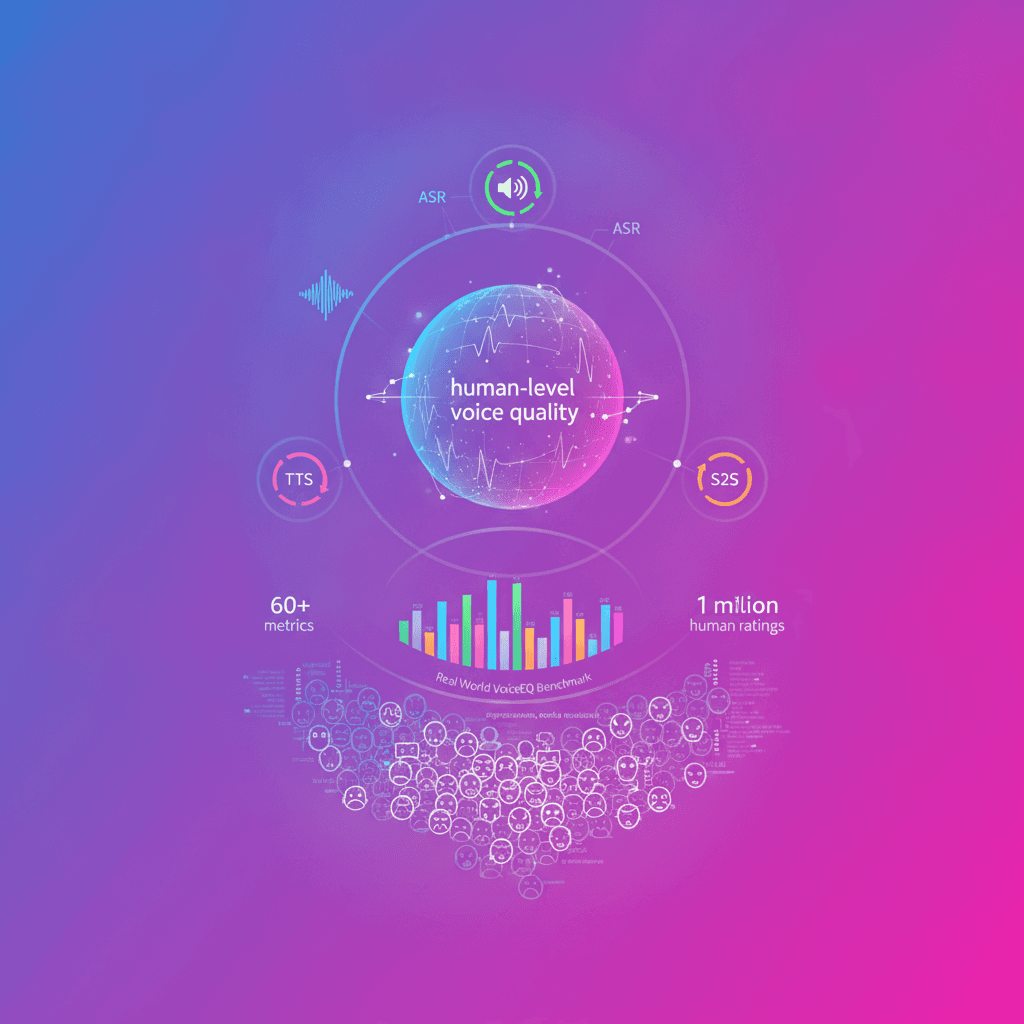
Voice has stopped being an experiment and has become the main interface of AI. But how do you know if a voice model sounds truly human and stays consistent in a real conversation? Hume answers with Real World VoiceEQ, a benchmark designed to measure exactly that: the human quality of voice interactions.
Qué es Real World VoiceEQ
Real World VoiceEQ is a benchmark designed to evaluate what traditional numbers don’t capture: tone, emotion, speaker identity, background context and conversational coherence. It doesn’t just aim for WER or latency; it wants to measure whether a system can recognize, produce and respond to the acoustic information that gets lost in transcripts.
The benchmark covers more than 40 models, both proprietary and open source, and over 60 metrics distributed across categories like ASR, TTS, S2S and Speech Understanding. It also includes more than 15 key evaluation dimensions to break down specific capabilities instead of collapsing them into a single score.
Cómo se construyó y evaluó
- More than 1 million human ratings collected across varied demographics, speaking styles and acoustic environments.
- 785,000 ratings for
TTSand 48,000 forSTS, making this one of the largest human-listening evaluations to date. - The entire evaluation was run using Kairos, a voice-native evaluation platform: it lets you run tests in production, collect human preferences and feed continuous improvement cycles via
RLHFor human feedback.
Important: human raters remain the reference for judgments that depend on acoustic perception and social context. Automated evaluators do well on verifiable tasks, but they fail on subjectivities like expressiveness or identity consistency.
Hallazgos técnicos clave
-
There is no model that dominates all capabilities. In
TTS, no configuration appeared among the top 5 across the eight families of measured capabilities. The race is no longer for an "absolute best" but for specializations. -
Large variation in
S2S. Some systems recognize emotion accurately but don’t respond naturally; others ignore paralinguistic cues and act basically on the transcription. -
Real robustness vs public benchmarks. Models that score well on standardized benchmarks show failures when there is accent, speaker overlap, background noise or long conversations. For example, transcription error rates (
WER) in speech with noise were roughly four times higher than in speech with background music. -
Signals of over-optimization. Some models replicated known errors from reference transcriptions or reconstructed words that were not in the audio, suggesting adaptation to public benchmarks rather than real improvement on acoustic data.
-
Automatic evaluators based on SLMs showed high agreement with humans on objective tasks like pronunciation, but lower agreement on open judgments, such as whether a voice fits a performance role or maintains a consistent identity.
¿Qué significa esto para equipos de producto y ML?
Do you want your voice assistant not only to transcribe well but also to be reliable and human in practice? Here are concrete steps:
- Evaluate by dimension: measure technical accuracy, expressiveness, emotional understanding, identity coherence and acoustic robustness separately.
- Include large-scale human evaluations for subjective tasks; use SLMs only for verifiable metrics and as a preliminary filter.
- Test in real conditions: accents, noise, various dialogue lengths and speaker overlap.
- Use voice-native evaluation platforms like Kairos to generate human preference data that feed
RLHFand improvement cycles. - Avoid optimizing exclusively for public benchmarks; monitor recurring errors and check if the model is learning shortcuts from reference data.
Recomendaciones técnicas rápidas
- Report disaggregated metrics: a single global score hides failures by use case.
- Add paralinguistic tests: measure detection of emotion, pauses, emphasis and loudness.
- Integrate continuous evaluations in production to detect performance degradation from changes in the acoustic environment.
- Consider hybrid pipelines: models optimized for accuracy can be complemented with modules specialized in expressiveness or emotion detection.
Implicaciones para la industria
Voice will be one of the defining interfaces of the next decade. Speed and WER are not enough: end-user preference will be more tied to whether the agent sounds coherent, empathetic and trustworthy in real situations. Real World VoiceEQ pushes that conversation toward human-centered, specific metrics that help identify real strengths and failures.
If you work on voice, this changes how you select models, design tests and prioritize improvements. Interested in an agent that sounds warm and empathetic for mental health? Then seek evaluations focused on emotion and identity consistency. Need maximum accuracy for financial data? Prioritize measures of accuracy under noise and human verification in critical cases.
Reflexión final
Classical benchmarks served their time: they gave us solid foundations, but now we need metrics that reflect real conversations. Real World VoiceEQ is not the only solution, but it marks an important step toward human-centered evaluations. The voice that will win users will combine technical accuracy with the ability to interpret and express human nuances.