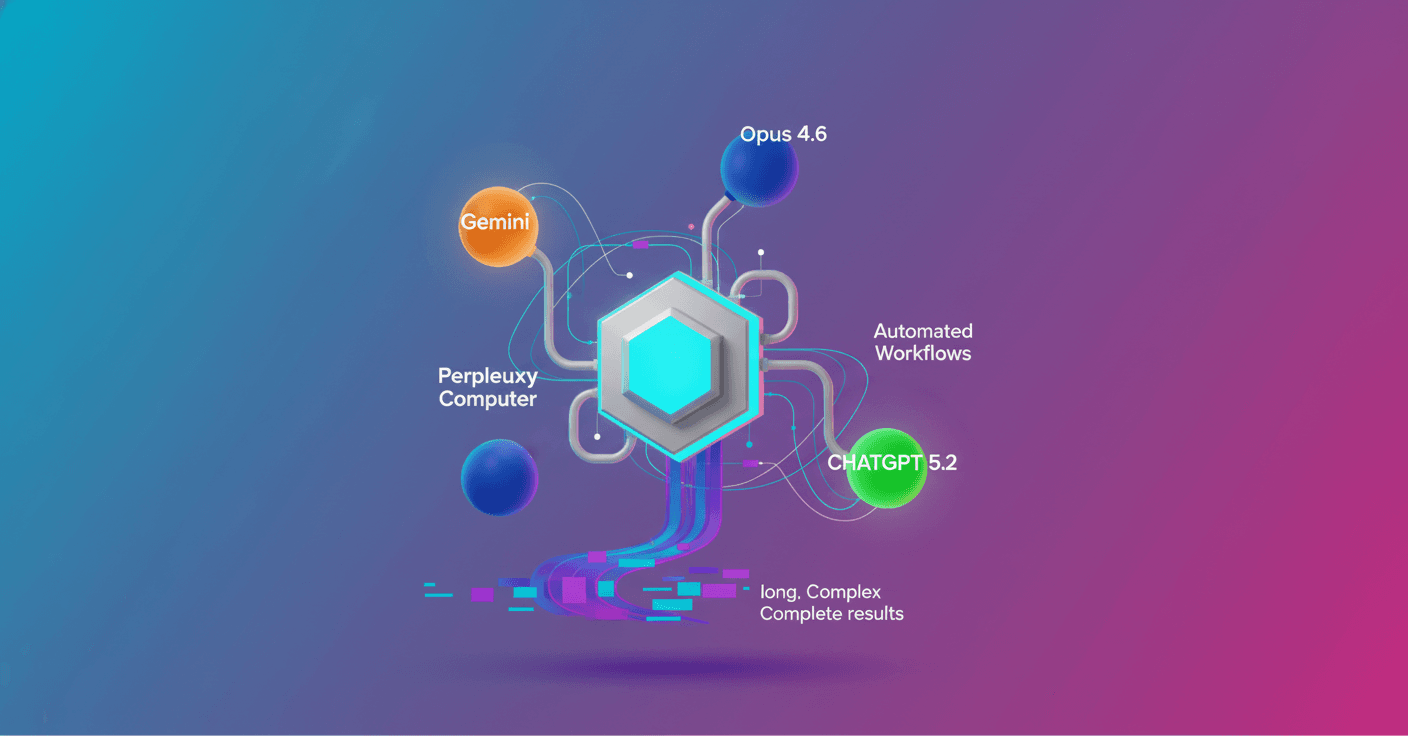
Perplexity introduces a new way to use AI: it doesn't just answer questions, it builds and executes full workflows that can run for hours or months. Sounds like a digital colleague who takes tasks, breaks them down, delegates them and hands you the results? That's exactly what Perplexity Computer aims to be.
What is Perplexity Computer
Perplexity Computer is a system that brings different AI capabilities together into a single generalist digital worker. Unlike a chat that gives you answers or an agent that performs one-off tasks, Computer constructs, coordinates and executes workflows made of sub-agents.
You start by describing a desired outcome. Computer breaks it into tasks and subtasks, spins up sub-agents and assigns them concrete jobs: web research, document generation, data processing or calls to connected APIs. All of this runs in isolated compute environments with access to a real filesystem, a real browser and the tool integrations you need.
How it works in practice
Imagine you need a market report. One sub-agent collects sources and data, another drafts the copy, another creates charts and another checks citations. Coordination is automatic and asynchronous; you can work on something else or run several instances in parallel.
When it hits a roadblock, Computer spawns sub-agents to resolve it: find API keys, research extra info or even program a small app. It will only ask for your intervention when it truly needs it.
Practical result: a flow that used to require meetings and human coordination can run in the background and deliver a ready-made deliverable.
Models and smart orchestration
Perplexity makes it clear it doesn't bet on a single model. Its approach is model-agnostic: it orchestrates the best model for each sub-task. At launch, Computer uses Opus 4.6 as the main reasoning engine and distributes tasks to specialized models: Gemini for deep research, Nano Banana for images, Veo 3.1 for video, Grok for light and fast tasks and ChatGPT 5.2 for long-context memory and broad searches.
What does this mean for you? Flexibility: you can let the system pick the best mix or choose specific models based on token budget, speed or accuracy.
Who it's for and what changes in daily work
- Professionals and teams: it automates long flows — for example, proposal preparation, content audits or data analysis — freeing human time for strategic work.
- Entrepreneurs and startups: it reduces the need to build costly internal integrations; the system already provides a browser, filesystem and connectors.
- Developers: it offers an environment that can run code, call APIs and orchestrate services without you having to set up the whole infrastructure from scratch.
The promise is ambitious: specialized models don’t clash with each other, they complement one another to deliver more complex and robust work.
Control, security and limits
Perplexity emphasizes that each task runs in isolated environments. That helps contain risks, but it doesn't remove the need for good practices: review critical results, audit access to API keys and define governance policies for flows that touch sensitive data.
There's also a practical consideration: running long, multi-model workflows has costs and token budgets. The platform lets you pick models per subtask to optimize cost versus quality.
Availability and business model
Perplexity Computer is available to Perplexity Max subscribers and will arrive soon for Enterprise Max users. It's a feature integrated into Perplexity's ecosystem, which includes Comet, the AI-native browser, and Comet Assistant.
Final thought
This isn't just a smarter chat. It's a bet on changing how we delegate complex work to machines: instead of asking for single answers, we ask them to design, coordinate and deliver complete results. Ready to think of AI as a colleague that can keep a project running for weeks? That's the core idea behind Perplexity Computer.
Original source
https://www.perplexity.ai/hub/blog/introducing-perplexity-computer