We're excited: OpenScholar, the open system for synthesizing scientific literature with verifiable citations, was accepted in Nature. Why does this matter? Because research moves fast and general AIs still trip on the basics: providing reliable evidence when you ask for it.
What is OpenScholar
OpenScholar is an open source model built specifically for scientific synthesis with verifiable citations. It was developed by researchers at Ai2 and the University of Washington with a clear focus on transparency and reproducibility.
This isn't just a text generator that sounds plausible. OpenScholar pairs a model trained for scientific synthesis with retrieval-augmented generation (RAG), which lets it search a huge corpus, bring in relevant works (including the most recent), and cite sources behind each claim.
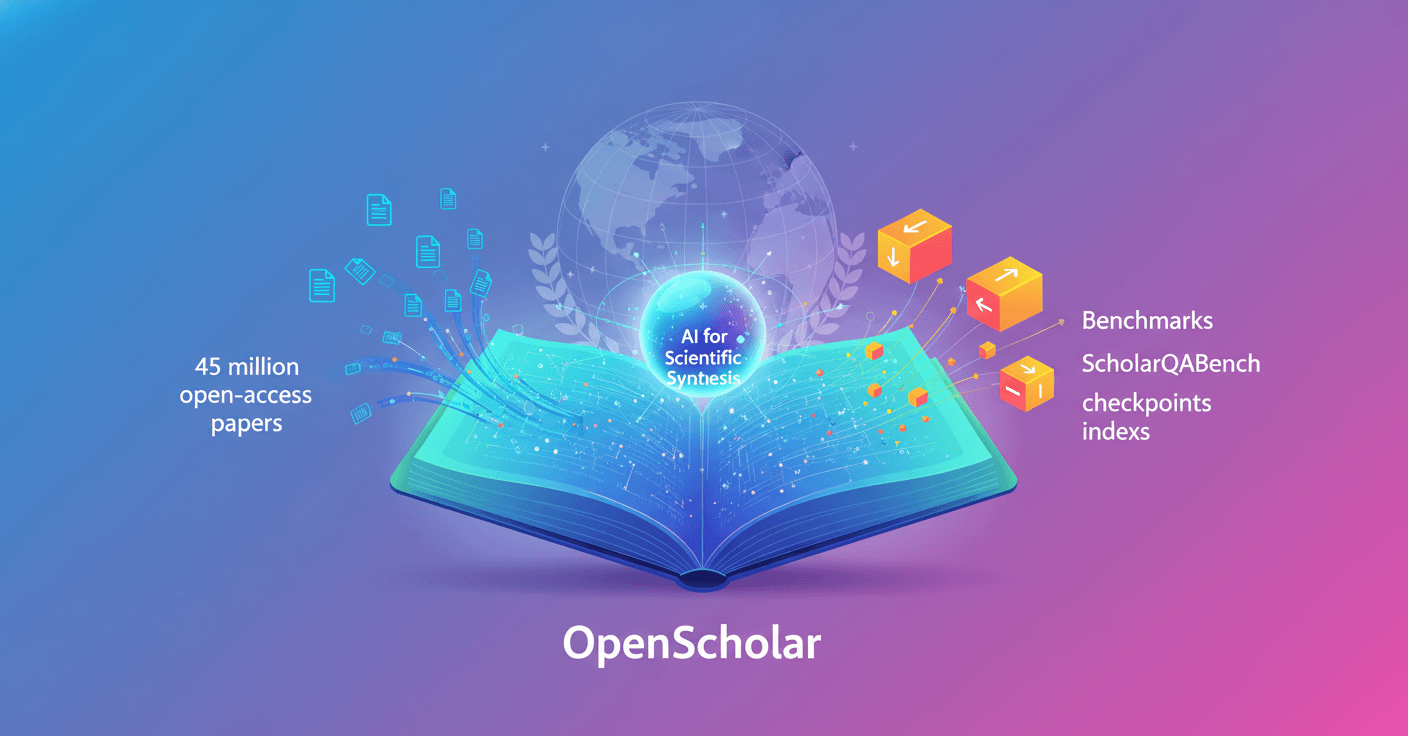
They built a corpus of 45 million open-access papers and an index of full-text snippets to retrieve evidence. That index is available through the Semantic Scholar API and the checkpoints, indexes, and data were published so anyone can inspect and extend them.
Architecture and key technical elements
The backbone is a RAG pipeline: first relevant documents or snippets are retrieved, then a model synthesizes the information conditioned on that evidence, and finally citation generation is handled. The crucial part isn't just retrieving, but ranking and presenting citations in a verifiable way.
To evaluate quality they did something important: they created ScholarQABench, the first large, multi-domain benchmark to assess scientific synthesis and citation quality. The computer science portion, ScholarQA-CS, evolved into ScholarQA-CS2 and is now part of AstaBench. Those evaluations measure not only whether the answer is correct, but whether the citations actually support what's claimed.
OpenScholar shows that a careful architecture for retrieval, ranking, and citation handling can materially improve the usefulness and trustworthiness of responses in scientific contexts. And by publishing checkpoints and the index, they make reproducibility and peer audit easier.
Practical impact for researchers and developers
What does this mean for you as a researcher or developer? First, less time wasted chasing invented references: answers come tied to retrievable snippets. Second, you can reproduce results because the model, the data, and the index are public.
For teams building research assistants, OpenScholar marks a path: it's not enough to generate convincing text—you need to show your work. On that foundation they built ScholarQA and later the reporting capabilities that now exist in Asta. They're continuing with Deep Research Tulu (DR Tulu), which adds multi-step search and information gathering for longer, more comprehensive reports.
What to watch closely
If you work on literature review tools, systematic review production, or research assistants, it's worth trying the checkpoints and the public index. Likewise, the ScholarQABench and AstaBench benchmarks are useful resources to measure hallucination risk and citation quality in your own systems.
The practical lesson: a useful scientific AI isn't the one that sounds most convincing, but the one that can point to and justify its claims with recoverable evidence.
OpenScholar doesn't solve everything, but it's a concrete step toward research assistants that show the chain of evidence and enable human validation. That changes how we can integrate AI into scientific workflows without sacrificing trust.