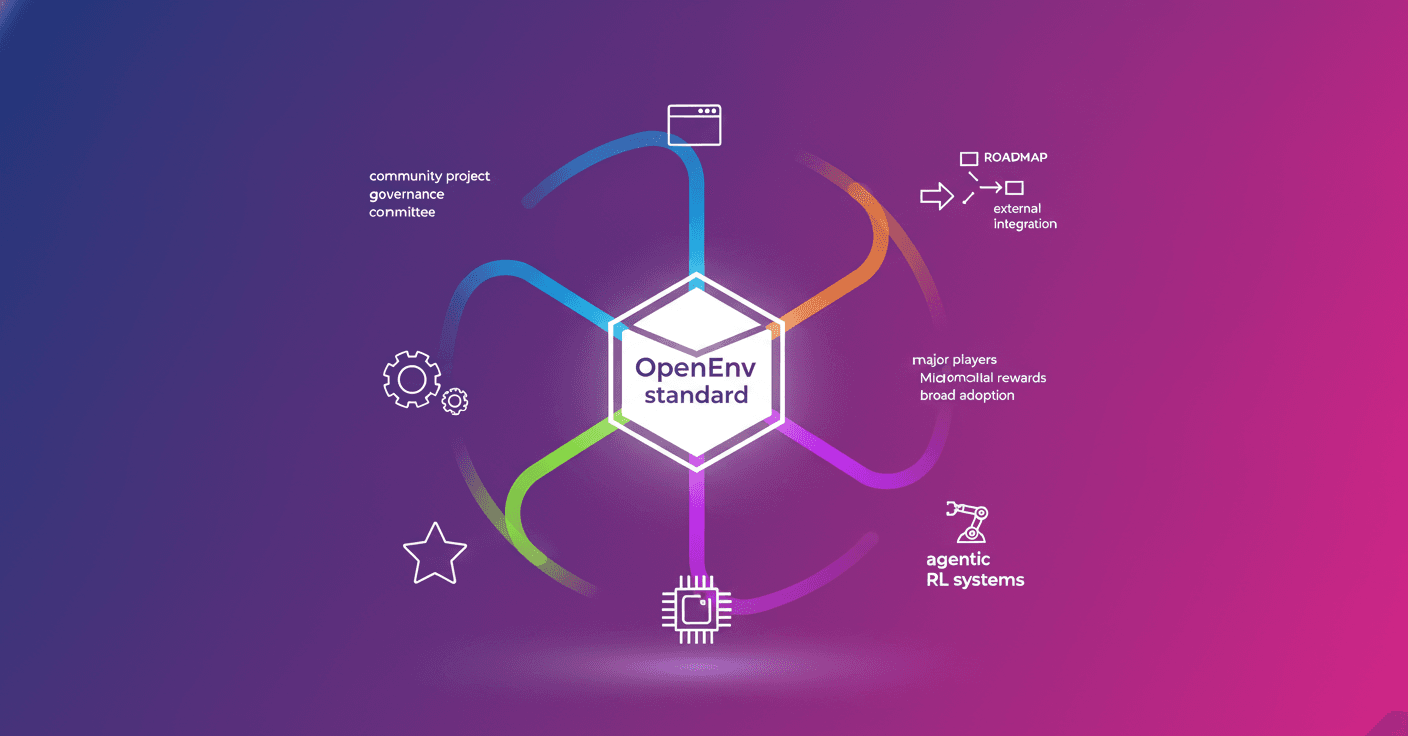
OpenEnv becomes a community project that aims to standardize how agents interact with executable environments: terminals, browsers and anything an agent can talk to or act on. If you train models that control agents, this matters to you: governance is opening up and the infrastructure becomes interoperable.
What is OpenEnv and why it matters
OpenEnv is an interoperability layer that connects three key pieces: the harness of the agent (the execution interface), the environment (what the agent perceives and can act on) and the trainer (the learning process). Think of OpenEnv as the common socket where models, environments and training tools can plug in.
Why is this relevant? In frontier labs, models are trained and optimized together with a specific harness, and that brings big efficiency gains. In the wild, every developer mixes and matches models, harnesses and inference engines. OpenEnv wants to reduce that friction so open models can enjoy the same efficiencies.
OpenEnv does not define how rewards are designed or how training logic is written. Its job is that everyone speaks the same protocol.
How it works technically
OpenEnv exposes environments with an API familiar to Gymnasium users: reset(), step(), state(). It works with a client/server architecture, so a trainer can control any compatible environment without writing custom glue code.
Key technical decisions:
- Standard protocols: HTTP and WebSocket for serving environments.
- Canonical packaging: environments distributed as Docker images for reproducibility.
- MCP compatibility: OpenEnv environments are first-class citizens for MCP servers, making it easier for the same environment to behave the same in simulation and production.
- Interoperability: you can define and consume environments from different ecosystems (verifiers, harbor, etc.) using OpenEnv as the deployment and interface layer.
In practice, a typical flow is: a repository of environments packaged in Docker is served over HTTP; the trainer connects via WebSocket; the model receives observations and returns actions. All of this without adapting the trainer to each new environment.
Practical example
Imagine you want to train a local model optimized for agent-assisted coding tasks. A possible pipeline would be:
- Define tasksets tied to a Hugging Face dataset (RFC 006).
- Package the coding environment as a Docker image and serve it with OpenEnv.
- Connect a trainer (for example TRL or Unsloth) that speaks OpenEnv.
- Use an agent harness (vLLM, Claude Code style) to execute actions and receive observations.
- Define external rewards managed by the library you prefer (RFC 007).
This lets you train models that learn to use the harness efficiently and reproducibly, without locking you into a single provider or stack.
Governance and adoption
Starting today OpenEnv will be coordinated by a committee that includes organizations like Meta-PyTorch, Reflection, Unsloth, Modal, Prime Intellect, Nvidia, Mercor, Fleet AI and Hugging Face.
The project already has support and adoption from many ecosystem players: PyTorch Foundation, vLLM, SkyRL (UCB), Lightning AI, Axolotl AI, Stanford Scaling Intelligence Lab, Mithril, OpenMined, Scaler AI Labs, Scale AI, Patronus AI, Surge AI, Halluminate, Turing, Scorecard and Snorkel AI.
Why does this matter? For OpenEnv to be a useful standard it needs to be guided and maintained by those building models, infrastructures and evaluation tools.
Technical roadmap and standards
The next months will focus on turning OpenEnv into a reliable standard. Key points are:
- Tasksets via datasets: connect environment tasks with Hugging Face datasets to compose environments and benchmarks (RFC 006).
- External rewards: allow rewards to be defined in the library you already use, with OpenEnv as the deployment layer (RFC 007).
- Continuous harness integration: first-class support for agentic harnesses.
- End-to-end examples: full training and evaluation guides using TRL, Unsloth and other tools.
- Self-validation: metrics to measure environment quality and its contribution to model learning, enabling scalable evaluations and community events (RFC 008).
Self-validation is especially interesting: imagine a system that tells you whether an environment actually helps your model improve before you pour large compute budgets into it.
What can you do now?
If you work with agents, open models or RL tools, there are clear ways to get involved: review and contribute to the RFCs, package environments with Docker, create tasksets tied to datasets, or integrate harnesses and trainers using the OpenEnv interface.
OpenEnv still has rough edges. That's normal and useful: it means the community can shape it. Want your environment to be compatible with multiple trainers and inference engines? Now is the time to contribute.