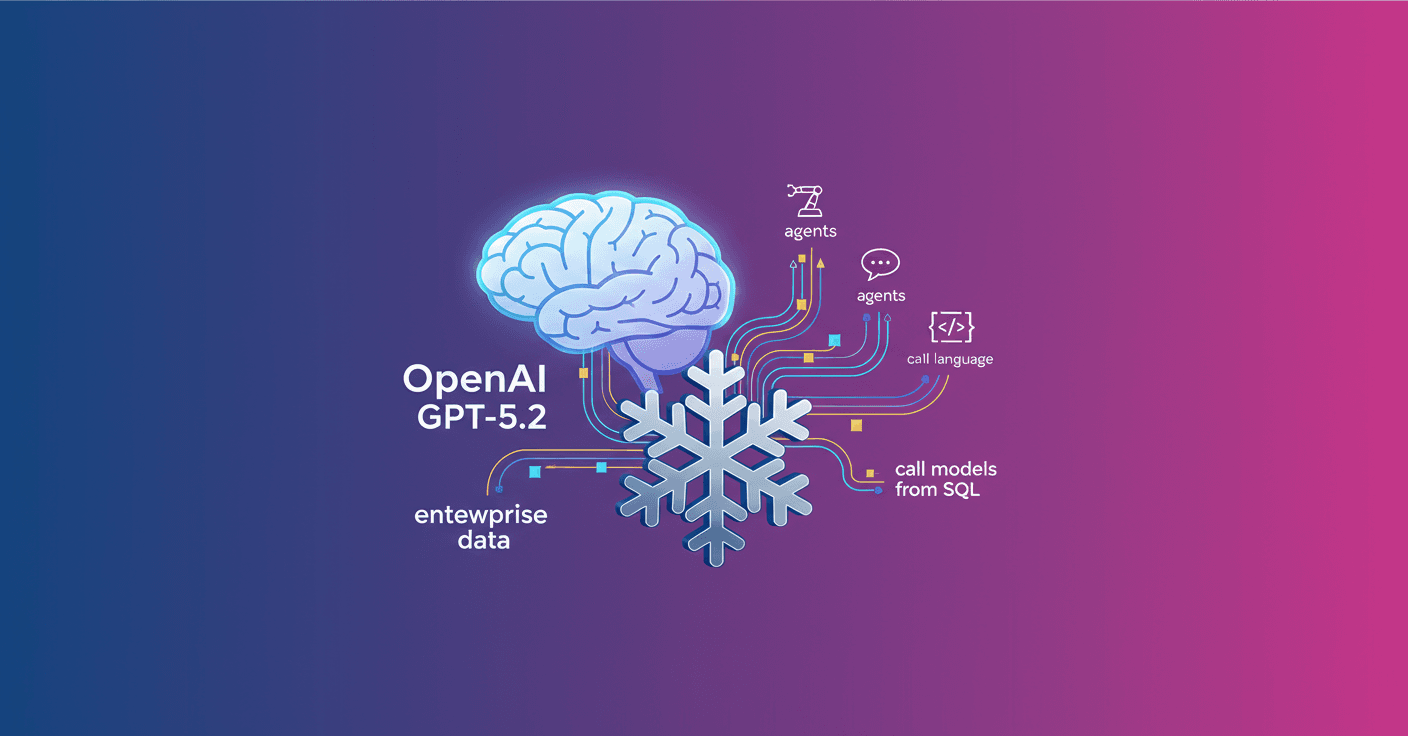
OpenAI and Snowflake announced a multiyear $200 million partnership that integrates OpenAI’s frontier intelligence directly into the Snowflake platform. What does this mean for companies? Basically, models like GPT-5.2 will be available to explore, analyze, and act on enterprise data without leaving the secure, governed environment many organizations already use.
What this deal means
The investment and integration aim to make OpenAI a core capability inside Snowflake, used across Snowflake Cortex AI and Snowflake Intelligence.
- Companies will be able to build AI agents and custom applications that operate on their own data stored in Snowflake.
- Business teams will be able to query data in natural language and get insights without writing code.
- With
Cortex AI Functions, you can invoke OpenAI models directly fromSQL, applying multimodal analysis to rows and columns, text, images, or audio.
In short: AI accessible from the data layer thousands of companies already use, with security and governance controls built in.
Sridhar Ramaswamy, CEO of Snowflake, emphasizes that the integration lets you deploy AI over the company’s most valuable asset using a secure, reliable platform.
Fidji Simo, from OpenAI, points out that bringing models to the enterprise data center reduces friction between capability and real value.
How it works in practice
Imagine you work in analytics and need a sales summary by product, plausible causes, and recommendations to optimize inventory. Now you can:
- Ask the question in natural language inside Snowflake Intelligence.
- Let an agent powered by
GPT-5.2retrieve, analyze, and combine data (even related images or audio) and deliver an actionable report. - Run additional automated steps based on those insights, without going back to developers.
The ability to call models from SQL is key: it turns a skill your team already masters into a gateway to advanced AI capabilities.
Use cases and testimonials
Some companies are already exploring the potential: Canva uses Snowflake and OpenAI to scale its visual AI offering; WHOOP improves internal decision-making with agents that analyze data at scale. These examples show two truths: the integration speeds up experiments and lets you keep security and performance.
Sectors that benefit include financial services, healthcare, retail, media, manufacturing, and the public sector. The promise is to apply advanced reasoning and multimodal capabilities directly on trusted data.
Risks and considerations
Not everything is magic. When evaluating this integration you should think about:
- Governance and privacy: How do you control which data reaches the model and how queries are logged?
- Accuracy and hallucinations: Even advanced models can be wrong. It’s crucial to validate outputs with metrics and human checks.
- Costs: Using frontier models at scale involves inference and storage costs; plan pilots and estimate ROI.
- Security and compliance: Verify contracts, encryption, and access policies to meet sector regulations.
What your company can do now
If you lead data or AI efforts, consider these practical steps:
- Identify a high-impact, low-risk case for a quick pilot.
- Coordinate data, security, and business teams to establish access rules and governance.
- Measure from the start: latency, cost per query, accuracy, and user adoption.
- Prepare templates and basic agents non-technical employees can use immediately.
Well-designed small pilots will tell you if the integration delivers real value before you scale.
In the end, the OpenAI–Snowflake alliance is designed to close the gap between what AI can do and what companies actually need: actionable insights, automated agents, and a safe path to deploy AI on trusted data. Ready to try it in your organization?