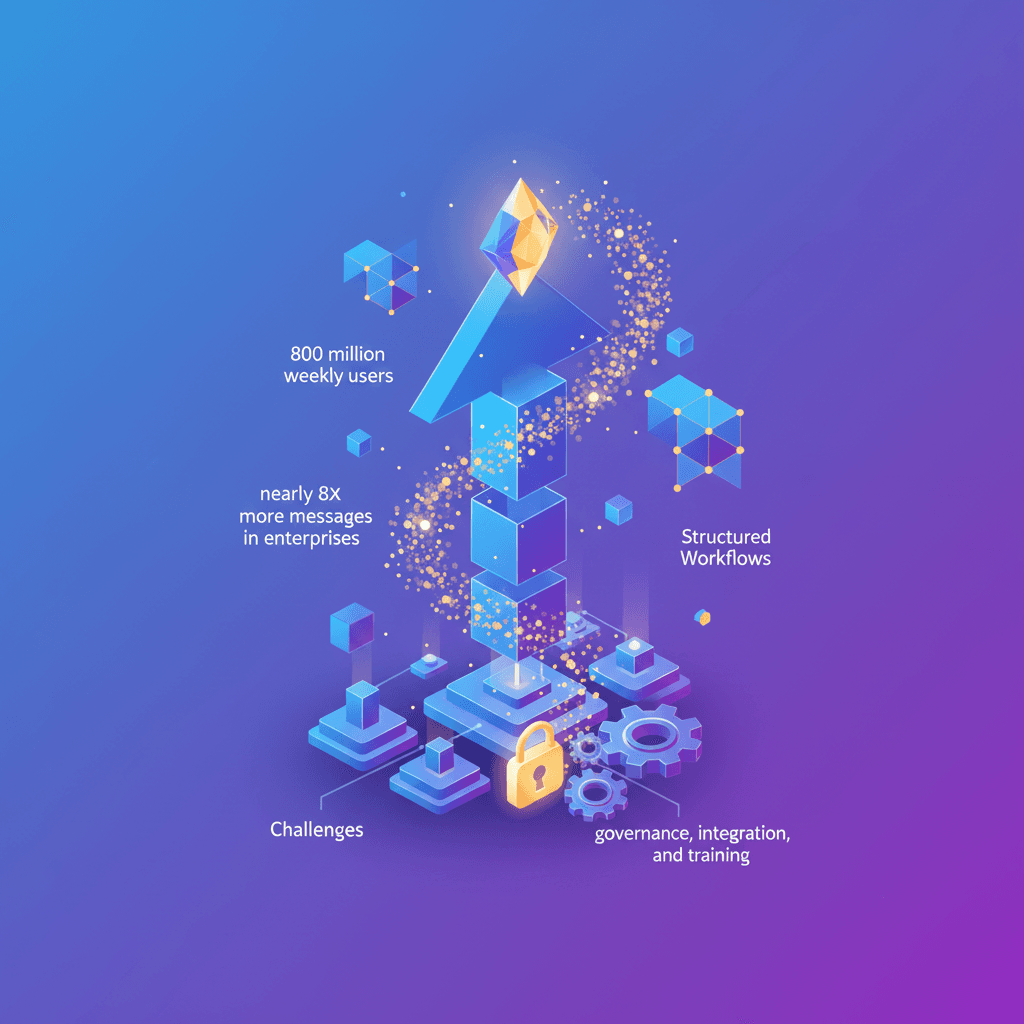
ChatGPT now serves more than 800 million users each week, and that massive adoption is pushing AI from personal life into professional life. What happens when what you use for quick queries becomes part of daily workflows in companies big and small?
What the report found
OpenAI publishes, for the first time, a broad analysis of how companies are adopting AI, based on two main sources: real usage data from enterprise customers and a survey of 9,000 workers across nearly 100 companies. All data were de-identified and aggregated to protect privacy.
The key points are clear: adoption is growing in both breadth and depth. It's not just that more people use AI, but that they use it for more complex and repeatable tasks.
ChatGPT Enterpriserecords 800 million users per week.- Weekly messages in enterprise accounts increased nearly 8x over the past year, and the average worker sends 30% more messages.
- Structured tools like
ProjectsandCustom GPTsrose 19x year-to-date, signaling a shift from occasional queries to integrated, repeatable flows. - Average consumption of reasoning tokens per organization grew roughly 320x in 12 months, suggesting systematic integration of smarter models into products and services.
The conclusion is clear: AI is no longer an isolated experiment. It's being integrated into real processes that generate value.
Impact on work and productivity
According to the survey, 75% of workers report that AI improves the speed or quality of their work. How much time does that save you day to day? On average, employees say they save between 40 and 60 minutes daily; heavy users report more than 10 hours a week.
Also, the improvement isn't limited to one area:
- 87% of IT workers report faster incident resolution.
- 85% in marketing and product see campaigns executed more quickly.
- 75% in human resources notice better employee engagement.
- 73% of engineers report faster delivery of code.
And it's not only doing the same things faster: AI lets you do new things. Messages related to code increased 36% among non-technical workers, and 75% of users say they can complete tasks they couldn't before.
Who's leading and where it's growing most
Growth is cross-industry, but with strong pushes in technology, healthcare, and manufacturing. At scale, professional services, finance, and tech appear as the sectors with the highest adoption.
Geographically, Australia, Brazil, the Netherlands, and France stand out with annual growth above 140% among enterprise customers. International API customer growth exceeded 70% in the last six months, and Japan is the country with the most corporate API customers outside the United States.
There's also a gap between pioneers and the median:
- Frontier workers (95th percentile) send 6x more messages than the average worker.
- Frontier companies send 2x more messages per seat and show much deeper integration.
In other words, intense adopters gain cumulative advantages: more consumption of intelligence -> more time savings -> more tasks covered.
Why the challenge is no longer the technology
OpenAI notes that the pace of innovation is enormous: a new feature or capability is released roughly every three days. With that cadence, the main limit for organizations stops being model performance and becomes the internal capacity to implement and scale: governance, processes, integration, and training.
If you expected the problem to be choosing the perfect model, here's good news: the technology is ahead. What you need now is to get organized to take advantage of it.
What your company can do right now
- Start by mapping concrete tasks that consume time and require creativity or analysis. Where are minutes being lost every day?
- Prioritize repeatable flows: if you can turn a query into a
Projector aCustom GPT, you gain consistency and scalability. - Measure what matters: times before and after, output quality, and team adoption. Real data lets you tell experiments that scale from those that don't.
- Train teams not with theory sessions, but with practical examples: a marketing analyst trying prompts on real campaigns learns faster.
- Define minimal governance: permissions, privacy, and human review in critical processes.
Small operational actions can make the difference between being a company that experiments with AI and one that uses it to transform its working model.
Final reflection
This report shows that enterprise AI is in a translation phase: from technical capabilities to scaled use cases that generate measurable value. The question isn't whether AI will affect work, but who organizes adoption well enough to turn early advantage into lasting impact. Is your team ready to take that step?
Original source
https://openai.com/index/the-state-of-enterprise-ai-2025-report