Artificial intelligence is not only changing how we create images, write texts, or program. It is also transforming one of the most sensitive areas of any company: finance.
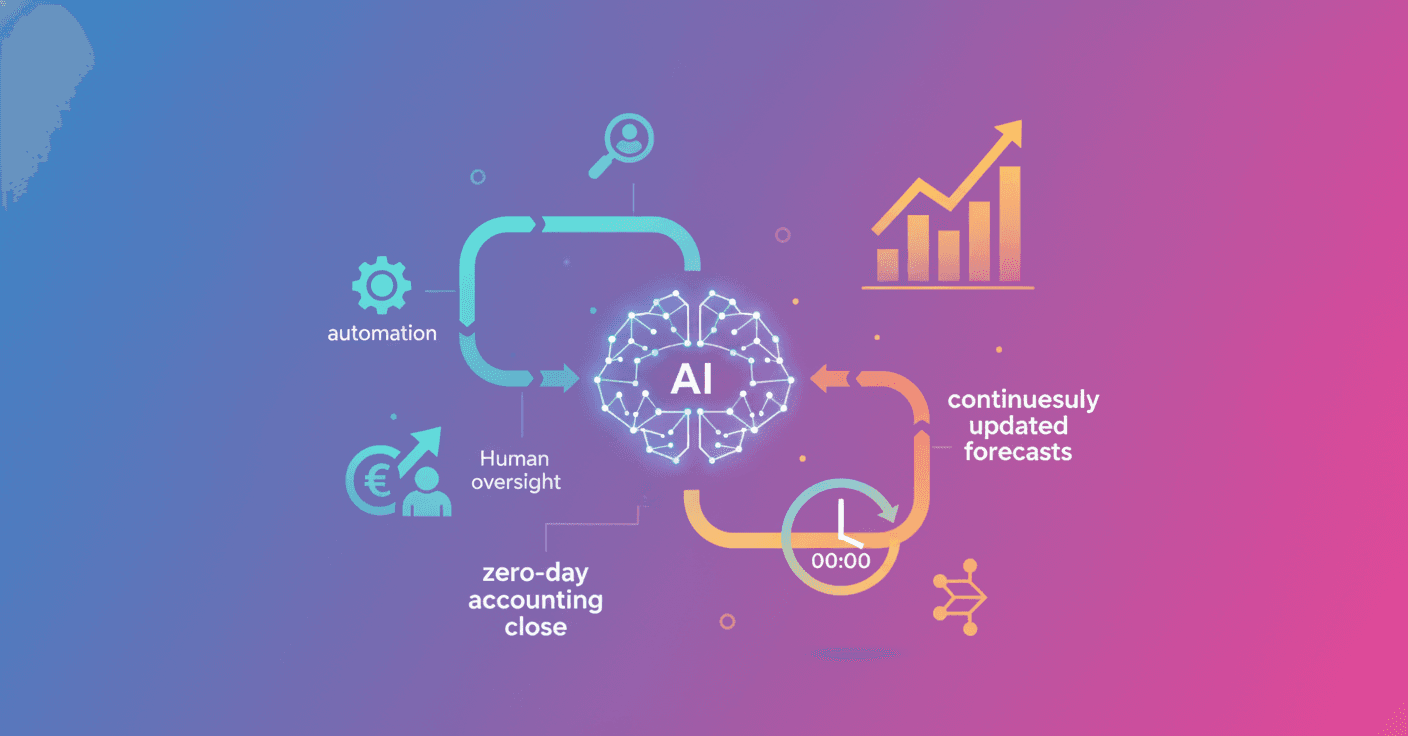
At OpenAI, its finance team is working toward two ambitious goals: closing the books in real time and keeping forecasts continuously up to date. The experience makes one idea clear: AI can help companies understand what is happening as it happens, not weeks later.
From delayed reports to real-time decisions
When OpenAI’s finance team began to grow, many tasks still depended on manual processes. Someone had to search for information across different systems, compare spreadsheets, explain variances, and prepare presentations before a leader could make a decision.
What was the problem? By the time the analysis reached the right person, part of the business reality had already changed.
That is why the team has established two main goals:
- Zero-day close: a reconciled, traceable financial view available practically in real time.
- Continuous forecasting: a forecast that updates as sales, expenses, commitments, and business conditions change.
This does not mean AI will replace financial judgment. The idea is different: machines handle gathering information, detecting discrepancies, and preparing initial analyses, while people validate the data, apply their judgment, and authorize decisions.
AI does not eliminate the accounting close. It eliminates much of the effort involved in reconstructing what happened after the period ends.
Five lessons for finance leaders
OpenAI’s experience offers several recommendations that may be useful for any CFO, including those at companies just beginning to explore AI.
1. Give people access and experiment with real problems
The first step was to let people explore AI within their own work. But this was not about opening a tool and waiting for magical results. The team combined broad access with structured experiments focused on specific tasks.
At a finance hackathon, sales engineers and finance professionals participated together. Each person brought a process they wanted to improve. That led to IR-GPT, a custom GPT based on materials approved by the investor relations team, designed to answer due diligence questions.
They also began creating similar tools for areas such as procurement and tax.
The value of the experiment was turning AI into something practical. In a single day, participants could identify a repetitive task, build a solution, test it with their colleagues, and improve it.
The recommendation for CFOs is to combine two approaches:
- Experimentation from the teams: people closest to the work are often best positioned to spot opportunities.
- Strategic direction: leadership should focus resources on the changes with the greatest business impact.
Transformation happens when both paths meet.
2. Design the entire process, not just automate one task
In finance, a forecast may require data from several systems, spreadsheet reconciliation, explanations of variances, charts, documents, and presentations. Often, the team spends more time preparing the information than analyzing it.
AI makes it possible to change the unit of work. Instead of automating just one part, leaders can redesign the entire journey from the original data to the final decision.
For example, a financial close may bring together information from the general ledger, purchase orders, accrued expenses, approved plans, and transaction details. In a connected platform, each discrepancy could be linked to the activity that caused it.
AI could also prepare an initial explanation and flag the exceptions that need review. The finance team would remain responsible for validating the figures and approving the outcome.
The same principle applies to forecasting. OpenAI describes tools that combine statistical models, business conversations, operational data, account-level evidence, and financial judgment in an interactive view.
This allows a leader to answer questions such as:
- What changed in the forecast?
- Why did it change?
- What assumptions are behind the calculation?
- What would happen if a new customer commitment were added?
- What decision could change the result for the quarter or the year?
The key is to start with an important decision and work backward. First, identify the necessary data, approvals, and handoffs. Then determine what AI can analyze, coordinate, or complete.
3. Let experts build their own tools
One of the most interesting ideas in the article is that finance professionals no longer have to limit themselves to spreadsheets and static presentations. With tools such as ChatGPT Work and Codex, they can create dashboards and applications tailored to their needs.
OpenAI cites its own research, according to which 40% of specialized AI use among finance professionals takes place outside traditional finance tasks, while 22% is related to engineering work.
A team member who had never programmed before used Codex to build an advertising planning tool. The system converts a monthly forecast into weekly and daily plans, accounts for business days and holidays, compares scenarios, and keeps the calculations linked to the approved model.
The result is a tool that allows marketing leaders to quickly see what changed, where to invest, and what return additional spending could generate.
Does this mean finance professionals need to become programmers? Not necessarily. It means they can now participate much more directly in creating the solutions they need.
Expertise does not disappear. It becomes more powerful because it can be supported by tools built by the people who understand the problem from the inside.
4. Maintain human control and traceability
Financial automation only builds trust if every result can be reviewed and connected to a reliable source.
In the case of IR-GPT, the tool can produce a first draft for answering investor questions in seconds. Previously, that work could take hours and even continue overnight.
However, the investor relations team still reads the draft, adds context, applies judgment, and verifies that the answers are consistent with one another.
This collaborative model is especially important in finance. Leaders should define, together with technology and data governance teams:
- What information each system can access.
- What actions AI can execute.
- When human approval is required.
- Which situations must be escalated.
- How each change is documented.
In addition, any modification to an approved forecast should require financial authorization. Speed matters, but so do control and accountability.
5. Measure real value, not just AI usage
Buying more licenses or consuming more tokens does not prove that an AI initiative is working. The important question is whether the work gets done better, how much it costs, and what decisions it enables.
OpenAI proposes four questions for evaluating each workflow:
- Did AI complete an important task?
- What was the total cost, including review, employee time, and corrections?
- Was the result good enough to use?
- Did it help people move faster or make a better decision?
For a financial close, metrics could include cycle time, the percentage of transactions reconciled automatically, the number of exceptions, and the time required to explain a variance.
For forecasts, teams could measure accuracy, update frequency, the time needed to create a scenario, and the quality of the decisions supported by the analysis.
There is also an important warning: the cheapest model is not always the most economical option. If a more capable model delivers a reliable answer with fewer attempts, less review, and less rework, the total cost may be lower.
The finance function as a starting point
Finance occupies a privileged position within a company. It has a direct relationship with strategy, capital, data, risk, and performance. That is why CFOs can become leaders of AI transformation, not just buyers of tools.
An AI-native finance function is not defined by having more automations. It is defined by faster cycles, stronger controls, better decisions, and more time for people to exercise their judgment.
The zero-day close and continuous forecasting are still goals in progress for OpenAI. But the path already offers a practical guide: give teams the right tools, redesign processes around relevant decisions, keep human accountability clear, and measure results rigorously.
AI does not make the finance team unnecessary. It allows people to spend less time chasing down data and more time understanding the business, challenging assumptions, and helping make decisions while there is still time to change the outcome.
Original source
https://openai.com/index/building-an-ai-native-finance-function