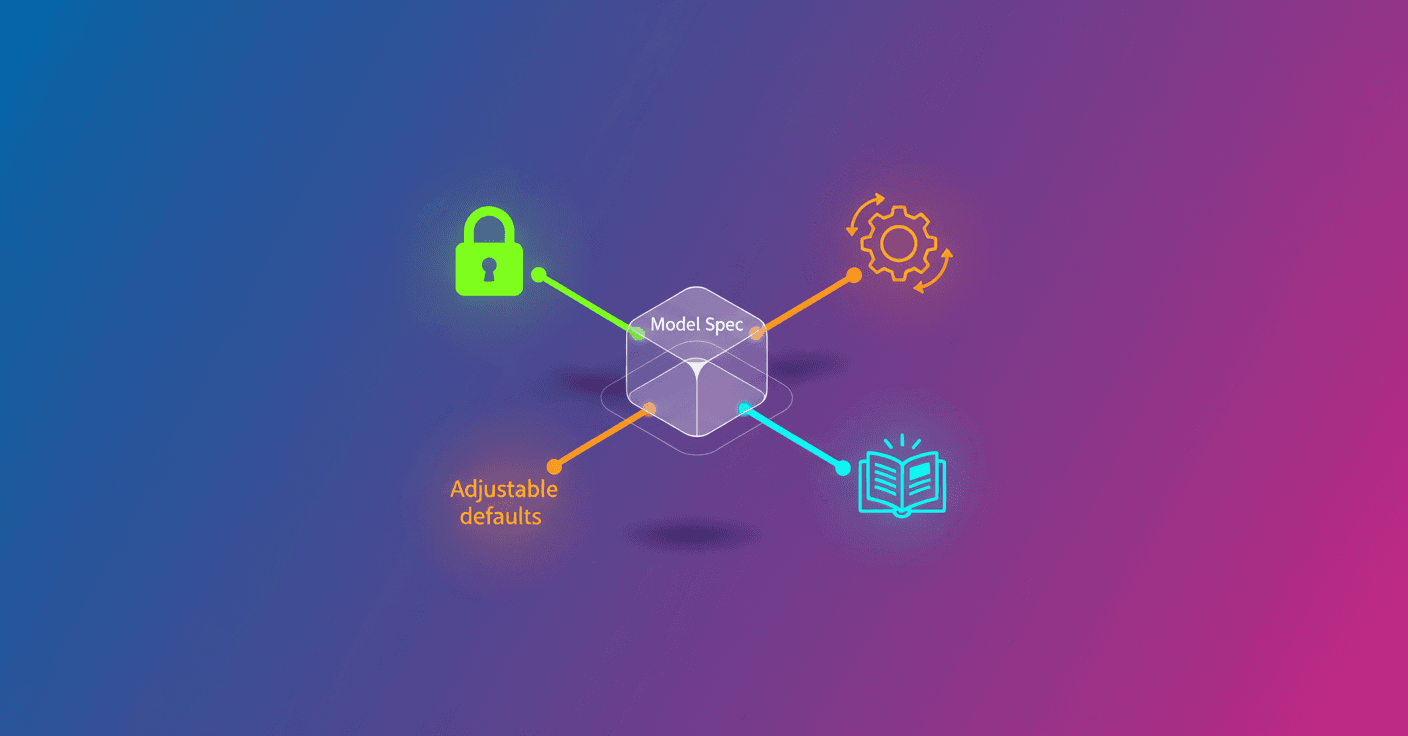
OpenAI shares why and how it publicly defines the behavior it expects from its models. Why make it visible instead of leaving it to the system's discretion? Because artificial intelligence is no longer just a black box for engineers: it affects health, education, work and the daily lives of millions.
What is the Model Spec
The Model Spec is a public guide that describes the behavior OpenAI wants its models to follow. It's not a promise of perfection: it's a target, a common language, and a reference for training, evaluating and discussing behavior.
Think of it as a mix between a constitution and an operating manual: it contains values, concrete rules, examples and interpretive tools to apply those rules in real situations.
Why it matters (for you and for society)
Transparency isn't just a nice idea. If models act unexpectedly, we need something public to point at and say: this is a bug, this was intended. That helps detect inequalities, correct biases and improve safety.
Also, when the rules are out in the open, users, developers and regulators can debate and contribute. Isn't it better that these decisions can be discussed instead of being decided by a single company in private?
How it's structured
At its core there are three levels of ideas: high-level intentions, non-overridable rules and defaults that can be adjusted.
- The preamble sets goals like: deploying models iteratively, avoiding serious harm, and maintaining the social license to operate.
- The hard rules (
rootorsystem) prohibit actions that could cause physical harm, illegality or violate the chain of command. Example: not helping to build a bomb. - The defaults are the behaviors used when no one specifies what they want. They're flexible: tone, format or depth can be adjusted by you or the developer, within safety limits.
They also use interpretive aids: decision rubrics and concrete examples that show correct and incorrect responses in borderline cases.
The Chain of Command: deciding between conflicting instructions
Instructions can come from OpenAI, from a developer or from a user, and sometimes they clash. The Chain of Command sets which instructions to prioritize, both in letter and in spirit.
This allows you to keep freedom for users and control for developers without sacrificing essential limits. For example: an offensive prank request can yield to safety limits, while a style request (like asking for a sarcastic tone) can usually be fulfilled.
It's not the technical model, but the human interface
The Model Spec describes the desired behavior, not the exact training recipe. It doesn't dive into details like internal token formats or specific techniques: its main audience is people, not machines.
That's why it complements usage policies and product layers like monitoring, memory or enforcement mechanisms. Safety is a defense in depth, not just a single rule inside the model.
Update, evaluation and examples
OpenAI publishes evals called Model Spec Evals: sets of scenarios designed to verify whether the model aligns with what the Spec demands. It's not the only measure, but it helps identify misalignments.
Updates to the Spec come from: public feedback, internal issues, changes in safety policy and new capabilities (for example, multimodal interactions or autonomous agents). The document evolves with real-world practice.
Practical limits and challenges
The Spec can be ahead of the model: sometimes the guide is 0 to 3 months ahead of what the model does in production. Also, training can accidentally teach unwanted behaviors, or the model can generalize poorly in rare cases.
There are conceptual limits too: it's not enough to say "be useful and safe." Many decisions involve value judgments where intelligence alone doesn't pick the correct balance. That's why a public specification remains necessary even as models improve.
Principles that guide the writing
When drafting it they aim for clarity, substantive rules and examples with high informational value. They prefer to spell out potential conflicts between rules rather than hide them behind ambiguous phrases.
They want someone to take a real prompt and say with reasonable confidence whether the response is inside or outside the lines. That makes evaluation, auditing and public debate easier.
And what does this mean for you?
If you're a user: you'll have clear reasons to understand why an assistant responds the way it does and channels to report problems.
If you're a developer: the Spec is a reference to design products and tests that match public expectations.
If you're a regulator or researcher: it's a coordination point to audit and compare behavior without relying on closed internal documentation.
Final reflection
Making public what used to stay private changes the conversation about AI. It doesn't remove risks, but it turns society into an interlocutor capable of reading, criticizing and improving the rules that guide systems increasingly present in real life.
Opening the Model Spec is, at heart, a bet on democratic coordination and iteration: mistakes will happen, but now there's a roadmap and an invitation to participate.