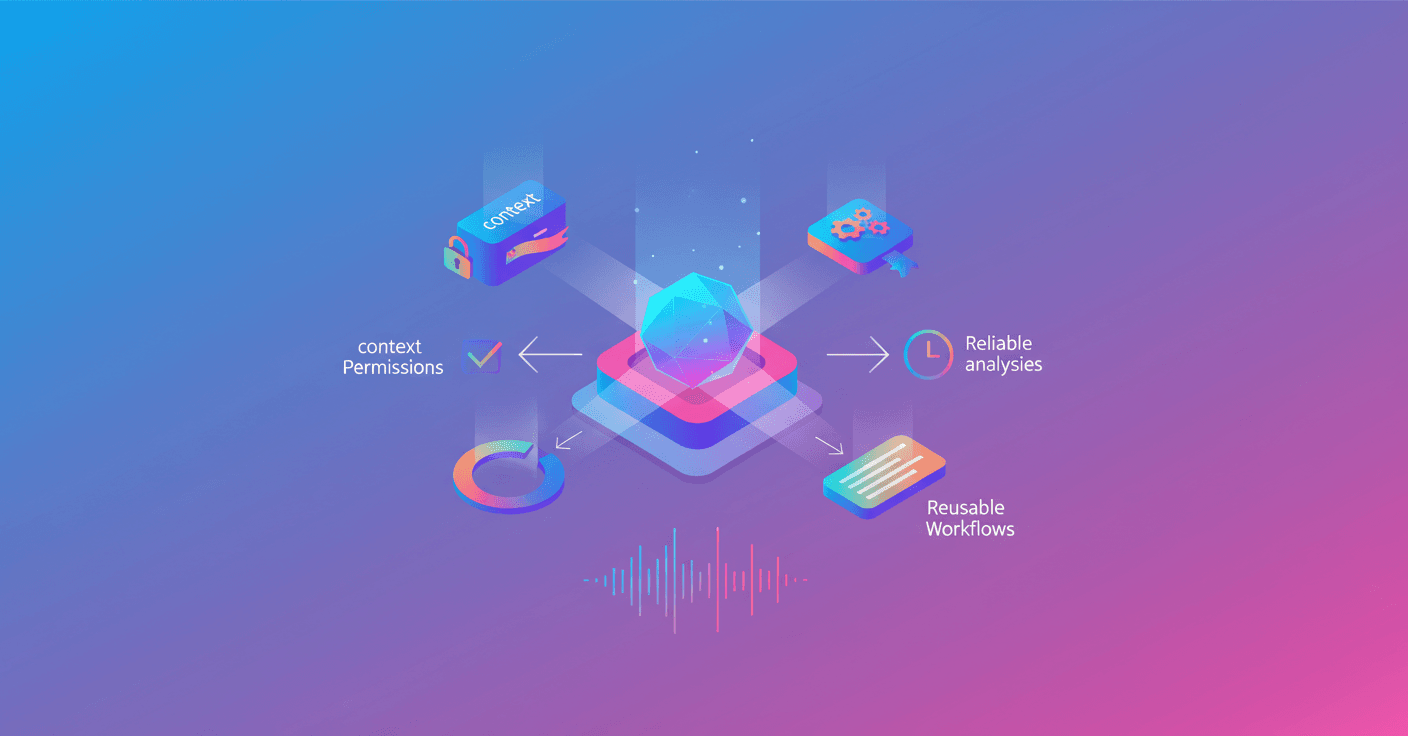
OpenAI built an in-house data agent so their teams can go from question to answer in minutes, not days. Sounds like magic? Not really: it’s the result of combining powerful models with rich context, strict permissions, and a memory that learns as it’s used.
What the agent is and why they made it
The problem is familiar: when a company has thousands of users and hundreds of petabytes of data, finding the right table and producing a reliable analysis takes time and is error-prone. Have you ever seen multiple tables that look the same and didn’t know which one to use? That friction was eating hours that should be spent on decisions, not debugging joins and filters.
OpenAI’s internal solution is an agent (not a public product) that explores and reasons about its own data platform. It’s integrated where people already work: Slack, the internal web, IDEs, and the internal chat app. Engineering, Data Science, Product, Finance, and Research teams use it for complex natural-language questions, from evaluating launches to diagnosing business health.
How it works, but without useless technobabble
The agent doesn’t guess about tables: it relies on several layers of context so it doesn’t get things wrong.
- Metadata and lineage: it uses column names, types, and relationships between tables to write safer queries.
- Query history: it learns how the organization usually joins tables and what transformations are common.
- Curated descriptions: domain experts document intent, semantics, and caveats you don’t see in the schema alone.
Also, the agent doesn’t just read schemas: it analyzes the code and definitions that generate the tables. That gives it info about freshness, granularity, and exclusions — critical details to know whether a table only contains first-party traffic or if certain events are excluded.
When something is missing or out of date, it can run live queries to inspect the data and validate assumptions. That prevents wild guesses or misinterpretations of metrics.
Memory and continuous learning
What’s interesting is the agent stores corrections and useful learnings. If you teach it to filter by a specific experiment or correct an assumption, it can save that as memory and reuse it. Memories can be personal or global, and they’re editable.
That means, over time, it reduces recurring mistakes: answers start from a more accurate baseline instead of tripping over the same traps again and again.
A conversational workflow
It’s not a rigid toolbox. The agent is conversational and keeps context across turns. You can ask for a broad exploration ("go see why this dropped") and then refine it without repeating everything. If it goes the wrong way, you interrupt and redirect it, just like with a human colleague.
If information is missing, it asks clarifying questions; if you don’t answer, it applies sensible defaults (for example, a default date range) so it doesn’t get stuck. That makes it useful both for people who know exactly what they want and for those who are exploring.
A concrete example: with a New York taxi trips dataset, the agent can identify pickup-dropoff ZIP pairs with the highest variability in trip times and point out when that variability happens — all in an automated flow that analyzes, queries, and synthesizes findings.
Repetition, automation, and consistency
Repetitive tasks become reusable workflows. Weekly analyses, table validations, and recurring reports are packaged as instructions anyone can run: consistency and speed without relying on human memory.
Quality, evaluations, and security
To avoid regressions, OpenAI uses systematic evaluations similar to automated tests: questions with expected answers and “golden” queries they compare the agent’s output against. It’s not about comparing text character-by-character: they compare the logic, the query, and the result to rate whether an answer is acceptable.
On security, the agent respects exactly the permissions you already have: it can only access the tables you’re authorized to see. If you don’t have access, it will say so or suggest authorized alternatives. It also always shows its reasoning and links to raw results so you can verify every step.
Practical lessons that make sense to know
- Too many overlapping tools confuse the agent, so they consolidated and restricted calls to reduce ambiguity.
- Overly prescriptive prompts made results worse; giving high-level guidance and trusting the model’s reasoning worked better.
- The code that builds tables says much more than the schema: capturing that logic was key to understanding the real meaning of the data.
What’s left to improve?
OpenAI is still polishing the agent’s ability to handle ambiguous questions, improve validations, and deepen integration with workflows. The goal is for it to feel like a natural extension of teams, not another tool you have to learn.
In the end, it’s not just about having a powerful model: it’s about context, control, and feedback. Combine those, and AI stops being a black box and becomes a practical helper that speeds up daily work.