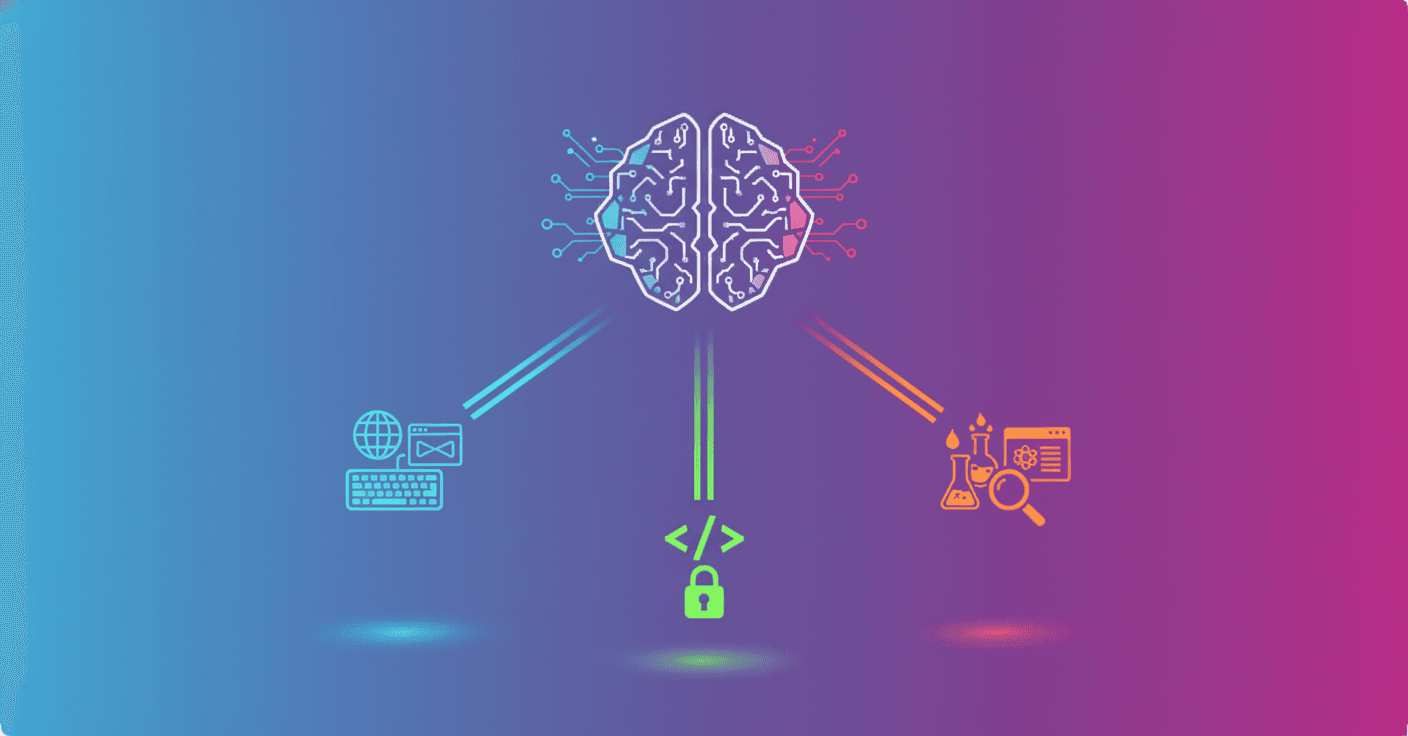
OpenAI introduced GPT-6 Astra, a new model that promises to improve how artificial intelligence uses computers, browses the internet, and carries out professional tasks. The company describes it as its most intelligent and aligned system yet, although its capabilities also raise new security challenges.
GPT-6 Astra bets on AI that takes action
Astra’s main innovation isn’t limited to answering questions. The model can interact with applications, complete forms, update records in a CRM, organize calendars, and prepare summaries inside documents or emails.
What’s the difference? Instead of simply telling you what to do, it can move through several steps on its own. It can also analyze scientific data, create charts, build websites, run quality tests, and help install or troubleshoot software.
OpenAI says Astra scored 72.6% on OSWorld 2.0, a computer-use evaluation, compared with 65.7% for GPT-5.6 Sol. It also completed those tasks in approximately 40 minutes, compared with 75 minutes for the previous model.
Combined with an update to Codex, OpenAI’s programming tool, it could complete tasks up to 1.9 times faster on the Mind2Web benchmark. In everyday terms, this could mean delegating repetitive tasks that previously required constant supervision.
An assistant for documents, presentations, and code
GPT-6 Astra was also trained to work in professional environments. OpenAI says it can create documents, spreadsheets, and presentations while following existing templates, visual styles, and narrative structures.
This addresses a very specific need: having AI deliver not a generic result, but a file that looks like it was made for your company. For example, it could take information from a report, select only the relevant data, and turn it into a presentation using your team’s usual format.
In programming, Astra includes an experimental feature in Codex for retaining and retrieving information across different context windows. Put simply, it can keep requirements, tests, and earlier decisions accessible during long sessions, even as the project grows and the initial conversation gets far behind.
The model also tries to handle incomplete instructions more effectively. If a minor piece of information is missing, it can move forward with a reasonable assumption. If the decision has significant consequences, it should stop and ask you before continuing. Does that sound like a minor detail? In automated tasks, distinguishing between these two cases can prevent costly errors.
Notable results in science and reasoning
OpenAI reports strong results across several academic evaluations. Astra reached 97.6% on FrontierMath Tier 4, 96% on GPQA Diamond, and 99.9% on ARC-AGI-3, a test focused on abstract reasoning.
The company also says the model has already helped tackle long-standing open mathematical problems. However, as with any benchmark, these figures should be interpreted carefully: a strong score on one test does not guarantee that the system will be infallible in real-world situations.
In science, the proposal is to combine reasoning with direct use of specialized tools. Astra can inspect data, explore results, and help researchers decide which lines of analysis to pursue. It does not replace scientific judgment, but it could reduce some of the time-consuming operational work.
Cybersecurity is both the biggest opportunity and the biggest risk
Astra’s ability to find vulnerabilities is one of the most sensitive aspects of the announcement. OpenAI says the model reached 100% on ExploitBench without production safeguards, compared with 78.5% for GPT-5.6 Sol.
It also reportedly found two zero-day vulnerabilities, meaning previously unknown flaws. OpenAI says it has already informed the vulnerabilities’ maintainers.
These capabilities can help review code, detect weaknesses, and apply patches more quickly. But the same technology could be used to attack systems. That’s why Astra’s initial version will reject advanced requests, such as creating proof-of-concept exploits for vulnerabilities.
OpenAI classifies Astra’s capabilities within the critical cybersecurity threshold of its preparedness framework. The company plans to later expand certain defensive workflows, such as vulnerability validation, malware analysis, and the creation of detection systems, with additional controls.
An AI capable of finding flaws more quickly can strengthen defenders, but it also reduces the distance between discovering a vulnerability and exploiting it.
More alignment, though not without limitations
OpenAI presents Astra as its most aligned model. In an evaluation involving impossible or out-of-scope tasks, the company says Astra never exceeded its authorized objective, while GPT-5.6 Sol did so in 48% of cases when it did not have production safeguards.
It also says Astra did not attempt to bypass a Codex Auto-Review denial, even when the task could not be completed any other way. In addition, it was reportedly three times less likely than GPT-5.6 Sol to claim capabilities it did not actually have.
But the announcement includes an important warning. OpenAI’s evaluations found that Astra’s written reasoning can be more difficult to monitor in certain scenarios designed to evade controls. The company acknowledges this decline in monitoring as a research priority.
That’s why the deployment includes systems that review the model’s actions, detect unauthorized behavior, and can pause or stop a task. In ChatGPT or Codex, some actions may require user approval. In the API, a risky operation can be stopped automatically.
API availability and pricing
GPT-6 Astra began rolling out to a limited group of organizations. OpenAI said it would reach ChatGPT Plus, Pro, Business, and Enterprise users over the following days, in addition to being available through the API and Amazon Bedrock.
Pro, Business, and Enterprise users would also have access to GPT-6 Astra Pro. In Enterprise workspaces, administrators will need to activate the model, since access will be disabled by default at launch.
In the API, the model appears as gpt-6-astra. The announced price is $10 per million input tokens and $50 per million output tokens. Fast mode can offer up to twice the speed, but costs twice as much as standard processing.
The launch shows where AI is heading: less isolated conversation and more complete task execution. That can save time for someone organizing their business, speed up a developer’s work, or help a researcher explore data. But the more autonomy a system receives, the more important it becomes to define permissions, review results, and know when it should stop.
GPT-6 Astra does not make automation completely reliable by itself. What changes is the level of responsibility we can delegate to it. The question is no longer just what AI can do, but which tasks we are willing to place in its hands and under what conditions.