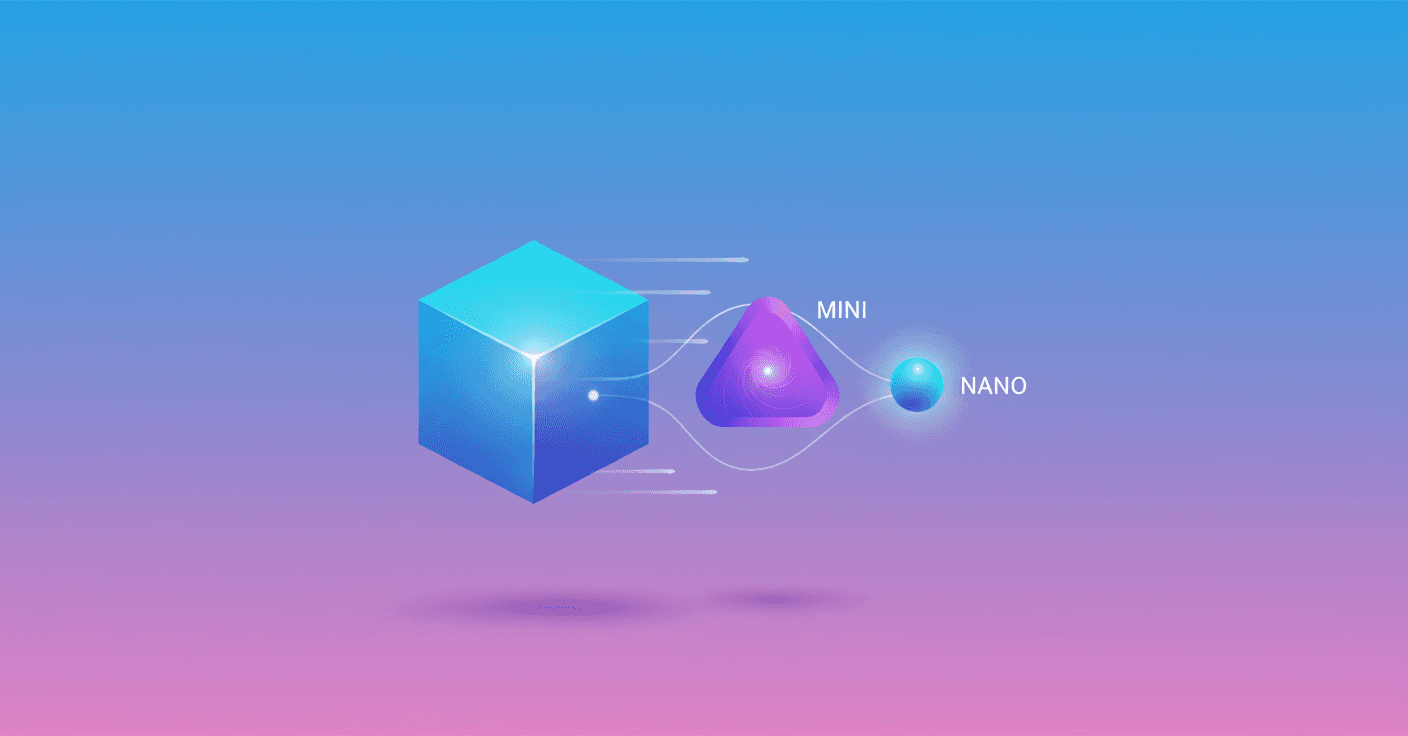
OpenAI today launches GPT-5.4 mini and GPT-5.4 nano, two smaller versions of its GPT-5.4 family designed for when speed and cost matter as much as quality. What are they really for? For letting code assistants, subagents and multimodal apps respond smoothly without always needing the biggest model.
What’s new
GPT-5.4 mini improves over the previous generation (GPT-5 mini) in several areas: reasoning, code handling, multimodal understanding and reliable tool use, and it also runs more than 2x faster on many workloads. GPT-5.4 nano is the smallest and most economical option, ideal when latency and low cost are the top priorities.
Both models are built for scenarios where latency shapes the experience: code assistants that must feel instant, subagents that complete support tasks in parallel, systems that interpret screenshots, and multimodal apps that reason about images in real time.
Performance in clear terms
I won’t drown you in tables, but I will give you the numbers that matter so you can compare quickly:
- SWE-Bench Pro (public evaluation): GPT-5.4 scores 57.7%, GPT-5.4 mini 54.4%, GPT-5.4 nano 52.4% and GPT-5 mini 45.7%.
- Terminal-Bench 2.0 (interactive coding): 75.1% for GPT-5.4, 60.0% for mini, 46.3% for nano and 38.2% for GPT-5 mini.
- OSWorld-Verified (computer use and UI tasks): 75.0% GPT-5.4, 72.1% mini, 39.0% nano, 42.0% GPT-5 mini.
- GPQA Diamond (high-confidence questions): 93.0% GPT-5.4, 88.0% mini, 82.8% nano, 81.6% GPT-5 mini.
In short: GPT-5.4 mini approaches the large model on several key tests while running much faster; nano gives a significant jump over the previous mini generation in cost- and latency-sensitive scenarios.
Practical use cases
- Code assistants that need to iterate quickly: reviews, snippet generation, code navigation and debug loops with low latency.
- Systems with subagents: a large model plans and evaluates, and minis or nanos perform subtasks in parallel (search repositories, process documents, extract data). Sound useful? It is when you scale.
- Real-time multimodal applications: interpret dense screenshots, complete computer-use tasks and answer about images without delays.
- Low-cost, high-frequency tasks: classification, data extraction, ranking and small code subagents are perfect for GPT-5.4 nano.
Availability and pricing
-
GPT-5.4 mini: available via API, Codex and ChatGPT. It supports text and image, tool use,
function calling, web search, file search, computer use and skills. It has a 400k token context window. Price: $0.75 per 1M input tokens and $4.50 per 1M output tokens. -
GPT-5.4 nano: available only via API. Price: $0.20 per 1M input tokens and $1.25 per 1M output tokens.
In Codex, GPT-5.4 mini consumes only 30% of the quota of GPT-5.4, which lets you handle many coding tasks for roughly a third of the cost by delegating to subagents.
Why not always use the largest model?
Because the best experience isn’t always the biggest model. Sometimes it’s about a fast reply, cost per call and reliable tool use. A flow where a large model decides and smaller models execute is often more efficient and economical.
An actual example? In an IDE extension, you can use GPT-5.4 to plan a complex refactor and delegate searches and targeted edits to GPT-5.4 mini or nano so the developer gets results in fractions of a second.
Safety and best practices
OpenAI refers to the System Card addendum in its Deployment Safety Hub for details on safeguards. It’s important to review those materials before deploying models to production, especially when there’s access to tools, the web or automated actions.
What to expect if you’re a developer or product person
- If you work on products that depend on low latency and high volume, try GPT-5.4 mini and nano first to measure costs and response times.
- If you build composite systems, design flows where decision responsibility and execution are separated between large and small models.
- If budget is critical and tasks are repetitive or structured, GPT-5.4 nano can cut costs without sacrificing too much performance.
GPT-5.4 mini and nano confirm a clear trend: production effectiveness is not measured only by peak accuracy, but by the combination of speed, cost and reliability in the real world. Ready to reconfigure your pipelines and take advantage of nimbler subagents?