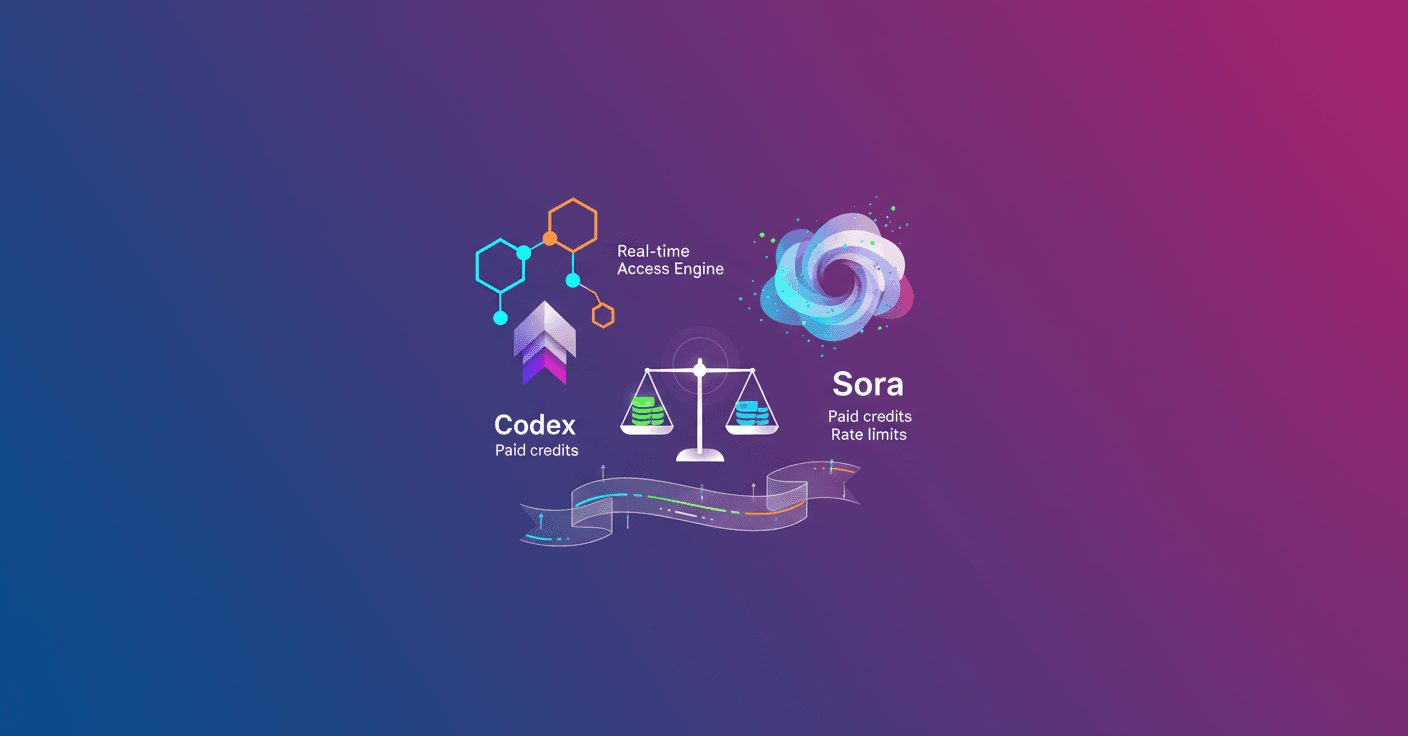
In recent months, Sora and Codex grew faster than expected. Users found value and then ran into a brake: rate limits. Sound familiar? That moment when you're about to take the next step and the platform tells you "come back later".
What changed for Sora and Codex
OpenAI decided hard caps were a poor experience when people are active and creating. The solution wasn't to raise limits indefinitely or to bill from the first token. Instead, they built a real-time access engine that mixes per-second limits with paid credits.
The core idea is simple in experience: when you approach a limit, the system can use credits to let you keep working. For you, it's almost invisible: you continue using the tool without interruptions. But under the hood there's a lot of logic to make that fair, correct, and auditable.
How the new access layer works
Think of it as a cascade of decisions: instead of asking "is this allowed?", the system asks "how much is allowed and where does it come from?" Each request goes through the same evaluation path that looks, in real time, at rate-limit windows and credit balances.
If usage is within the limit, it proceeds. If it exceeds the limit, the system checks credits and decides instantly whether it can consume them. Credit consumption is verified in real time so you aren't surprised by sudden blocks. Then the balance adjustment settles asynchronously but with logs that allow everything to be verified.
It's not magic: it's a hybrid model where limits, free tiers, promo credits, and enterprise contracts are just layers of the same decision stack. For you this means continuity; for the product, control and fairness.
Three records that make the system auditable
To prove charges are correct, the system keeps and links three datasets:
- Product usage logs: what you actually did (calls, tokens, actions).
- Monetization events: what you'll be charged for that usage.
- Balance updates: how your credits are changed and why.
Each event carries a stable idempotency key, so retries or restarts don't cause double charges. Also, the balance reduction and the insertion of the balance record are done in a single atomic transaction, serialized per account, to avoid spending races.
They accept a small delay in the visible balance update to build this audit trail. If that latency causes the system to briefly overdraft you, an automatic refund is issued. In other words: they prefer demonstrable correction and user trust over immediate punishment.
Why not use an external platform
They evaluated third-party billing and metering solutions. Those platforms are good for invoices and reports, but they fail in two critical ways for interactive products:
- They don't know instantly whether you have credit when you hit a limit. Deferred counting causes surprise blocks and inconsistent balances.
- They don't provide the on-demand transparency needed to explain why a request was allowed or blocked and how much it consumed.
To avoid those visible failures when the user is most engaged, they chose an internal solution that integrates decisions, counting, and observability in the same path.
Real benefits for users and teams
So what do you get in practice? Several things:
- Fewer interruptions: you won't get cut off mid-creative session by a rigid ceiling.
- Trust: charges are demonstrable and there's a trail that explains every adjustment.
- Predictability: a single evaluation path avoids different behaviors across teams and products.
- Flexibility: you can explore without paying from the first token, but also scale when real demand appears.
For product teams, it also means less duplicated logic between services and a common foundation to extend this model to other products.
Building this wasn't just engineering; it was prioritizing the user experience. When you're creating or developing, the last thing you want is to wonder whether a call will go through or whether you'll be overcharged.
What's next
The platform is designed to scale to more products. Sora and Codex are just the beginning: an infrastructure that treats correctness as a feature allows continuous and transparent access where people need it most.
Think of a coding session or a creative project that flows without unexpected stalls. That's the promise: smart limits that protect system capacity and credits that appear when you need them, without you having to worry about reconciliations or surprise charges.