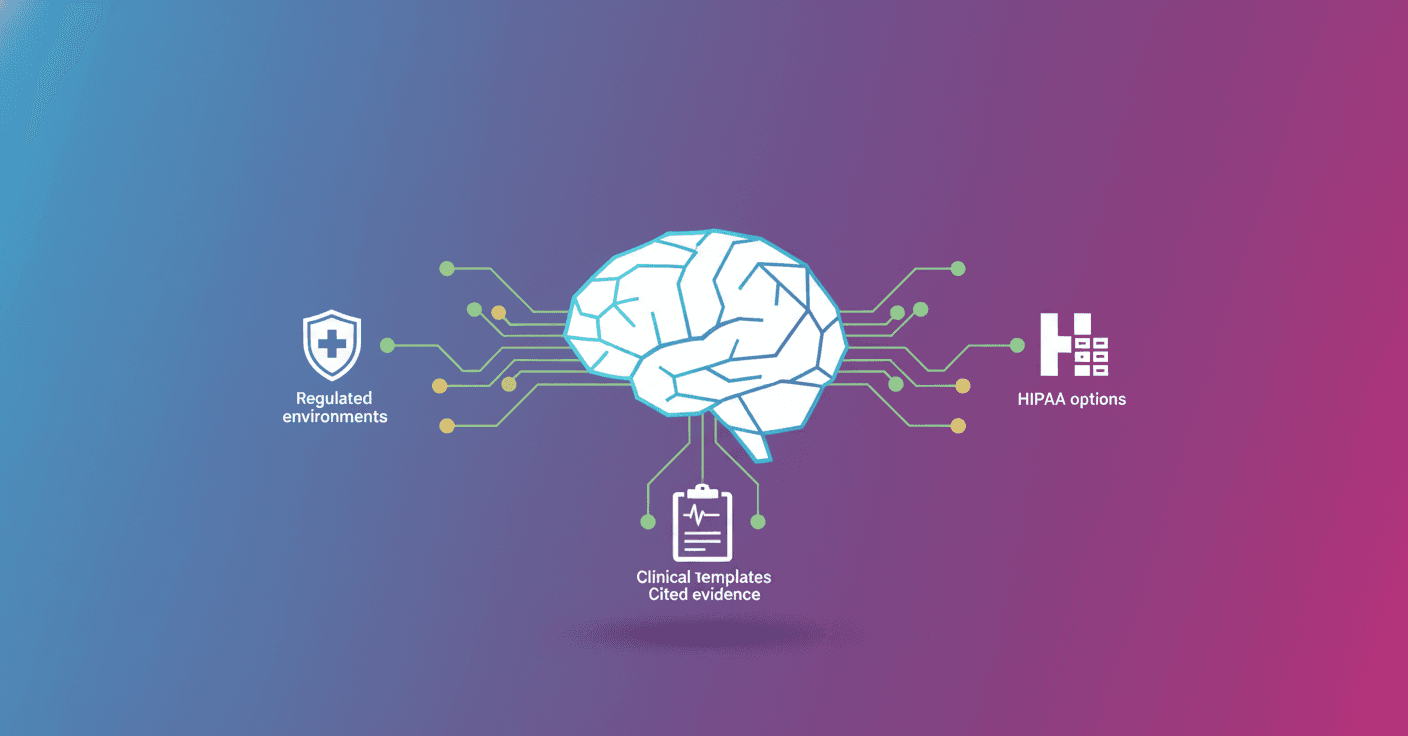
OpenAI announces "OpenAI for Healthcare", a suite designed so hospitals and medical centers can use AI safely, reduce administrative work, and speed up clinical decisions without losing control over patient data.
What is OpenAI for Healthcare
What does it consist of? It’s a set of enterprise products that includes ChatGPT for Healthcare and the OpenAI API adapted for regulated environments. The idea is to deliver tools that help clinical, administrative, and research teams work more consistently and faster, supporting compliance requirements like HIPAA.
ChatGPT for Healthcare is already available and is being rolled out at institutions such as AdventHealth, Baylor Scott & White Health, Boston Children’s Hospital, Cedars-Sinai, HCA Healthcare, Memorial Sloan Kettering, Stanford Medicine Children’s Health and UCSF.
What it offers and why it matters
-
Models built for clinical workflows. High-quality responses geared to clinical work, research and operations, powered by GPT-5.2 models evaluated with tests led by physicians.
-
Evidence retrieval with clear citations. Answers are anchored in peer-reviewed articles, clinical guidelines, and public health guidance, showing titles, journals and dates so you can check sources quickly.
-
Alignment with institutional policies. Integrations with enterprise tools allow responses to take into account the hospital’s own policies and care pathways.
-
Reusable templates. To draft discharge summaries, patient instructions, clinical letters and prior authorization support. Less rewriting, more time for the patient.
-
Access management and governance. A centralized workspace with role control, SAML SSO and SCIM to manage users and permissions.
-
Data control and HIPAA support. Options for data residency, audit logs, customer-managed encryption keys and the possibility of a BAA with OpenAI. Important: content shared with ChatGPT for Healthcare is not used to train the models.
Real cases and evidence
This isn’t just marketing. Companies like Abridge, Ambience and EliseAI already use the API to build features like ambient listening, automatic clinical documentation and appointment scheduling. A study with Penda Health showed reductions in diagnostic and treatment errors when a clinician-supervised OpenAI-powered clinical copilot was used.
OpenAI also reports evaluations with more than 260 licensed physicians in 60 countries who reviewed over 600,000 model outputs. Benchmarks like HealthBench and GDPval measure clinical reasoning, handling uncertainty and communication, and GPT-5.2 performs better than previous generations.
Safety, compliance and practical control
The platform aims to offer the controls compliance departments expect: BAA, access controls, audit logs and data residency options. All of this tries to solve a real dilemma: how do you apply powerful AI in a regulated context without risking privacy or clinical responsibility?
In practice, this lets a team use AI to synthesize evidence, prepare documentation and adapt materials for patients, while always keeping the clinician as the final decision-maker.
How to get started and who it can serve
If you work in a hospital, health center or medtech company, you can contact the OpenAI team for more information or explore the API platform. There are options to request a BAA and for enterprise customers with access to extended support and governance.
Imagine a service that helps write a discharge summary while the physician reviews and confirms it in seconds, or a system that highlights the most relevant evidence for a complex case with direct citations. That’s the practical help these tools aim to provide.
OpenAI highlights that AI adoption in health is growing fast and that these solutions try to balance clinical utility with safety and compliance.