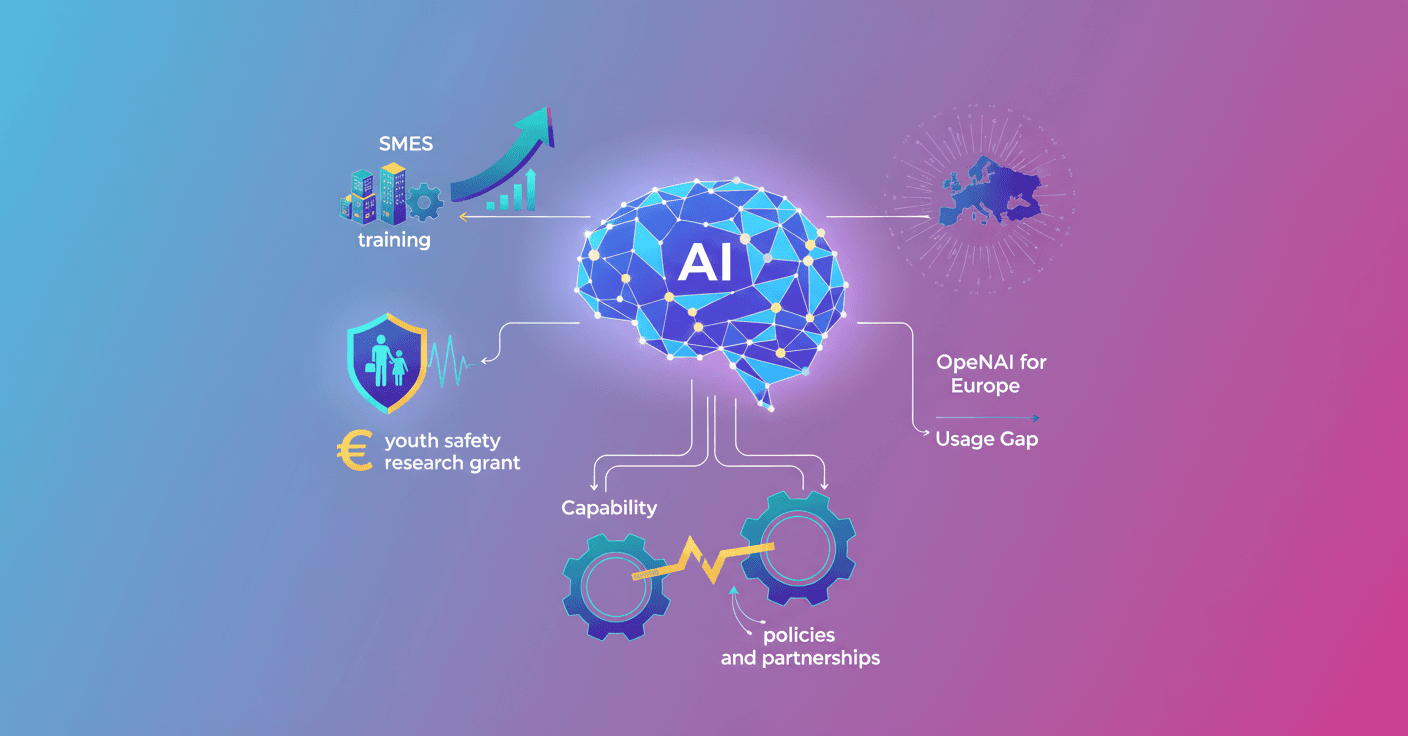
OpenAI published the EU Economic Blueprint 2.0 on January 28, 2026, and it brings a package of initiatives designed to speed up AI adoption across Europe. The idea? That you—people, SMEs and governments—don't get left behind in the intelligence era and that the productivity advantage doesn't end up concentrated in just a few hands.
Main announcements of the Blueprint 2.0
- SME AI Accelerator program to train 20,000 SMEs in Europe, in partnership with Booking.com.
- A €500,000 grant for an NGO dedicated to research on safety and youth wellbeing in digital environments.
- Expansion of OpenAI for Europe to collaborate with governments on national AI priorities.
What is the "capability overhang" and why does it matter?
OpenAI introduces the idea of capability overhang: the gap between what the most advanced AI systems can do and how they are actually used by people, companies and countries. Sounds technical, right? The core message is simple: there’s capacity available that isn’t being taken advantage of.
Key data: the heaviest users use 7 times more reasoning capabilities than a typical user. Between leading and lagging countries the difference can be 3x. On average the EU uses 17% more capabilities than the rest of the world, but inside the EU there are inequalities: the most intensive country uses about 40% more than the least intensive, and nine European countries are below the global average.
If this isn’t addressed, the economic and productive benefits of AI can concentrate in a few regions and companies. Can you imagine your country or your small business being left out just when automation and intelligence lift productivity elsewhere? That’s the urgency the Blueprint highlights.
What this means for SMEs
OpenAI launches the SME AI Accelerator to help 20,000 small and medium-sized businesses across six countries: France, Germany, Italy, Poland, Ireland and the United Kingdom. The program will be both in-person and virtual, and it’s open to entrepreneurs without technical backgrounds.
Why does this matter? According to Eurostat, in 2025 AI adoption among SMEs was 17% compared to 55% in large companies. That gap is huge. With practical training, an SME can use AI to:
- automate customer replies and cut waiting times,
- speed up invoicing and administrative tasks,
- generate content and translate it for new markets,
- optimize inventory and internal processes.
If you run an SME, thinking about AI today is thinking about competitiveness tomorrow.
Safety and youth: the other side of the plan
OpenAI announces a €500,000 grant to support research and projects on child protection, digital wellbeing and evidence-based approaches to youth safety online. It’s a clear signal: pushing AI use must go hand in hand with investment in trust and care for the generations growing up with these tools.
Partnerships with governments and regional priorities
OpenAI reaffirms its intent to work with European governments through OpenAI for Europe. The 2026 plan includes initiatives in education and health, training and credentials for AI skills, disaster response, cybersecurity and startup acceleration.
The company has already worked on projects like sovereign infrastructure in Germany, the Stargate project in Norway, and education and skills programs in countries such as Estonia, Greece, Ireland and Slovakia.
Recommendations for policymakers
OpenAI proposes concrete measures to reduce the adoption gap:
- create national AI frameworks in education;
- design a portable system for accrediting AI skills;
- measure AI adoption and use by sector and country to monitor progress.
These are practical actions that help plan investments, design curricula and sustain inclusive policies.
And now what? A practical call
If you work in government, education, an NGO or an SME, there are clear opportunities: take part in the trainings, apply for funding initiatives and demand measurements that show real progress. Fair AI adoption isn’t automatic; it’s built with policies, partnerships and training.
OpenAI puts resources and data on the table. The question is whether the region and its actors will seize the chance so intelligence isn’t a privilege for a few, but a tool for many.