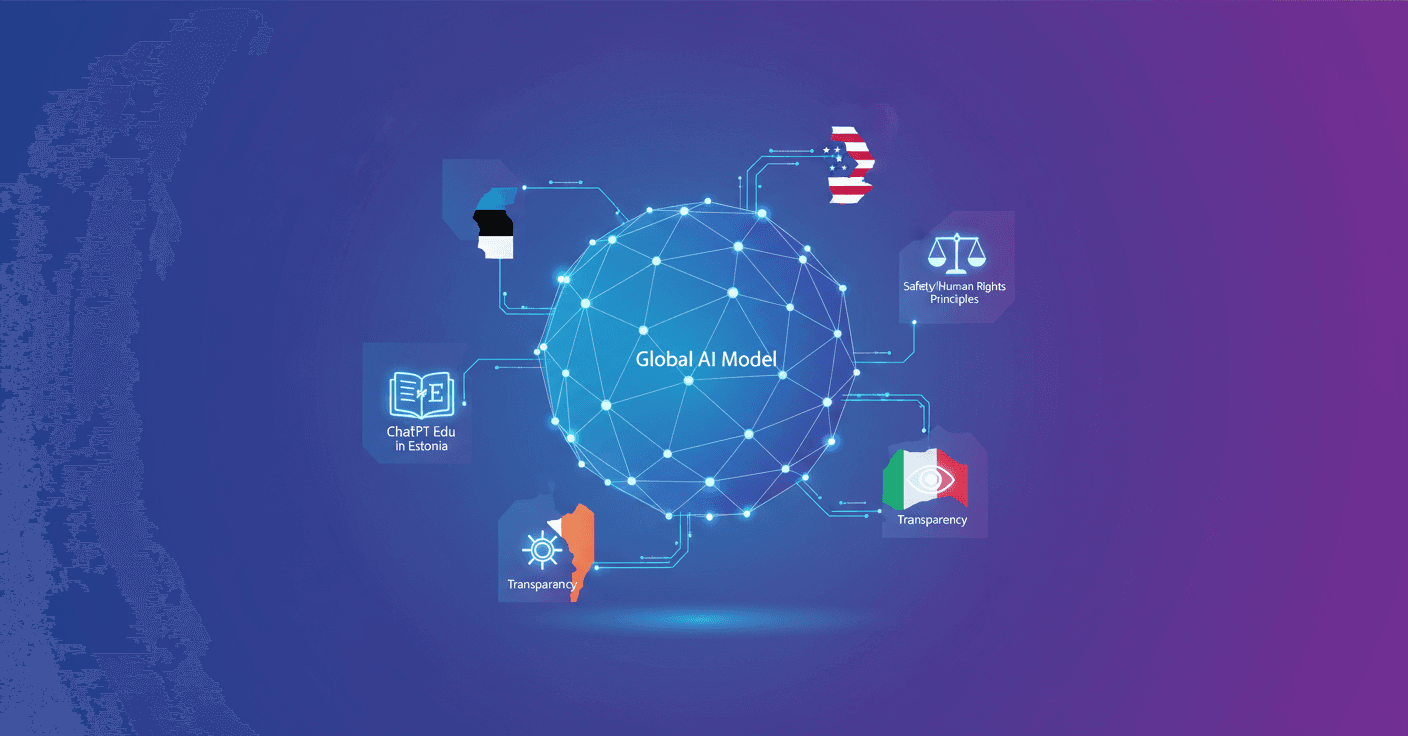
OpenAI announces its bet on bringing artificial intelligence tailored to each country. Sounds obvious, right? But in practice it involves technical, legal, and cultural decisions that change how AI interacts with people, governments, and education systems around the world.
Qué significa localizar la IA
Localizing is not just translating words. It means the AI speaks the local language and accents, respects national laws, and understands cultural norms and values. For many countries, the challenge isn’t building a model from scratch, but adapting the best available model so it works in their context.
Can you imagine a school assistant that doesn't know your curriculum or the nuances of your education system? That’s why localization matters: it makes AI useful and relevant from day one.
Cómo está enfocando OpenAI la localización
OpenAI proposes a cooperative path: combine a cutting-edge global model with local adaptations. The program OpenAI for Countries explores how to give countries the capacity to develop sovereign AI in collaboration with OpenAI, without sacrificing the quality of the base model.
A concrete example: they are piloting a localized version of ChatGPT for students in Estonia within ChatGPT Edu, incorporating local curriculum and pedagogical approaches. It’s a good reminder that localization can be practical and specific, not just theoretical.
Principios y límites claros
OpenAI has a public document called Model Spec that defines how its models should behave. This is not a secret manual; it’s the compass that guides customization, localization, and deployment.
Inside the Model Spec are the so-called "red-line principles" that are non-negotiable. Among the most important are:
- No allowing models to enable severe harm like violence or development of weapons of mass destruction.
- No permitting use for persecution, terrorism, mass surveillance, or large-scale manipulation.
- Protect people’s privacy in their interactions with the AI.
Human safety and human rights are priorities. These rules apply in all deployments, including local and sovereign projects.
Also, when OpenAI offers direct experiences to users, like ChatGPT, it commits to:
- Making it easy for people to access reliable information and critical safety guidance.
- Ensuring personalization and localization do not contradict the basic rules of the
Model Spec. This includes theobjective point-of-viewprinciple: localization can adjust language or tone, but not change facts or the balance of information. - Indicating to users any content omitted due to legal requirements, explaining why the information was removed without revealing the censored content. Likewise, any added information must be clearly signaled.
¿Qué implica esto para gobiernos, escuelas y desarrolladores?
For governments: it means a possible route to obtain advanced AI capabilities without building models from scratch, while keeping local control over data, legal compliance, and cultural adaptation.
For schools and teachers: localization can translate into more relevant educational resources, answers that understand the local curriculum, and tools that respect pedagogical norms.
For developers: it opens opportunities to build local experiences on a global foundation, always within public and transparent limits.
Transparencia y aprendizaje continuo
OpenAI promises to share what it learns during these pilots and evolve its approach openly. It’s not a black box arriving in a country to be used as-is; it’s a collaborative process where rules, limits, and changes should be public.
Does this mean all concerns are solved? No. Localizing AI raises complex questions about sovereignty, technological dependence, and governance. But the proposed route seeks to balance technical excellence with respect for local contexts and human rights.
In the end, localization aims for AI to stop being a tool designed in the abstract and become something that really serves people in their daily lives, in their language, and under their rules.