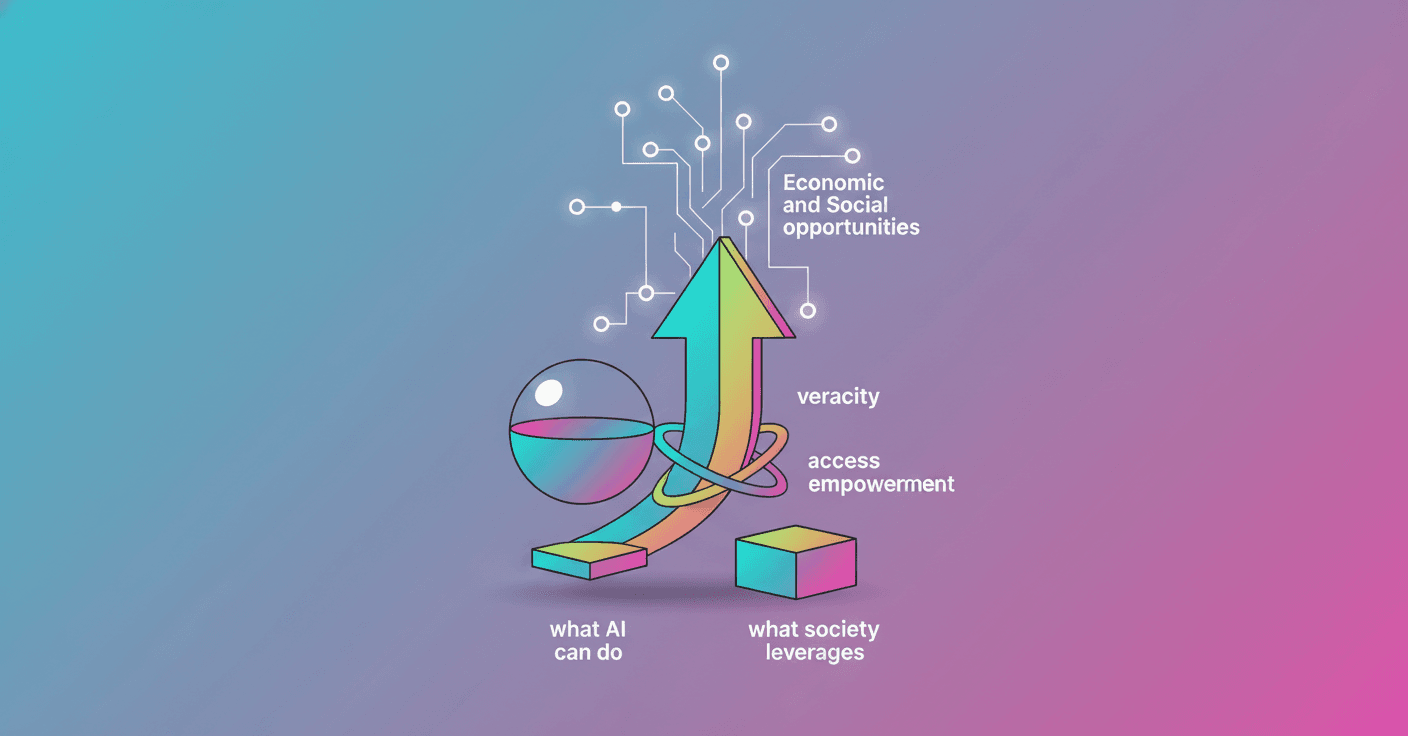
OpenAI publishes a key essay about how artificial intelligence should amplify people, not replace them. The piece introduces the concept of capability overhang: the gap between what AI systems can already do and the real value most people, businesses, and countries are capturing today.
What is the "capability overhang"?
Can you imagine a tool that can do a lot more than what we actually use it for? That's capability overhang. It's the distance between AI's technical ability and the way society adopts or takes advantage of it. In practice it means there's untapped potential: tasks AI can already solve that still don't impact the economy or your daily life.
OpenAI reminds us that AI behaves counterintuitively and surprises as it's deployed. When they launched ChatGPT three years ago, nobody expected how fast and creatively people would adopt it. Today, frontier AIs reason and act on complex tasks: from writing software to advancing mathematical research. And the interesting part? Many applications are still waiting to be discovered.
Why should you care?
Because AI isn't just a tool for experts. If you embrace it, you can multiply your productivity. OpenAI shows that an advanced ChatGPT user uses seven times more thinking capacity — and therefore seven times more compute power — than a typical user. That's not just trivia: it translates to producing work with higher economic value.
At the macro level, the stakes are high: AI can drive double-digit economic growth, improve access to effective healthcare, and speed up scientific discoveries. But all of that depends on how we manage the overhang: if it stays in the hands of a few, the gap will widen; if we manage it well, the opportunity spreads.
OpenAI's principles for managing the overhang
OpenAI proposes three practical principles so AI's capability benefits more people:
- First to Truth
In times of rapid change, truthful information creates agency.
With clear data on how AI is being used — which roles grow or shrink, where productivity gains appear — people and governments can make better decisions. OpenAI publishes public measurements that compare AI performance against humans on different tasks to help build that shared base of truth.
- Access
If AI defines economic outcomes, access to its tools and compute should be broad. OpenAI points to three paths: a free layer of ChatGPT supported by advertising, a standard API for developers, and collaborations with institutions and governments to broaden access to frontier capabilities.
- Self Empowerment
AI should put power in people's hands. That means customizable tools that serve both everyday tasks (optimizing a household budget, looking for a job, designing business ideas) and entrepreneurs who turn those capabilities into new companies and products.
What can you do today?
- Try the free tools and see how they can solve specific tasks in your life or work.
- Be curious: experiment with templates, prompts, and workflows to discover unexpected uses.
- If you work at a company, propose pilots that measure real productivity and economic gains.
- In your community or in policy, ask for clear data on adoption and labor effects; transparency helps make better decisions.
You don't need to be an engineer to benefit: often the winner is whoever explores first and adapts the tool to their context.
Final reflection
OpenAI's central idea is clear and optimistic: the Age of Intelligence can expand opportunities if we manage the gap between capability and use well. That requires honest information, broad access, and tools designed to empower you. Ready to explore what AI lets you do today?