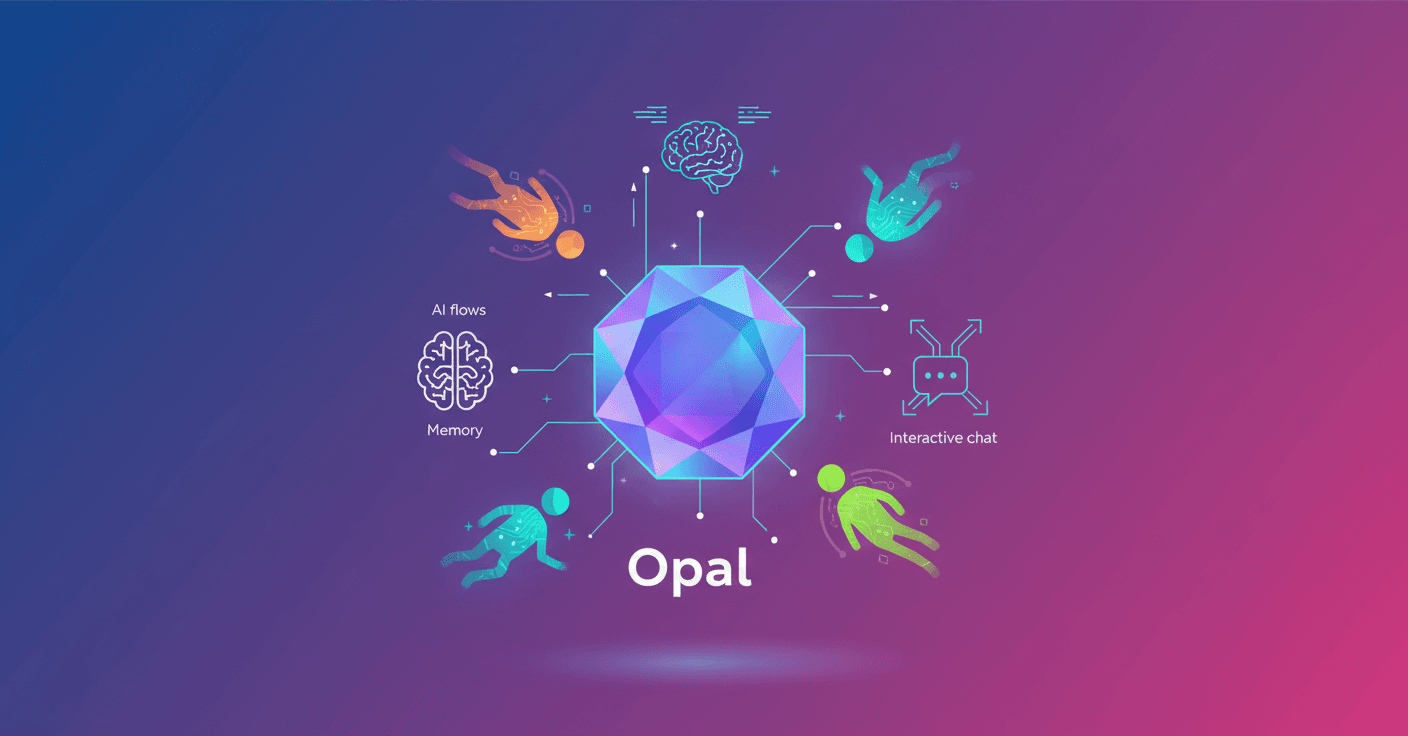
Google Labs transforms Opal: what used to be static calls to models can now be agents that decide and act for you.
Can you imagine an assistant that not only runs a model but chooses the best route to reach your goal? That’s exactly what the new generate step in Opal does: you pick an agent and it determines which tools and models it needs, from a web search to a video service, to solve complex tasks without you configuring every detail.
What changes in Opal
Before, building an Opal meant thinking in rigid steps: pick a model, define how many pages a storybook would have, or what questions to ask the user. Now the agent makes decisions in real time: it decides what information it needs, asks clarifying questions, uses tools and adapts the flow.
It’s a jump from rigid formats to interactive, unique experiences. A Visual Storyteller Opal no longer asks for a full script; its agent proposes plot points, asks what’s necessary and adjusts the story as you build it.
Practical examples
-
Room Styler: you upload a photo of your living room and describe your style. The agent generates an initial concept, asks about concrete details and refines the design. Don’t like a lamp? Tell it and the agent researches substyles to offer something more yours and less generic.
-
Visual Storyteller: instead of predefining the number of pages, the agent suggests a structure, requests specific info and creates a narrative that changes with your creative choices.
Do you see the difference? It moves from a tool that follows instructions to one that collaborates with you.
New tools that make the agent more capable
-
Memory: the Opal can remember data across sessions, like your name, your preferences or a shopping list. That makes interactions more personal and faster.
-
Dynamic routing: you define criteria and the agent decides which path to take. For example, an Opal for executive briefings can search public information for new clients or review internal notes if the client already exists.
-
Interactive chat: when information is missing, the agent asks you. It’s not a blind flow; it involves you exactly when needed to move forward.
What it means for users and creators
For users: smoother, more personalized experiences. Fewer forms, more conversation with the tool. The Opal becomes a companion that learns from you and corrects itself when needed.
For creators: a balance between control and autonomy. You can keep building fixed steps for high-precision prototypes, or let the agent explore dynamic routes when you want creativity and flexibility.
Final reflection
This advancement reduces the friction between what you want to achieve and how AI executes it. You don’t need to be an expert to benefit: the agents do the heavy lifting of choosing models and resources while you guide the objective. Ready to try Opals that act like creative partners instead of static tools?
Original source
https://blog.google/innovation-and-ai/models-and-research/google-labs/opal-agent