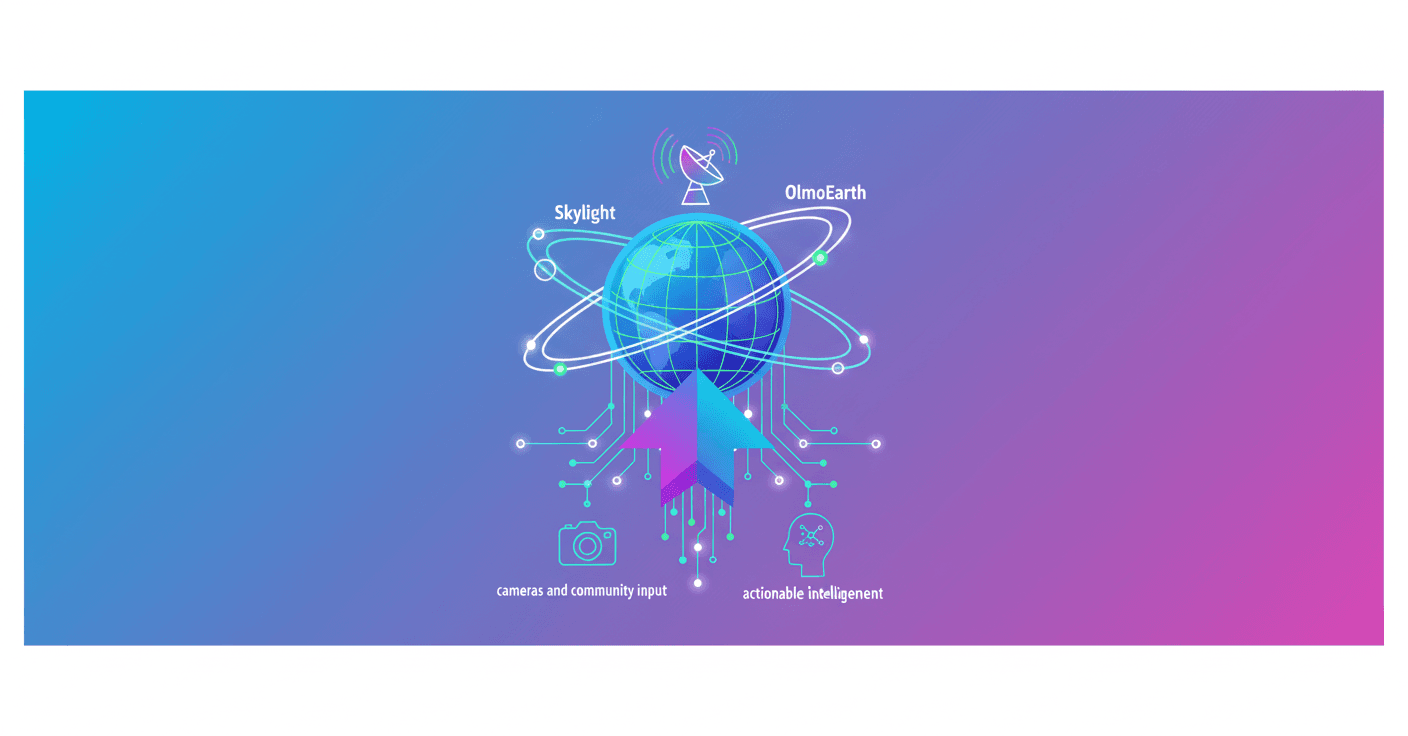
This Earth Day Ai2 celebrates ten years of bringing real-time intelligence to the people who actually need it: rangers, coastal communities, and governments that protect ecosystems. Why does it matter? Because AI shouldn't be a lab luxury — it should be in the hands of people on the ground, with data that arrives in time for action.
A decade of field operations
Ai2 turned a philanthropic conviction into operational tools at planetary scale. Today their main platforms are EarthRanger, Skylight and the OlmoEarth family of models.
-
EarthRangercoordinates protection across more than 900 protected areas in 95 countries. It's not just software: it's a network that ties cameras, sensors, and community participation together to turn alerts into responses. -
Skylightapplies that idea to the ocean, supporting nearly 150 organizations to detect vessels and illegal activity in near real time. -
OlmoEarthis the AI muscle: open foundation models that process optical images, radar and other satellite sources to produce usable intelligence in hours instead of months.
Want a concrete example? In Thailand, farmers and rangers use EarthRanger with AI-enabled cameras and a mobile app: 64 cameras across 32 farms send automatic alerts when elephants are detected. Local response teams mobilize within minutes to guide the animals back to the forest before serious damage occurs. That's information that changes decisions in real time.
OlmoEarth: the engineering behind the global view
OlmoEarth is a family of foundation models trained on terabytes of satellite data. It's multimodal: it combines optical imagery, radar (for example SAR) and ground observations for tasks like vessel detection, mapping land cover change, estimating fire risk, and spotting deforestation.
Technically, the most interesting part is the pipeline: massive data ingestion, normalization and spatial tokenization, distributed inference, and postprocessing to generate geolocated alerts. Because of that chain, what used to take months to produce maps or anomalies now gets produced in hours.
Measurable result: Global Mangrove Watch, in early access to
OlmoEarth, reported 97% accuracy and drastically reduced processing times, enabling near real-time monitoring of mangroves.
If you want technical details: these models need region-specific fine-tuning (climate, sensors and local dynamics), cross-validation with ground data, and inference-latency optimization so alerts are actually useful for operations.
Skylight: detecting vessels and changing maritime governance
The ocean brings different challenges: trackers turned off, transfers at sea, and huge distances. Skylight pioneered near real-time global detection using public satellite imagery and validated analytics. That enabled real enforcement cases.
One example: the Argentine Naval Prefecture used Skylight detection to confirm the presence of a foreign vessel in national waters. The analytics contributed to a financial sanction without needing to intercept the ship. That's a paradigm shift: sanctions based on satellite evidence and legal chains, not only patrolling.
Skylight is also expanding capabilities to detect pollution, like oil spills, and to shorten the time between an event and operational visibility.
Operational impact and technical challenges
This sounds perfect, but what technical and practical challenges are behind it?
-
Data: continuous satellite ingestion means massive data handling, sensor normalization, and quality control.
-
Latency and compute: turning terabytes into alerts in hours requires distributed inference and latency optimizations, sometimes running inference in the cloud and sometimes at the edge for cameras and mobile devices.
-
Validation and false positives: models must be calibrated by region. Human intervention remains crucial to verify and prioritize alerts.
-
Governance and ethics: responsible use of satellite imagery, community consent when there is ground data, and transparency about how evidence is used for enforcement.
-
Accessibility: opening the models (
OlmoEarth) makes it easier for NGOs and governments to fine-tune locally and reduce dependence on closed vendors.
What does this mean for communities and governments?
It means faster decisions and better information for people on the front lines. Rangers can mobilize before conflict escalates. Coastal authorities can prove illegal activity without risking vessels. Local communities can use data to defend resources like mangroves or fisheries.
Ai2 doesn't just deliver software; it delivers a data architecture, models and processes that integrate technology with human action. That's what lets you move from reaction to prevention: using spatial and historical patterns to anticipate events, not just respond to them.
Looking ahead
Next steps combine more sensors, faster models, and better legal and operational workflows. The promise is simple and demanding at once: give the people who protect nature the right information, at the right moment.
Interested in how these models work internally or how to adapt OlmoEarth to a local project? I can explain the technical pipeline, fine-tuning options, and infrastructure considerations.