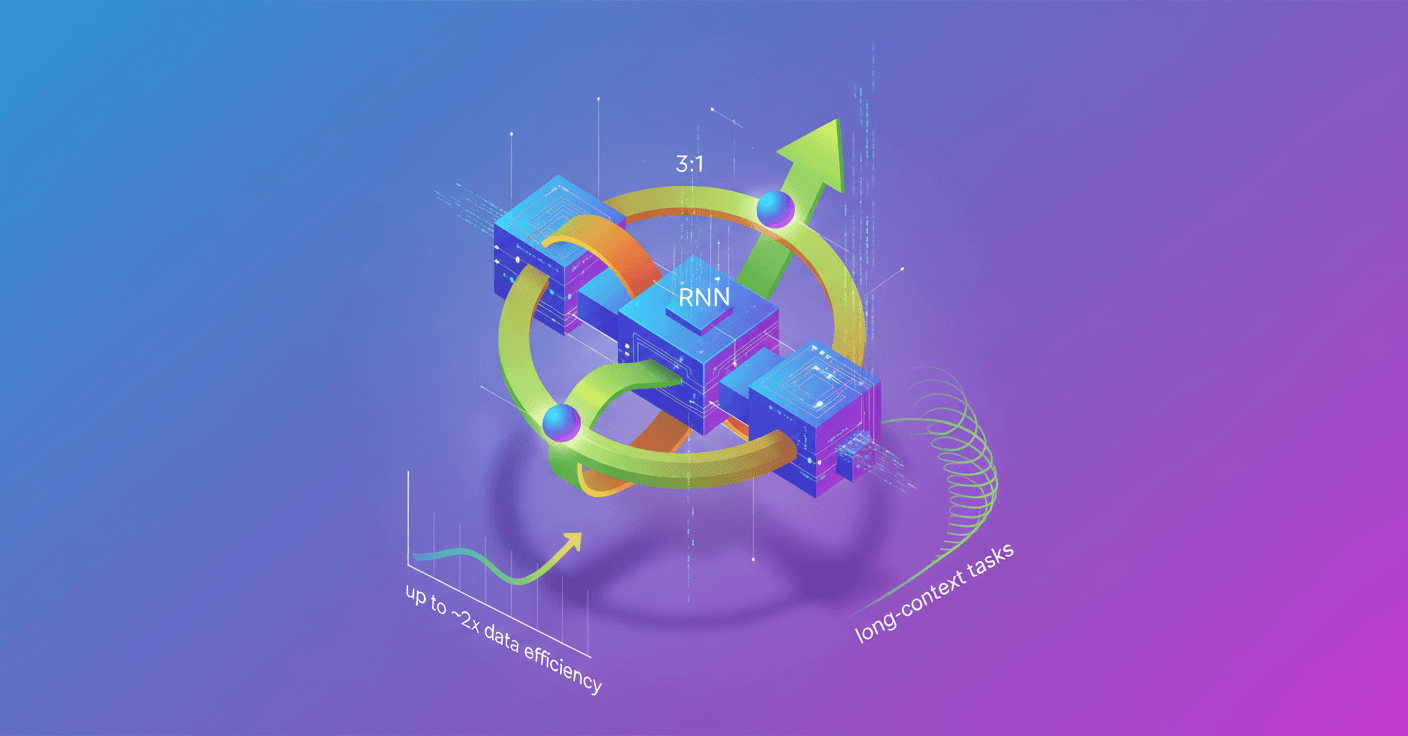
Olmo Hybrid arrives to show that mixing transformers with linear RNNs isn't just a theoretical curiosity: it's a practical path to train models that are both more expressive and more efficient with long contexts. Why does this matter? Because it promises to reduce the amount of data and compute you need to reach the same level of capability.
What is Olmo Hybrid and why it matters
Olmo Hybrid is a fully open family of 7B-parameter models that interleaves transformer layers with modern linear recurrent layers called Gated DeltaNet. The architectural recipe follows a 3:1 pattern: three DeltaNet sublayers for every multihead-attention sublayer — in other words, it replaces 75% of the mixing done by attention with recurrent state routes.
They trained Olmo Hybrid on 6 trillion tokens using the improved Olmo 3 32B data mix, in a pretraining run on 512 GPUs (starting on NVIDIA H100 and later migrating to NVIDIA HGX B200 on Lambda infrastructure). Important detail: training throughput was matched to Olmo 3, so the gains don’t come from training faster, but from the hybrid architecture.
Key results and technical metrics
-
MMLU: Olmo Hybrid reaches the same accuracy as Olmo 3 using 49% fewer tokens. That’s roughly 2x data efficiency for that target.
-
Common Crawl slice: parity with 35% fewer tokens.
-
Long-context (RULER): with long-context adaptation the gap widens. At 64k tokens, Olmo Hybrid with
DRoPEreaches 85.0 on RULER, versus 70.9 for Olmo 3 7B withYaRN. Even using the sameYaRN, the hybrid still leads (76.9). -
Domain behavior: by the end of pretraining Olmo Hybrid shows improvements on a selected suite of math and science benchmarks; early on it lags slightly on code and QA tasks, but after the midpoint of training those gaps close and the hybrid surpasses Olmo 3 across major evaluation families.
-
Additional evaluations: gains on BBH and MMLU Pro; small regressions on LBPP and DM Math in held-out benchmarks.
In short: fewer tokens = less training overhead because throughput was comparable. In practice that translates into direct compute savings to reach the same capability.
Architecture and why theory supports the results
Two pieces explain the hybrid's value:
-
Attention (transformer): direct access to any part of the context, ideal for precise recall and in-context reasoning. But compute scales quadratically with sequence length.
-
Linear RNNs like
Gated DeltaNet: they maintain a state updated token-by-token and can scale linearly with context length at inference. Modern versions are parallelizable during training, which makes them practical at scale.
The team's central observation is that a hybrid model creates complementary architectural routes: recurrent layers ease state-tracking while attention layers let you retrieve fine-grained details. Theoretically, they show hybrids are more expressive than a pure transformer or a pure linear RNN. Under an idealized scaling-law model called the quantization model, increasing expressivity reduces the fraction of subtasks that are inexpressible and therefore improves loss-reduction efficiency with data.
They also fit scaling-law curves under controlled conditions. Point estimates favor Olmo Hybrid, though statistical uncertainty prevents absolute conclusions for every coefficient. The fitted predictions indicate the token advantage grows with scale: from ~1.3x at 1B parameters to ~1.9x at 70B for a fixed loss target.
Practical implementation and training considerations
-
3:1pattern: interleaving threeGated DeltaNetsublayers per attention sublayer keeps enough attention so information doesn't get trapped solely in the recurrent state. -
Parallelization and throughput: by designing
DeltaNetto be parallelizable during training, the team achieved throughput comparable to Olmo 3 — meaning the gain comes from architecture, not a faster train run. -
Hardware and logistics: training on H100 and then on B200s (Lambda) shows the pipeline adapts to a new generation of accelerators without losing reproducibility.
-
Long-context adaptation: they tested two methods (
YaRNandDRoPE). Results show the hybrid architecture gains more in extended contexts and that the choice of adaptation method can amplify those gains.
Trade-offs and limitations
-
Not a panacea: there were small regressions on specific tasks (for example, early coding performance and some specific metrics) during intermediate phases of training.
-
Statistical uncertainty in fits: scaling-law curves favor the hybrid but with a margin of uncertainty; more scale points (for example 70B) are needed to strongly confirm projections.
-
RNN design and hybrid ratio matter: the report includes ablations on the hybrid proportion and RNN layer design that indicate not every mixture works the same.
What's next and how you can try it
The team publishes the model and a technical report covering empirical results, theoretical expressivity analysis, scaling-law fits, and implementation details (including ablations on hybrid ratio and RNN design). They also compare with other open models and explore post-training variants.
If you work on training or deployment, this suggests two practical routes:
-
If your task requires very long contexts or robust state, try a hybrid with context adaptation; you might pay fewer tokens and get better results.
-
If your pipeline depends heavily on training throughput, look at parallelizable
Gated DeltaNetimplementations so you keep speed while gaining data efficiency.
Final reflection
Olmo Hybrid doesn't just add another hybrid model to the list: it provides controlled evidence that mixing transformer and RNN architectures can translate into real pretraining gains and better long-context behavior. The practical lesson is clear: architecture matters as much as data and hardware. So, is it worth experimenting with hybrids in your projects? If you work with long contexts or seek data efficiency, the answer is probably yes.