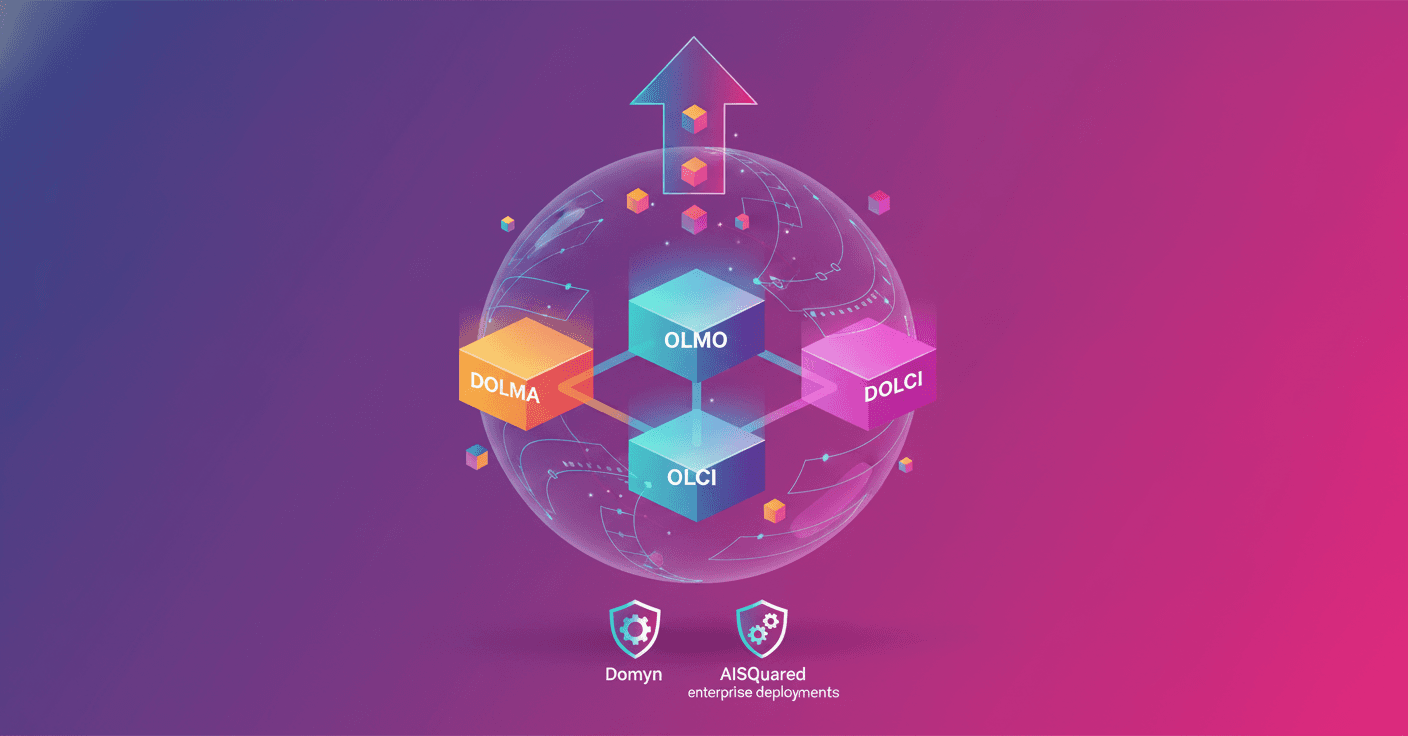
Ai2 published a set of open resources that let companies in regulated sectors build auditable, controllable models without starting from scratch. What happens when a lab gives you not only weights, but the full recipe — data, code and architecture — so you can justify every decision to compliance and auditors?
Why AISquared chose Olmo
AISquared built the Bolt family from Olmo for enterprise use cases like RAG, document processing and model routing. Bolt Instruct is fine-tuned from Olmo 2, Olmo 3 and Olmo 3.1 in 1B, 7B and 32B sizes, and their choice wasn’t accidental.
For Jacob Renn, AISquared’s cofounder, the main difference was visibility. Having full access to the architecture and training data let them trust the foundation more and avoid solutions with poorly supported architectures or costly, opaque fine-tuning processes.
"Because
Olmois fully open, we had complete visibility into its architecture and training data, giving us a higher level of confidence..."
In practice, AISquared adapted Bolt Instruct to produce structured outputs, reduce hallucinations in RAG, detect PII and jailbreak attacks, and route requests to the most efficient model inside their UNIFI platform. The result: nearly a 50% infrastructure cost reduction for AISquared, with clients seeing similar cuts.
How Domyn used Dolma and Dolci for traceability and better reasoning
Domyn released Domyn Small (10B parameters) leaning on the open datasets Dolma and Dolci. The key for Domyn was the documented provenance of those data: knowing exactly which examples entered training lets regulated organizations trace the model end-to-end.
The technical strategy was: start from Italia 10B (a model trained from scratch) and apply a multistage post-training pipeline to turn it into a reasoning model with an extended context window. Dolma contributed long, high-quality, publicly sourced data, which eased calibration against internal data and sped up procurement review for commercial deployment.
To sharpen answer accuracy, Domyn used Dolci — a dataset of roughly 260K response pairs — published alongside Olmo 3. In reasoning benchmarks like GPQA-Diamond, Dolci boosted Domyn Small by 10.1 points, the single largest improvement in their post-training pipeline.
What makes Ai2's openness different for regulated clients
The bar in finance, healthcare or government isn’t just performance: it’s auditability, traceability and clear licensing. The EU, for example, raises those demands with the AI Act, which asks for detailed summaries of training data. In the U.S., federal contracts and internal compliance policies require proof of origin and license permissions.
Ai2 offers the full stack: models with open weights, datasets with documented sources and permissive licenses. That lets labs like Domyn and AISquared build:
- Direct traceability from data to inference.
- Reproducible workflows for audit and verification.
- Adjustments and relicensing for clients that require sovereignty and control.
The upstream openness feeds compliance artifacts downstream. For regulated clients, that’s not just a technical advantage: it’s a business requirement.
Practical implications for engineering teams and compliance officers
If you work on a team that has to justify models to auditors, keep in mind:
- Ask for datasets with source documentation and cleaning processes. Don’t accept a "web crawl" without traceability.
- Value models that deliver the full flow (weights, code, architecture). It makes debugging, auditing and adaptation easier.
- Consider total cost: well-supported open models can cut operational latency and hosting costs, as AISquared showed.
- Use relevant benchmarks (for example GPQA-Diamond for advanced reasoning) and record gains after each post-training phase.
Final reflection
This isn’t an academic debate: Ai2’s practical openness shows you can combine technical capability with regulatory demands. For organizations that need accountability, adaptability and risk reduction, having the model "recipe" is as important as having the top benchmark score.