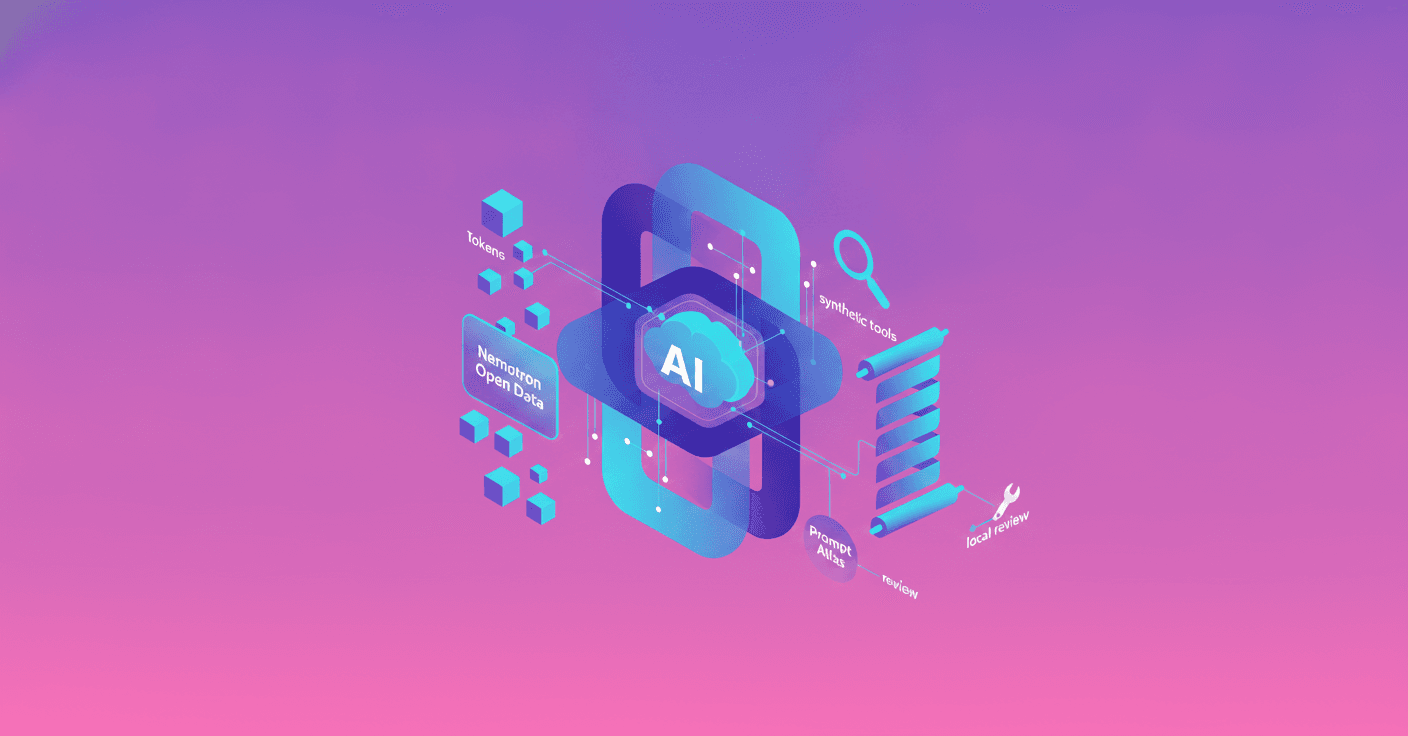
Building AI agents that work in the real world is much more than fine-tuning weights. Have you seen a model freeze when an API fails or stumble on a new routine? That’s not an agent — it’s an autocompleter with tools. NVIDIA wants to change that by putting open data, inspection tools, and well-documented synthetic data at the center of the problem.
What does Nemotron Open Data bring and why does it matter?
NVIDIA published a massive collection: over 10 trillion pretraining tokens and millions of post-training samples. That already sounds like volume, but the point isn’t just quantity. It’s about being able to understand what’s inside those data, how they were mixed, and why an agent learns certain behaviors.
To make it tangible, they released the Nemotron Post-Training v3 Prompt Atlas, an interactive embedding visualization where each point is a prompt sample from the post-training set. The visualization is volume-sampled, meaning it reflects the real proportions of the data mix to avoid misleading impressions about the distribution.
What can you do with the atlas?
- Explore semantic clusters: code, reasoning, safety, agentic behavior.
- Filter by dataset, pipeline stage, domain, or tool usage.
- Inspect representative examples to curate data, build evaluations, or trace why an agent acts a certain way.
Synthetic data and personas: Nemotron-Personas and NeMo Data Designer
NVIDIA also publishes synthetic datasets designed to help agents understand real users without exposing sensitive data. Nemotron-Personas generates synthetic personas that reflect official demographic and geographic statistics. It’s not about recreating individuals, but about ensuring your tests cover languages, occupations, and local patterns.
This is built with NeMo Data Designer, a compound-AI tool for synthetic generation. Why is that useful? Because many valuable signals live inside companies that can’t publish their data. Synthetic outputs let you preserve useful signals without leaking secrets.
Reproducibility, transparency and the idea of "synthetic thresholds"
Opening weights is important, but it’s not enough. An agent’s reproducibility depends on the data, curation decisions, training recipes, and evaluation metrics. NVIDIA emphasizes that agentic behavior must be inspectable. If a model calls tools, runs flows, and retrieves information, developers need to understand the source of those behaviors.
They introduce the concept of synthetic thresholds, points where data stops being treated as fully real. It’s a useful mental tool to document:
- What was generated synthetically.
- What was anchored to real data.
- What was human-reviewed.
- What was used to evaluate faults and recovery.
Generating examples isn’t enough. You must document them, draw the line between synthetic and real, and assess the associated risks.
Local quality, evaluation and metrics for agents
Data quality for agents isn’t universal. A toxicity classifier trained in English can fail in Korean or Japanese, where hostility can be encoded through levels of politeness. That’s why local review is key: natives, subject-matter experts and communities should participate in validation.
In a technical context, think about these metrics and criteria:
- Task coverage and diversity of flows.
- Success rate on multi-step tasks and recovery paths.
- Coverage of tool failures and error handling.
- Distributional fidelity for personas and regionalities.
- Safety evaluations: bias and toxicity detection by language and region.
- Traceability and lineage: a record of how each sample was generated.
These aren’t just numbers. They’re guides to design datasets that enable robust, explainable agents.
Practical use: how to leverage Nemotron if you build agents
- Use the Prompt Atlas to locate clusters relevant to your flows and extract representative examples.
- Design recovery tests: create intentional tool failures and measure the agent’s ability to recover.
- Integrate Nemotron-Personas to test regional coverage and assess cultural biases in interactions.
- Document synthetic parts with tags, versions and human-review processes.
- Measure not only accuracy, but behavior under failure and transparency of decisions.
What does this change for the community and industry?
NVIDIA shows that sharing synthetic data and inspection tools makes collaboration between companies, governments and academia easier without forcing anyone to reveal trade secrets. That collaboration improves data diversity, and that reduces the chance that all models end up feeling the same.
Plus, the academic community is already using Nemotron: about 145 ICML papers cite Nemotron models and datasets, showing research impact.
Opening data isn’t a magic solution. It’s part of an ecosystem that requires curation, documentation, local review and agent-oriented metrics. But it’s a concrete step toward more robust, inspectable and useful agents.
Final reflection
If you work on agents, the lesson is clear: invest in data as much as in models. Use visualizations like the Prompt Atlas to understand what your agent is learning. Integrate synthetic data carefully, document and review locally. The real scarcity isn’t tokens; it’s trust between organizations. Well-made open data can be one of the few tools to build it.