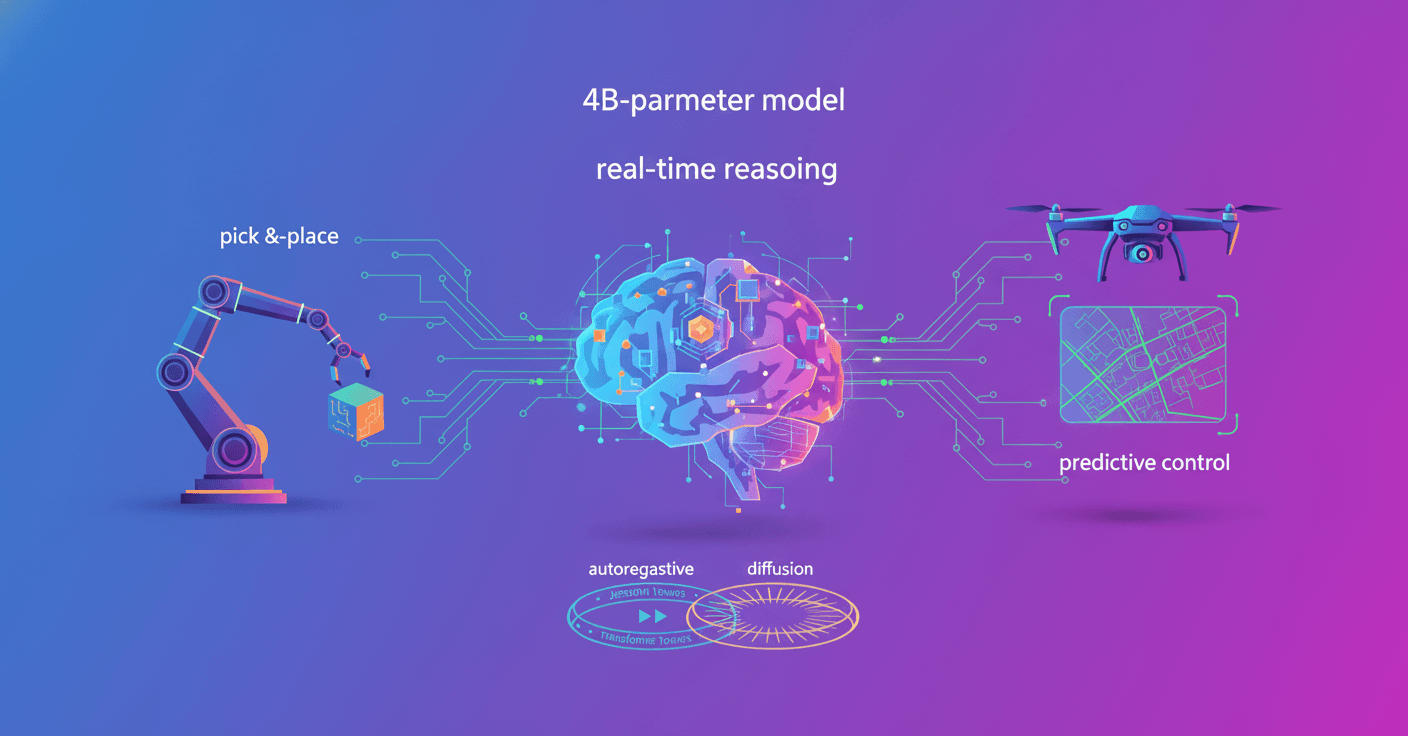
NVIDIA introduces Cosmos 3 Edge, a 4-billion-parameter open-world model designed so robots and vision agents can reason and act in real time directly on edge devices. Why does it matter? Because now you can bring data-center-level capability to systems with limited memory, from factories to hospitals.
What is Cosmos 3 Edge
Cosmos 3 Edge is a compact, open model that works both as a vision language model (VLM) and as a world action model (WAM). It’s built to run highly efficient, high-performance inference on NVIDIA edge hardware: RTX PRO, DGX, GeForce RTX and the Jetson family (including Jetson T2000 and T3000 modules).
You can download the model here: https://huggingface.co/nvidia/Cosmos3-Edge
Architecture and technical design
Cosmos 3 combines two transformer-style towers that work together but have different roles:
- Autoregressive tower: processes vision and text tokens to understand and reason. It uses causal attention for language.
- Diffusion tower: processes vision, audio and action tokens to predict, generate and simulate. Its attention pattern is broader to support coherent prediction.
Each tower keeps its own normalization layers and MLPs, but they share multimodal attention layers that align information across text, video, audio and actions. That design lets the system first reason about the scene and then generate outputs (reasoning tokens from the autoregressive tower or denoised video/action from the diffusion tower).
Actions and representation: Cosmos 3 maps different ways of describing action (ego pose, camera movement, end-effector pose, grip state) to a compact geometric vector that encodes:
- Translation
- Rotation
- Manipulation state
That representation connects control and visual structure directly, so pixel changes tie to physical motion and control inputs.
Performance, metrics and relevant examples
- Operational observation resolution:
640x360at a robotic control level. - Action generation: up to
32actions per inference onJetson Thorand real-time control at15 Hz. - Benchmark: among similar 4B-parameter models, Cosmos 3 Edge ranks first in VANTAGE-Bench for vision analysis and sets state of the art in robotic policy learning.
NVIDIA also publishes a post-trained policy called Cosmos 3 Edge Policy (DROID) trained on the DROID dataset for pick-and-place tasks, along with post-training scripts.
To fine-tune the model before deploying to the edge, it’s recommended to use a small cluster of H100 or a DGX Station for efficient post-training. Reference checkpoints and training recipes are also released to adapt Cosmos 3 to specific workloads.
Distillation and acceleration
NVIDIA also releases the Cosmos 3 Super 4-Step checkpoint and post-training scripts. This is a distillation that reduces denoise steps from 35–50 to just 4, achieving up to 25x inference acceleration while keeping image and video quality. It’s a practical reference if you need very fast image or video generation in production.
There’s also work on optimizations with open inference frameworks like vLLM to reduce latency and memory use across different hardware.
Use cases and practical flow
Imagine a robot in a kitchen: recognizing the banana is just the start. With Cosmos 3 Edge the system can infer where the banana is, predict how the effector will move, simulate the result of a grasp and generate the action to put it on the plate. Input: current state; Output: expected action and its visual consequence.
This opens concrete possibilities:
- Manipulation and pick-and-place in logistics and manufacturing.
- Vision agents that simulate next frames for predictive control.
- Training robust policies using data simulated by the model itself.
Recommendations for developers
- Evaluate
Cosmos3-Edgeon your validation dataset to measure latency and vision/policy accuracy. - If you need better behavior in a specific domain, perform post-training using H100 GPUs or DGX.
- For low-latency deployment, consider distilling with
Cosmos 3 Super 4-Stepand optimizing checkpoints withvLLMor other inference frameworks. - Always measure control frequency (Hz), memory consumption and success rates on the real physical task.
- Keep safety and robustness in mind: validate generated actions in simulation before sending commands to real hardware.
Final reflection
Cosmos 3 Edge brings world modeling and action closer to the device, combining understanding, prediction and control in a single efficient model. Is it magic? Not really — it’s engineering so physical agents can reason and act with low latency and fewer resources. If you work in robotics or smart infrastructure, this gives you an open, practical starting point to build more realistic policies and simulations.