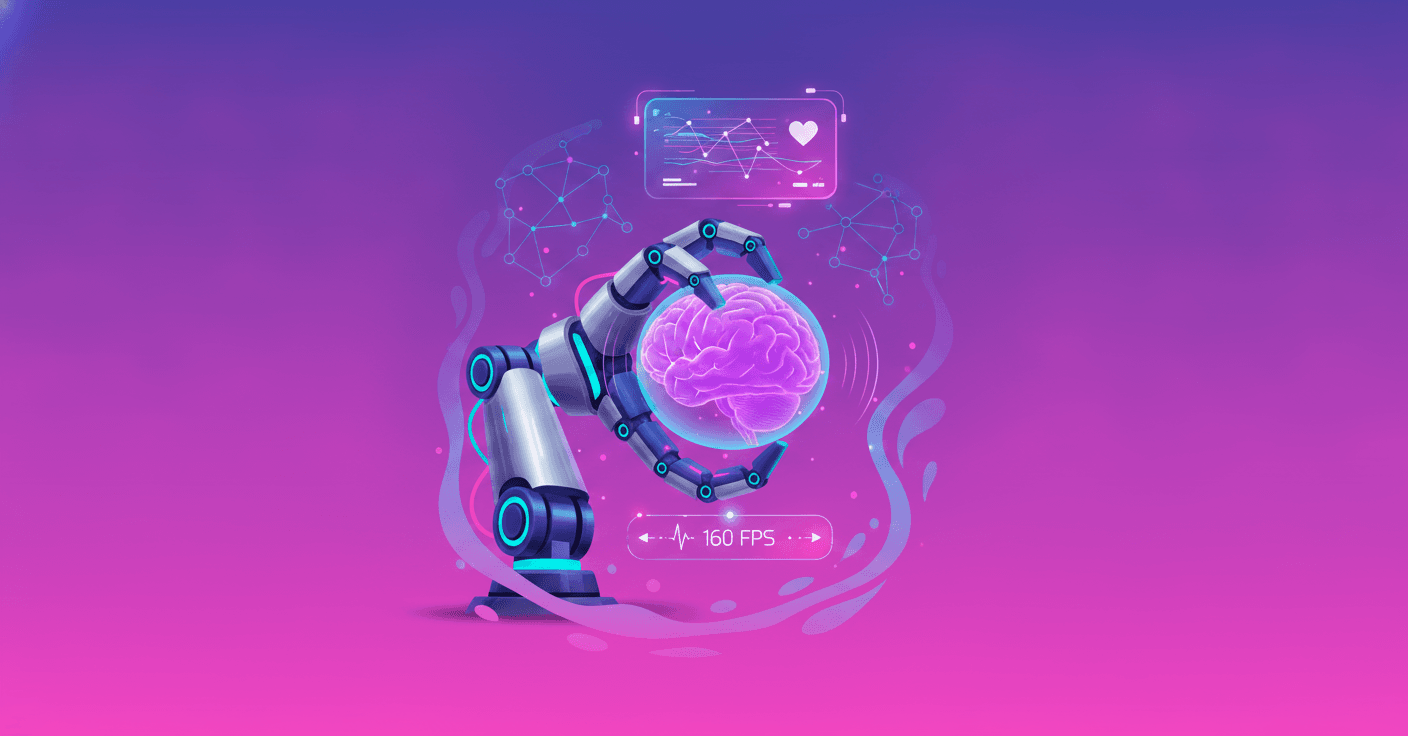
Cosmos-H-Dreams is the next iteration of generative simulation that turns world models into interactive environments for surgical robotics. Can you imagine testing a suturing policy without touching a single physical robot and with human-level latency? This makes it possible by combining distillation, accelerated inference and a causal architecture designed for streaming.
Qué es Cosmos-H-Dreams y por qué importa
Cosmos-H-Dreams takes what was learned from Cosmos-H-Surgical-Simulator and turns it into a causal student model that can generate surgical video in real time, conditioned on robot actions. The key point: it's no longer just about producing offline rollouts to evaluate policies; now you can control the simulator in a closed loop from a person, a VR controller, or a learned policy.
The reference architecture starts with a teacher based on Cosmos-Predict2.5-2B, post-trained on the Open-H-Embodiment dataset. That teacher generates bidirectional rollouts and learns a unified 44-dimensional action representation. Then it is distilled into a causal student that operates autoregressively and supports low-latency inference.
Componentes técnicos principales
-
Teacher: it began from the Cosmos-H-Surgical-Simulator checkpoint and was fine-tuned on the JHU dVRK tabletop mix, which includes successful demonstrations and failure episodes (needle drops, failed knots). Including failures in the dataset is critical so the simulator reproduces real consequences of bad actions.
-
Action representation: dual-arm dVRK (relative translation of the end-effector, rotation and gripper state) mapped to the teacher's common 44-dimensional representation.
-
Temporal progression in training: the teacher is trained by progressively increasing temporal length, starting at horizons of 12 frames up to 72 frames, reusing pretrained weights at each stage to stabilize learning on long rollouts.
-
Denoising and caching: the teacher's denoising trajectories are precomputed and cached to train the student with realistic, efficient data.
Distilación y estabilidad en rollouts largos
Autoregressive models suffer from the mismatch between training (clean context) and deployment (context generated by the model itself). Cosmos-H-Dreams uses a strategy called self-forcing distillation:
- The student generates its own context during training.
- A frozen teacher evaluates and provides distribution-matching supervision on those self-generated rollouts.
This prepares the student for real interactive inference conditions and reduces error accumulation.
Additionally, the student supports few-step diffusion: it works with as few as two denoising steps per latent frame, instead of the teacher's tens of steps, which speeds up generation while keeping surgical priors.
Rendimiento y serving: FlashDreams
Distillation alone is not enough; you need to serve the model with very low latency. That's where FlashDreams comes in—the accelerated inference library for autoregressive world and video models.
Key optimizations in FlashDreams:
- Streaming KV cache for causal attention.
- CUDA Graph capture to reduce per-step overhead.
- Model compilation and memory optimizations.
The result is a performance leap: from roughly 10 fps in the standard version to about 160 fps on a single NVIDIA RTX PRO 6000. That enables smooth interaction with human control and real-time policies.
Integraciones y clientes
Cosmos-H-Dreams already demonstrated integration with real platforms: it specialized in dVRK tabletop suturing and connected to the Versius controller from CMR Surgical and Cambridge Consultants. It supports multiple interfaces:
- Browser client: keyboard commands and frame streaming via WebRTC.
- Meta Quest: mapping controllers to the action space and viewing through WebXR.
- Closed loops with learned policies: generated observations and predicted actions can be swapped to train or evaluate without physical hardware.
Para entrenar tu propio student
NVIDIA publishes a full recipe: teacher fine-tuning and a self-forcing distillation pipeline. The idea is to reuse multi-embodiment priors and specialize the student for your robot and dataset, keeping the causal structure and streaming infrastructure.
Qué medir ahora: nuevos benchmarks necesarios
Pretty video is not enough for a useful surgical simulator. Proposed metrics to evaluate systems like Cosmos-H-Dreams include:
- Tool-tip reach and pose accuracy.
- Gripper cycle fidelity.
- Stability in idle state.
- Diversity of counterfactual actions.
- Drift in long-horizon rollouts.
- Agreement between simulation outcomes and the physical robot.
Those benchmarks tell you whether the conclusions you draw in simulation will transfer to the real world.
Aplicaciones y límites éticos
Cosmos-H-Dreams is a research and development platform: it generates synthetic data, trains policies, simulates rare failures on demand and explores applications like latency-aware telesurgery, interactive trials and planning support. It is not, and should not be, a diagnostic system, a replacement for intraoperative imaging, or a controller for real robots.
A real-time simulator can reduce the need for physical hardware for experiments and speed up research iterations, but it requires rigorous validation before any clinical use.
Reflexión final
This piece of engineering brings world models, advanced distillation and runtime optimization together to move surgical simulation from offline to interactive. What does that mean for researchers, engineers and surgical trainers? Faster experimentation, more synthetic data and reproducible environments that help you iterate without relying on scarce robot access. The challenge now is to close the gap between visual fidelity and physical fidelity, and to build benchmarks that measure what really matters.