Meta is returning to the open-model space with Muse Glimmer, a multimodal artificial intelligence with 30 billion parameters that can run locally, use tools, analyze images and videos, write code, and work as an autonomous agent.
The proposal is interesting for one specific reason: it does more than chat. Muse Glimmer can observe a screen, call a weather API, detect objects in an image, answer questions about a video, and help deploy a quantized version of itself. Are we looking at futuristic AI? Not exactly. The difference is that several of these capabilities can now run on computers and servers under the user’s control.
A multimodal model designed for agents
Muse Glimmer combines a visual encoder with 2 billion parameters and a text decoder with 28 billion. The same visual component processes images and videos, while the language model interprets instructions, reasons, and produces structured responses.
Its architecture includes 52 layers organized in a hybrid pattern: three attention layers with a sliding window of 2,048 tokens and a fourth layer with global attention. This sequence is repeated 13 times.
In simple terms, local attention makes it possible to process context while using less memory, while global attention helps connect distant pieces of information. The model also uses Grouped-Query Attention, where each key and value is shared among 16 query heads. According to Meta, this reduces KV cache memory usage 16-fold and can speed up generation.
The architecture adds Q-K normalization and additional query scaling to keep the values used in attention stable. These are technical details you may not notice while chatting with the model, but they affect inference speed, memory usage, and stability.
Images and videos
The visual encoder has 50 layers and uses spatial attention with 2D RoPE. Then, a pixel shuffle process groups neighboring tokens and reduces the number of visual tokens fourfold without removing their information channels.
For videos, the processor works with approximately two frames per second and supports up to 96 frames distributed throughout the clip. It also inserts timestamps into the input, allowing a response to be connected to specific moments in the video.
For example, you can ask it to describe what happens in a recording without audio or identify an object inside an image and return its coordinates in a structured format.
Results compared with other open models
Meta and Hugging Face published comparative results against Gemma4-31B in reasoning mode and Qwen3.6-27B, also in reasoning mode. The figures correspond to the results published for each model, so they should not be interpreted as a universal test under identical conditions.
Muse Glimmer achieved particularly strong results in several agent and programming tasks:
- MCP Atlas: 75.5 compared with 54.2 for Gemma4 and 62.5 for Qwen.
- DeepSearch QA: 74.6 compared with 61.7 and 71.1.
- SWE-Bench Pro: 51.2 compared with 36.9 and 50.2.
- SWE-Bench Verified: 76.0 compared with 66.6 and 77.2.
- SciCode: 43.6 compared with 43.4 and 39.8.
- AIME 2026: 94.7 compared with 89.2 and 94.1.
- AA-LCR: 80.0 compared with 68.3 and 73.3.
In other tests, it did not come in first. Qwen achieved better results in OSWorld-Verified, SkillsBench, TerminalBench 2.1, and several multimodal evaluations. Gemma4 outperformed Muse Glimmer on GPQA Diamond and Humanity's Last Exam without tools.
The most balanced interpretation is this: Muse Glimmer appears competitive in programming, tool use, reasoning, and some multimodal tasks, but it does not dominate every scenario. As always, the benchmark that matters is the one that resembles your real work.
Support from day one
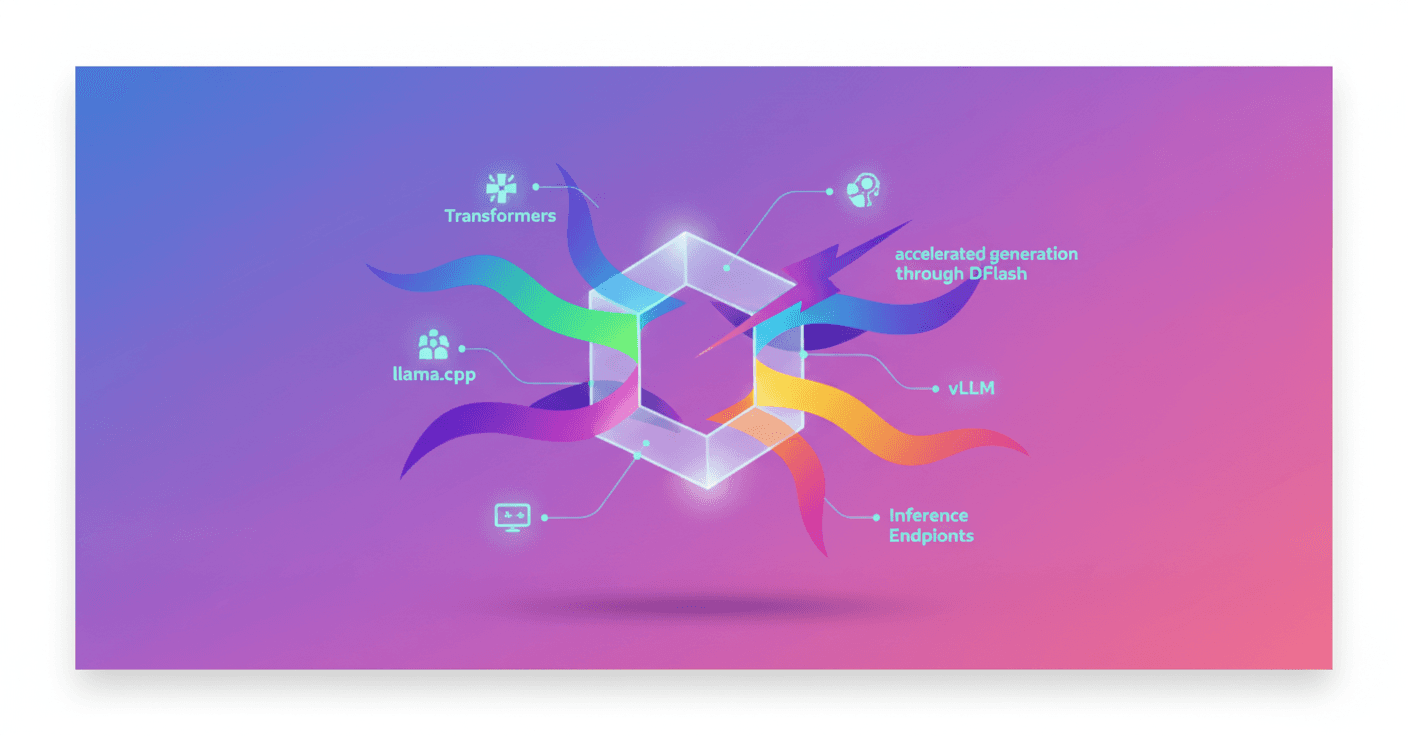
The model arrives with initial support for several tools in the open AI ecosystem:
transformersllama.cppvLLM- Hugging Face Inference Endpoints
- TRL for fine-tuning and training
In transformers, it can be loaded with AutoModelForMultimodalLM and AutoProcessor. The same configuration with device_map="auto" can distribute the model across compatible NVIDIA, AMD, or Intel accelerators.
To get started with the reference implementation, Hugging Face recommends updating the dependencies:
pip install --upgrade transformers accelerate torchvision torchcodec
The basic loading process looks like this:
from transformers import AutoProcessor, AutoModelForMultimodalLM

MODEL_ID = "meta/Muse-Glimmer-30B"

processor = AutoProcessor.from_pretrained(MODEL_ID)
model = AutoModelForMultimodalLM.from_pretrained(
    MODEL_ID,
    dtype="auto",
    device_map="auto"
)
With the processor, you can apply a conversation template and send text, images, or videos. The model also supports tool calls through function-compatible schemas, such as a weather.get API that receives the name of a city.
Faster generation with DFlash
Muse Glimmer includes an optional auxiliary model for speculative decoding, implemented with DFlash. The idea is for a smaller model to propose several future tokens and for the main model to verify them. When the proposals match what the larger model would have generated, more tokens can be produced in fewer steps.
The DFlash block uses an anchor and up to 15 proposed tokens. Its benefit depends on the hardware, the type of request, and how many proposals are accepted. Meta notes that it works especially well with structured content, such as code.
This technique does not necessarily change the final response. Its main goal is to reduce generation latency, although it requires additional memory to load the auxiliary model.
How much memory do you need?
Muse Glimmer is not small. For inference and evaluation in bfloat16, the documentation lists at least one 80 GB H100 GPU. For a LoRA fine-tuning run in the same format, it also mentions an 80 GB H100 with a microbatch size of one and activation checkpointing.
Full fine-tuning requires approximately eight 80 GB H100s using FSDP or ZeRO-3. For GRPO with LoRA, one GPU may be enough in tightly constrained scenarios, although with little headroom and lower speed. A more practical setup separates generation and training tasks across eight H100s.
This means that “local” does not equal “runs comfortably on any computer.” Quantized versions can reduce consumption, but the full model is still aimed at powerful workstations and servers.
An assistant that can deploy itself
The most striking part of the demonstration is not limited to the benchmarks. Hugging Face shows Muse Glimmer connected to agents such as OpenClaw, the Hugging Face MCP server, and command-line tools.
With the right instructions, the agent can:
- Search the Hub for compatible weights.
- Choose or create a
GGUFversion, usuallyQ4_K_M. - Convert and quantize the weights.
- Launch
llama-serverwith an OpenAI-compatible API. - Check the
/v1/modelsand/v1/chat/completionsendpoints. - Deploy the model on Hugging Face Inference Endpoints.
- Test inference configurations on an H100.
Here, it is worth separating the model’s capabilities from the automation around it. Muse Glimmer does not perform these tasks by magic: it needs permissions, credentials, access to tools, and explicit rules explaining how to inspect hardware, modify files, start services, and validate results.
That distinction matters. An agent with access to a terminal and external services can be very useful, but it can also cause problems if the instructions are ambiguous or if there are no limits on its actions.
An alternative for technical teams and entrepreneurs
With llama.cpp, Muse Glimmer can run using GGUF weights and be exposed as a local server with a web interface or an OpenAI-compatible API. With vLLM, it can handle requests across multiple GPUs through tensor parallelism.
For a startup, this opens up several possibilities: analyzing private documents without sending them to an external provider, building internal assistants with vision, automating programming tasks, or connecting an agent to business tools.
For an individual user, the appeal lies in privacy and control. But before downloading it, it is worth checking three things: the available memory, the quantized format you will use, and the actual speed you need. A large model that responds slowly may be less useful than a smaller, more agile one.
Muse Glimmer represents a clear direction for open AI: models capable of seeing, reasoning, programming, and acting, while running on infrastructure the user can manage. It still requires considerable hardware and careful configuration, but the barrier between chatbot and operational assistant continues to shrink.
The question is no longer just what an AI can answer. It also matters what tools it can use, what actions it can verify, and within what limits it can operate. In that area, Muse Glimmer is as interesting for its architecture as it is for the ecosystem around it.