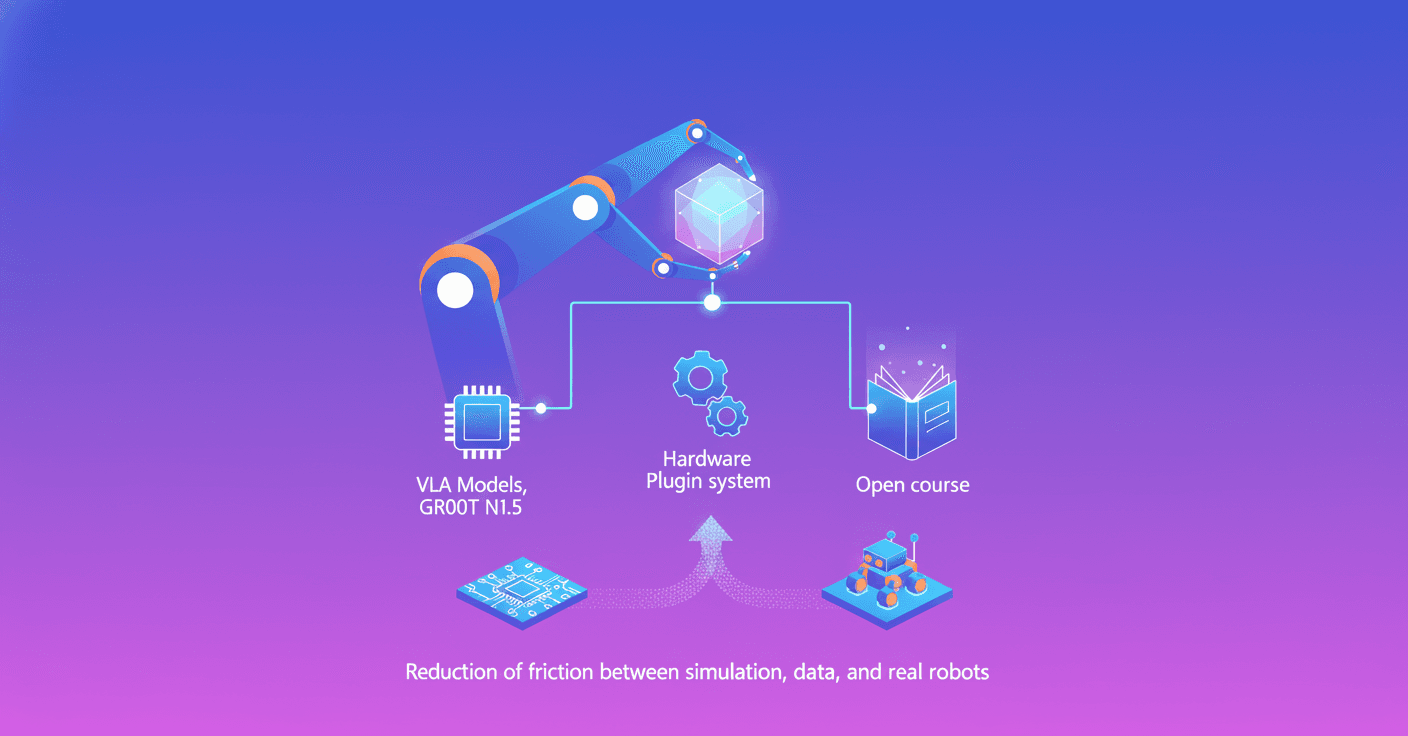
The LeRobot update arrives to shake up the open robotics ecosystem. Can you imagine training policies on datasets of hundreds of gigabytes without waiting hours while everything loads? LeRobot v0.4.0 aims for that: more data, more models, and less friction between simulator, model, and real robot.
The essentials in a few lines
LeRobot v0.4.0 is a big upgrade for Hugging Face's robotics platform: it brings Datasets v3.0 with support for chunked and streaming episodes, integrates VLA models like PI0.5 and GR00T N1.5, adds a plugin system for hardware, and launches a new training pathway with an open course on robot learning. (huggingface.co)
Datasets v3.0: data at real scale
If you've ever worked with camera recordings, sensors, and actions, you know the bottleneck isn't just training — it's handling the data. LeRobotDataset v3.0 introduces chunked episodes and streaming designed for OXE-scale datasets, meaning they support gigantic collections and optimize loading and memory. That translates to less time waiting for initialization and more time experimenting. (huggingface.co)
Also, metadata now lives in unified Parquet files instead of thousands of scattered JSONs. If you already have data in v2.1, there are conversion scripts to migrate to v3.0 without drama.
Simulators and benchmarks: LIBERO and Meta-World
LeRobot expands support to key benchmarks: LIBERO, with over 130 Vision-Language-Action tasks, and Meta-World, with dozens of multi-object manipulation tasks. What does that mean for you? The ability to evaluate general policies in richer, more comparable scenarios across teams. (huggingface.co)
Models and policies: PI0, PI0.5 and GR00T N1.5
Integrating the pi0 and pi0.5 policies brings VLA models to the ecosystem that aim to generalize to new worlds, trained on heterogeneous multimodal data. Meanwhile, the arrival of GR00T N1.5, in collaboration with NVIDIA, provides a cross-embodiment foundation model for more general reasoning and manipulation. In practice this makes it easier to experiment with policies that understand language instructions and vision, and transfer skills between different robots. (huggingface.co)
Code and pipeline: processors and multi-GPU
Moving data from robot to model is no longer a puzzle: Processors act as a modular pipeline where each ProcessorStep normalizes, tokenizes, moves tensors to the GPU, and leaves everything ready for inference or real-time control. There are two flavors: PolicyProcessorPipeline for batching and RobotProcessorPipeline for point-to-point control.
If you need to scale training, LeRobot integrates Accelerate to launch experiments easily on multi-GPU with a single command. That dramatically reduces experiment times when you move from 1 to 2+ GPUs. (huggingface.co)
Hardware and teleoperation: plugins and Reachy 2
Do you have your own hardware or want to connect a camera or a teleoperator? The new plugin system lets you package integrations as independent Python packages and add them with pip install without touching the library core. This makes community contributions easier and prevents the main library from becoming bloated.
As an immediate example, LeRobot already supports Reachy 2 for real and simulated control. They also added examples to teleoperate an arm from your phone, using the RobotProcessor to transform actions across different spaces. That opens doors to quick demos and prototypes where the human interface is just a mobile device. (huggingface.co)
Course and tutorials: learn by doing
Hugging Face launched an open, self-guided robot learning course covering everything from classical fundamentals to modern techniques like generative models for imitation learning and RL applied to robots. They also published a deep tutorial with ready-to-use examples in LeRobot and a Space with executable notebooks. If you're curious or training a team, this is a solid gateway. (huggingface.co)
Why does this matter for you?
Because the barrier between researching and building practical prototypes gets lower. If you're a researcher, you spend less time on infrastructure. If you're a developer or founder, you can iterate faster on demos and proofs of concept. And if you're a student or teacher, there are more open resources to teach robot learning with real examples.
And the risks? As always, when tools make powerful hardware and models more accessible, you need good practices: test in simulation before running in the real world, validate safety in teleoperation, and protect sensitive data when working with cameras or audio.
To get started now
- Check the announcement and docs to upgrade to
lerobot v0.4.0. (huggingface.co) - Try the conversion to Datasets
v3.0if you handle large collections. - Explore the
pi0.5andGR00T-N1.5models on the Hub to understand their behavior on VLA tasks. - If you have hardware, see how to create a plugin to integrate it without touching the core.
In the end, LeRobot v0.4.0 feels like an invitation: less friction to experiment and more ready-made pieces for the community to build on. Are you up for connecting your next robot and telling us what happens?