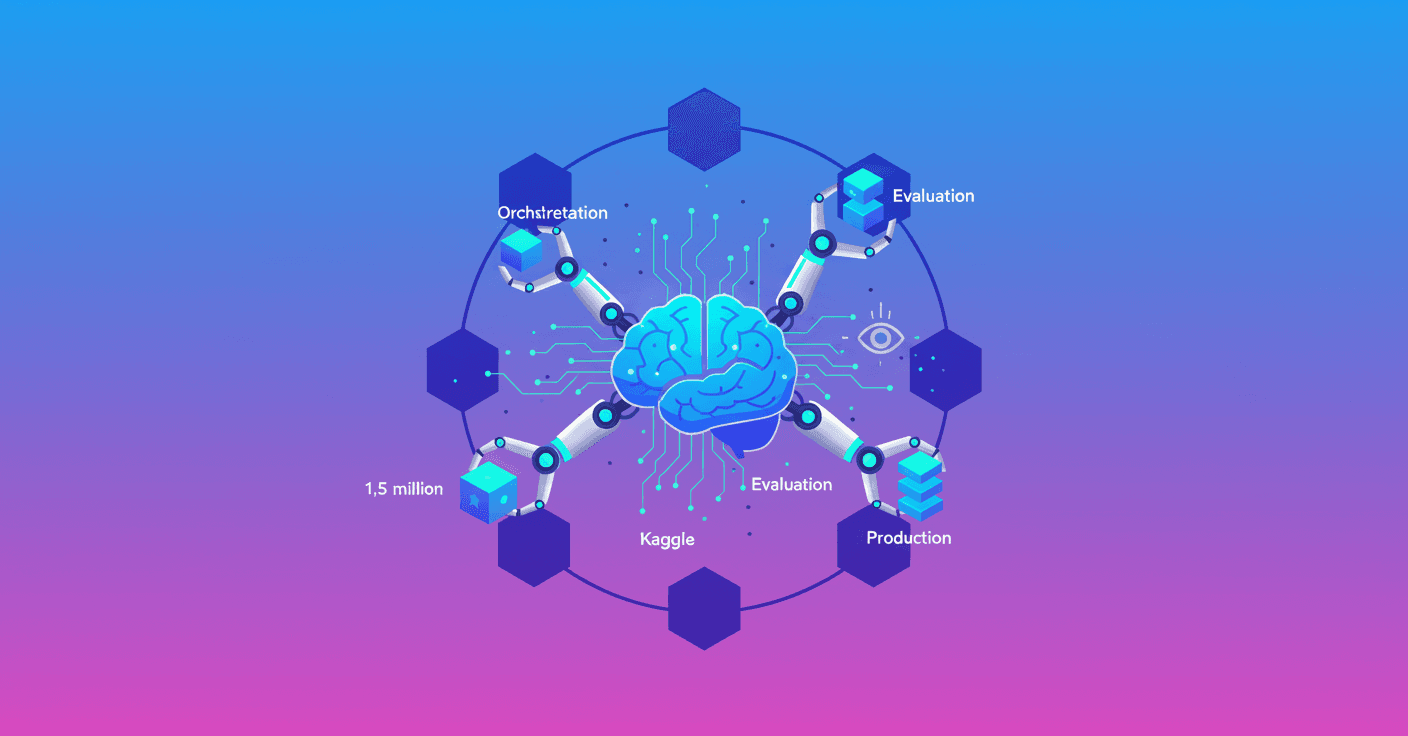
Kaggle and Google put into practice what many call the next step of AI: agents that not only converse, but reason, plan and act. Can you imagine an online class that combined theory, notebooks and real projects with more than 1.5 million participants? That was exactly what happened in the 5-Day AI Agents Intensive.
What the intensive covered
The course built on the foundations of the previous GenAI intensive and focused on the practical realities of AI agents. It wasn't just theory: there were technical sessions with leaders from Google, Cohere, Reified and NVIDIA, and a strong emphasis on architectural decisions and production best practices.
- How agents work: modeling reasoning, planning and action execution.
- Integrating
LLMwith external tools and orchestrators to execute real-world tasks. - Architectural patterns for monolithic agents and
multi-agentsetups.
The goal was clear: teach how to move from a conversational prototype to systems that make decisions, manage state and work with APIs or simulated environments.
Reach and participation data
The impact was huge and measurable. Here are some relevant figures:
- 1.5 million learners in total.
- 160,000 active participants in Kaggle's Discord.
- 2 million views on the course whitepapers.
- 3.3 million views on the technical notebooks.
- More than 11,000 capstone project proposals.
These metrics don't just show curiosity; they show a community ready to build real solutions.
Technical aspects relevant to developers
If you're a developer or engineer, here are the practical parts that matter most.
- Core of the agent
- Many teams use an
LLMas the engine for reasoning and planning. The key is how you connect it to tools: code execution, database queries, external APIs and environment controllers. - Technically, you'll see architectures that combine prompt engineering, short- and long-term memory, and verification mechanisms to reduce hallucination errors.
- Orchestration and state
- Agents require flow control: deciding when to plan, when to execute and how to handle failures.
- Task queues, lightweight containers and serverless services are used to isolate tools and reduce latency.
- Evaluation and metrics
- Evaluating an agent isn't just about PPL or accuracy. Metrics include task success rate, computational cost, inference latency and human evaluation of action quality.
- For multi-agent systems, coordination and robustness under partial failure become important metrics.
- Security and control
- Output validation, permission limits for tools and audit policies are essential before putting agents into production.
- End-to-end tests that simulate real environments help verify stability.
Concrete examples of projects and applications
The capstones showed a wide variety of uses:
- Automated workflows for data analysis, where an agent reads a dataset, suggests transformations and generates visualizations in a notebook.
- Multi-agent systems that coordinate tasks in logistics simulations or emergency response scenarios.
Interested in starting with something practical? An initial project could be an agent that automates cleaning and exploratory analysis of a Kaggle dataset, using an LLM to generate code and execute it in a controlled environment.
How to apply what you learned right now
- Review the intensive notebooks to see implementation patterns and reproducible tests.
- Use the Kaggle Learn Guide that turned the course materials into step-by-step practice.
- Join the Discord to collaborate: the community was key for forming teams and launching projects.
- Start with a small pilot: define a clear task, limit tool access and measure success with simple criteria.
What challenges persist
Agents promise a lot, but there are still real technical challenges:
- Reducing hallucinations when executing real actions.
- Efficiently managing state and memory in long interactions.
- Scaling with controlled latency and cost in production.
- Designing evaluations that reflect real-world performance.
Looking toward 2026
Kaggle and Google already plan to repeat the experience in 2026. Meanwhile, the community can keep honing skills through Kaggle competitions and public notebooks. The big lesson is that mass adoption isn't just curiosity: it's the capacity to build and validate solutions at scale.
Learning by doing was the intensive's mantra. If you participated, your work contributes to a global base of practices and patterns. If you haven't yet, the material is available so you can start today.
Original source
https://blog.google/technology/developers/ai-agents-intensive-recap