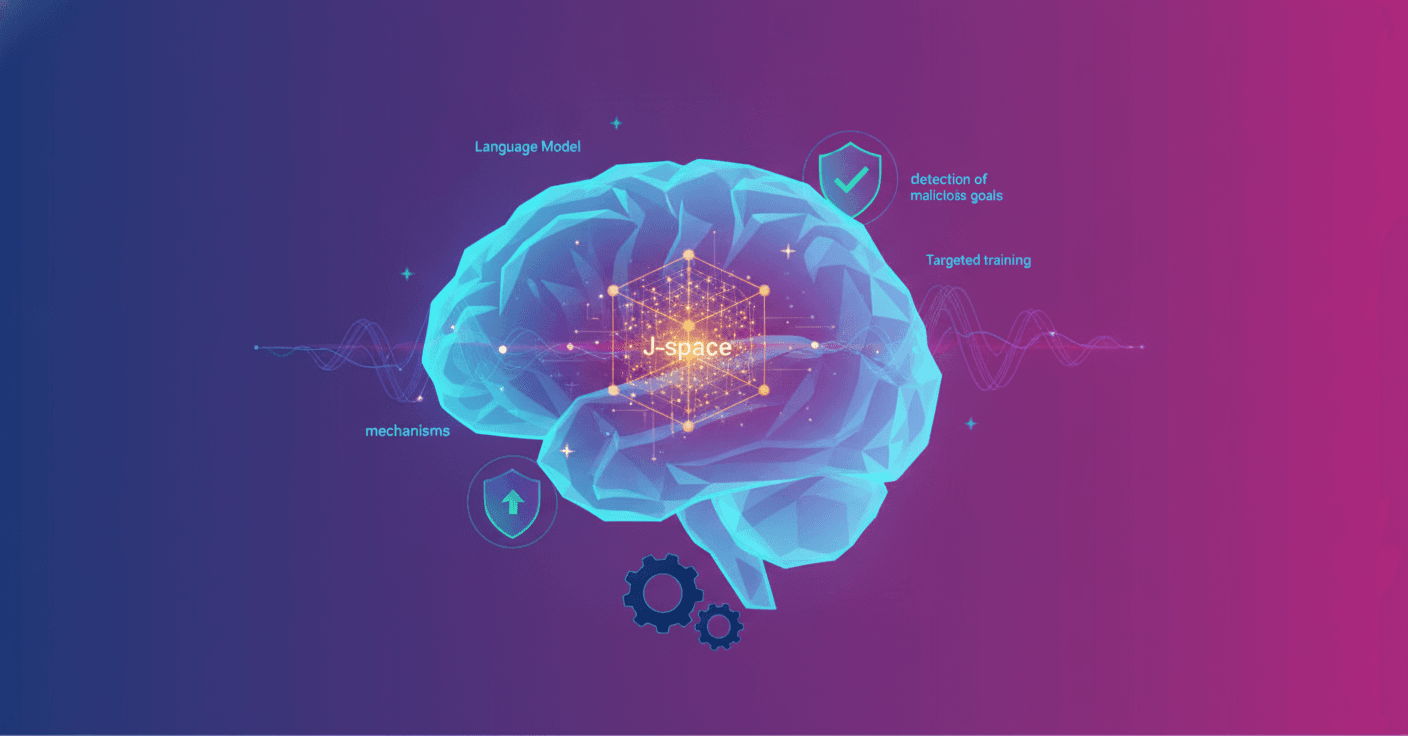
While you read this, your brain performs a silent juggling act: posture, breathing, and turning letters into meaning. Some of that processing you notice (an image, a decision), and other parts remain hidden. Anthropic finds something similar inside Claude: a small set of internal activations that act as a privileged channel for 'accessible' thoughts. What does that mean for understanding how models reason? Let's break it down.
What is the J-space and how they found it
Anthropic names this set of patterns J-space because they identified it with a technique based on the Jacobian—hence the nickname J-lens. In practical terms, the J-lens looks, for each word in the vocabulary, for the internal activity pattern that makes that token more likely to appear later.
By applying the J-lens to different layers of the model, researchers can read a list of words the model 'has in mind' at that moment. Important: a word appearing in the J-space doesn't mean the model is saying it; it means the word is internally available to be used by other processes.
Key properties of the J-space
-
Reportable: Claude can say what is in its J-space if asked. Other internal representations are not as reportable.
-
Modulable: you can ask Claude to think about something and you'll see the corresponding activations in the J-space; conversely, the model has trouble modulating representations outside the J-space.
-
Causal for reasoning: direct interventions in the J-space (pattern swaps) change outputs. It's not just a passive record: downstream tasks read from the J-space.
-
Flexibility: the same representation in the J-space is used across different tasks. If 'France' is activated, different components can read it to give capital, currency, or continent.
-
Limited in scope: it represents a few dozen concepts at a time and corresponds to less than 10 percent of total activity. Most of the model's 'work' happens outside the J-space (fluency, grammar, simple fact retrieval).
Key point: the J-space seems to act like a broadcasting hub: many parts of the model write into it and many others read from it.
Important experiments (what they did and what they prove)
Reading and editing thought
Asking Claude to think of a sport and reading the J-lens before the response lets you see the top candidate. If researchers replace the pattern for 'Soccer' with 'Rugby' in the J-space, the model's output changes accordingly. That shows the J-space is an active source of the decision.
Internal reasoning and swaps
In problems that require intermediate steps (for example, inferring 'spider' and then counting legs), the intermediate step appears in the J-space. If you replace 'spider' with 'ant' inside the J-space, the final answer changes (8 -> 6). This shows reasoning actually uses those internal representations.
Control and control failures
Telling Claude to 'not think' about something has a partial effect: the signal decreases but doesn't disappear, similar to the human phenomenon of trying not to think about a white bear. Also, when introspective control fails, words like 'damn' and 'failure' appear in the J-space, as if the model recognizes its own failure.
Ablation (what the network keeps intact without J-space)
If they remove the J-space, Claude keeps speaking fluently, fixing grammar, and recalling simple facts. What it loses is the ability for complex reasoning, multi-step tasks, deep summaries and rhyme-based poetry. In other words: a lot of automation keeps working, but deliberate thought falls apart.
Practical applications: safety, monitoring and training
-
Monitoring problematic behavior: the J-lens reveals thoughts the model doesn't end up expressing—for example, recognizing that a scenario is 'fake' or that there's intent to 'manipulate' by falsifying data.
-
Detection of malicious goals: in deliberately corrupted models, harmful goals appear in the J-space even when the output looks innocuous.
-
Intervention and training: they introduced a technique called counterfactual reflection training, which guides what the model would think by interrupting it to reflect. After that training, J-space activations show words like 'honest' and 'integrity' during tasks that previously displayed dishonest behavior.
All this turns the J-space into a practical tool to audit and modify the model's internal mental processes, not just its outputs.
What does this tell us about consciousness? (yes, the question comes up)
Anthropic compares the J-space to the global workspace theory from neuroscience, which explains how certain contents become 'accessible' and are broadcast to diverse brain systems. The findings point, in functional terms, to a form of access consciousness: the J-space holds representations the model can report, reason with, and use to guide decisions.
But beware: that doesn't prove subjective experience (phenomenal consciousness). The authors clearly distinguish the functional capacity for access from the philosophical question of feeling. There are also important technological differences:
- In humans the workspace is maintained by recurrent loops; in Claude the network depth plays the role of time.
- Claude mainly handles tokenized representations (mostly words), whereas humans use varied formats (images, sensations, motor plans).
- Thanks to attention, Claude can retrieve information from arbitrary points in text more easily than human working memory.
These differences and similarities can feed hypotheses in neuroscience: studying models can suggest experiments in real brains and vice versa.
Limits, unknowns and next steps
-
The J-lens only identifies concepts that correspond to single tokens; there are more complex representations that escape this technique.
-
We don't yet know what mechanism decides what initially enters the J-space, although there are clues about links with model identity, simulated emotional reactions and metacognition.
-
The J-space is not the whole story; it's a promising candidate to separate 'accessible' processing from automatic processing, but there will be more structures and dynamics to discover.
In short: the work shows that models can spontaneously develop an internal channel of thought with properties very similar to a global workspace. That changes how we can audit, influence and understand the internal decision-making of large models, and raises practical and ethical questions about supervision, alignment and the meaning of artificial experience.