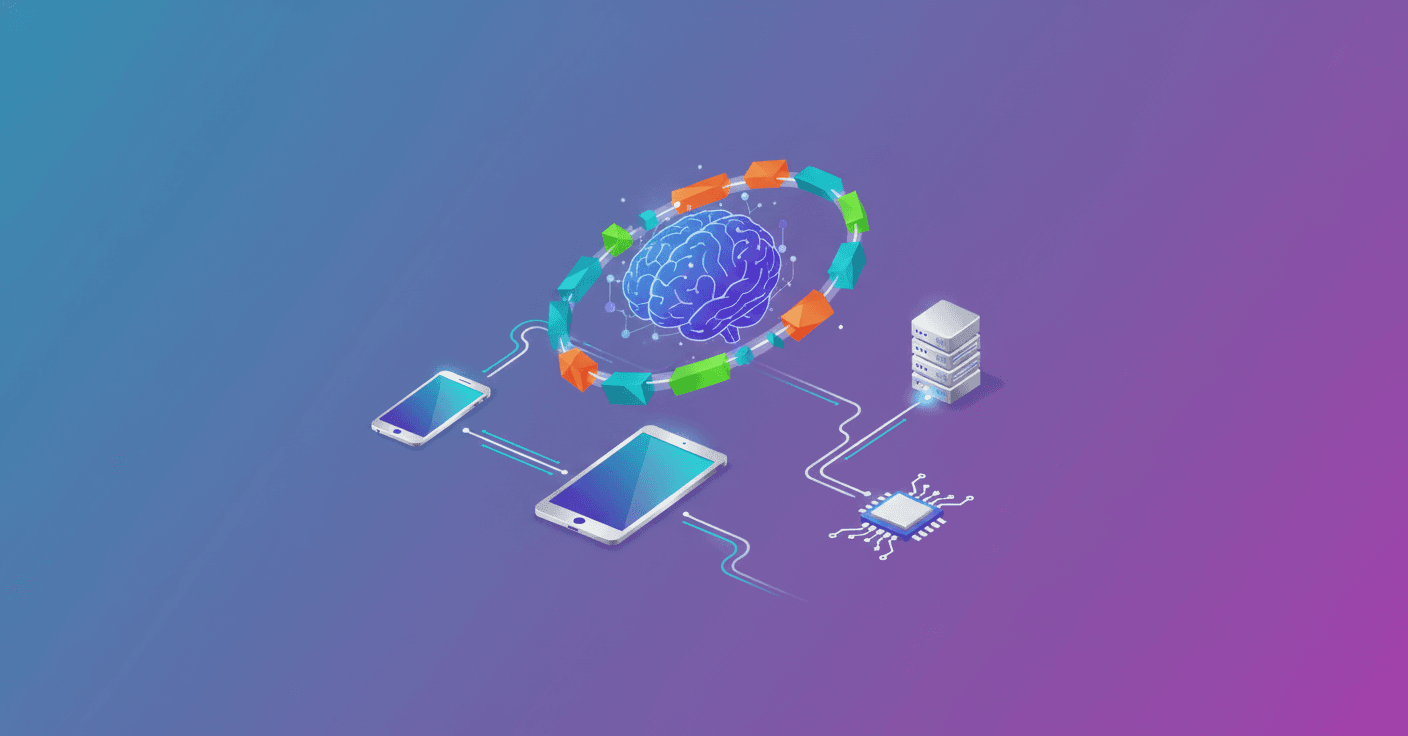
Holo3.1 arrives to answer a practical question: how do you run agents that control apps and workflows reliably on both desktop and mobile, and do it wherever you want (cloud or fully local)? Their bet is robustness on three fronts: environments, agent frameworks, and deployment targets, with quantized checkpoints ready for local inference.
Qué es Holo3.1
Holo3.1 is the evolution of Holo3, built on the Qwen family and designed so computer-usage agents behave consistently in browsers, desktops, and mobile devices. It’s not just a new model: it’s a family made for real operational conditions, where environment changes can cause big behavior shifts.
The most relevant technical news is that, for the first time, they publish quantized checkpoints optimized for local execution: FP8, Q4 GGUF and NVFP4. That opens the door to running powerful models on edge hardware with much lower latency and cost.
Mejoras clave: entornos, frameworks y despliegue
-
Entornos: Holo3.1 expands coverage to mobile in addition to browser and desktop. In concrete benchmarks, the 35B-A3B variant improves on AndroidWorld from 67% to 79.3%, while the 4B and 9B models go from 58% to 72%.
-
Frameworks de agente: there’s now native support for
function-callingprotocols in addition to structured JSON outputs. That makes it easier to integrate Holo3.1 into different agent stacks without redesigning the orchestration layer. -
Targets de despliegue: the family ships in four sizes (0.8B, 4B, 9B, 35B-A3B) and with quantized checkpoints aimed at local, edge and GPU data center deployment.
Cuantización y checkpoints para inferencia local
Holo3.1 brings three quantized weight formats ready for production:
FP8: lower memory usage while keeping very good accuracy.NVFP4: checkpoints optimized with NVIDIA’s Model Optimizer inW4A16configuration. Designed to maximize throughput on NVIDIA infra.Q4 GGUF: a format geared toward deployment on consumer hardware and local tools that read GGUF.
What do you get from this? Less memory, more speed, and the ability to run the model on the user’s own machine to preserve privacy and reduce latency. According to the published numbers, FP8 and NVFP4 reach OSWorld scores almost identical, barely 2 points below the BF16 checkpoint.
Rendimiento y números prácticos
Some results that matter if you plan to take this to production:
- Throughput: on DGX Spark,
NVFP4in W4A16 delivers 1.41× the total throughput ofFP8and 1.74× that ofBF16. - Composite latency: optimizations in the agent harness with NVIDIA plus
NVFP4quantization give a compound speedup of ~2× over theFP8baseline, dropping average time per step from 6.8s to 3.3s. - Request rate: in tests, the vLLM +
NVFP4combo achieved the highest request rate in Default and Fast modes, followed byQ4 GGUFandFP8. - Functional benchmarks: function-calling and native execution reach near parity on OSWorld and the internal benchmark covering e-commerce, enterprise software, and collaborative workflows. Inside the Holotab product, Holo3.1 improves >25% over Holo3.
These numbers help you estimate trade-offs: NVFP4 gives maximum speed on NVIDIA infra, Q4 GGUF eases local deployment on consumer CPU/GPU, and FP8 is a solid middle ground.
Modelos y casos de uso prácticos
The family includes:
Holo3.1-0.8B: ultra-light agents for simple tasks and execution on low-power CPUs.Holo3.1-4B: cost-effective option for private deployments on personal machines or edge devices.Holo3.1-9B: balance between performance and latency for agents with more state.Holo3.1-35B-A3B: top-tier performance for complex flows.
Immediate use cases: automate workflows in enterprise apps, assistants that control the desktop for repetitive tasks, or offline agents on corporate laptops where privacy is mandatory. You can run the agent locally on Windows or Mac and the model on the same machine or on a DGX Spark in the same network; in both scenarios execution can be fully local.
Cómo desplegar y consideraciones técnicas
- If you target NVIDIA infra in a data center,
NVFP4+ vLLM on DGX Spark will give you the highest request rate. - For privacy and deployment on consumer devices,
Q4 GGUFis the practical choice: smaller footprint and compatibility with local toolchains. - On Mac with Apple Silicon there are reference numbers included in the release, useful if you plan to run locally on end-user machines.
- Pay attention to integration: native
function-callingsupport makes it easier to map model responses to API calls or system actions without ad-hoc logic.
If you know your concrete workflow, ask yourself: do you prefer minimal latency or low cost per inference? Do you need everything to stay inside the local network? Is your infrastructure NVIDIA or heterogeneous? The combinations of model and quantized format let you optimize for each case.
Reflexión final
Holo3.1 isn’t just another large model; it’s a release designed for the real transition to agents that live where people work: browsers, desktops and mobiles. The push for quantized checkpoints and small sizes for local deployment sends a clear message: useful AI is moving toward privacy, efficiency and interoperability with different agent stacks.
If you’re a developer or architect, this gives you concrete tools to move proofs of concept to production with real local execution options. If you’re an end user, you’ll soon see faster, more private agents on your machines.