Can you imagine having climate information at hand about the near future of your own city: how much seasonal snow will reach the mountains that feed your reservoirs? How intense could the biggest summer downpour be so you can design an urban drainage system? Will the character of the tropical cyclones that hit your coast change in the coming decades?
Answering those questions requires simulating the atmosphere with fine detail to capture storms and their interactions with the terrain. Traditional climate models usually run at coarse resolutions, for example 100 km, which lets them simulate centuries of climate but loses local detail. Global models that resolve storms at 3 km can do it, but at a huge computational cost: a decade of simulation can take months and consume energy equivalent to decades of household use.
HiRO-ACE is a solution that shifts that balance: a two-stage AI architecture that emulates a 10-year simulation run with X-SHiELD, the GFDL 3 km global model, and lets you generate decades of 3 km precipitation data for any region in a single day on one GPU.
What is HiRO-ACE
HiRO-ACE combines emulation and high-resolution downscaling to deliver kilometer-scale climate information that is accessible and probabilistic. It's trained on the output of a 10-year X-SHiELD simulation, so it's not learning directly from observations but emulating the physics and behavior of the reference model.
The two key pieces are:
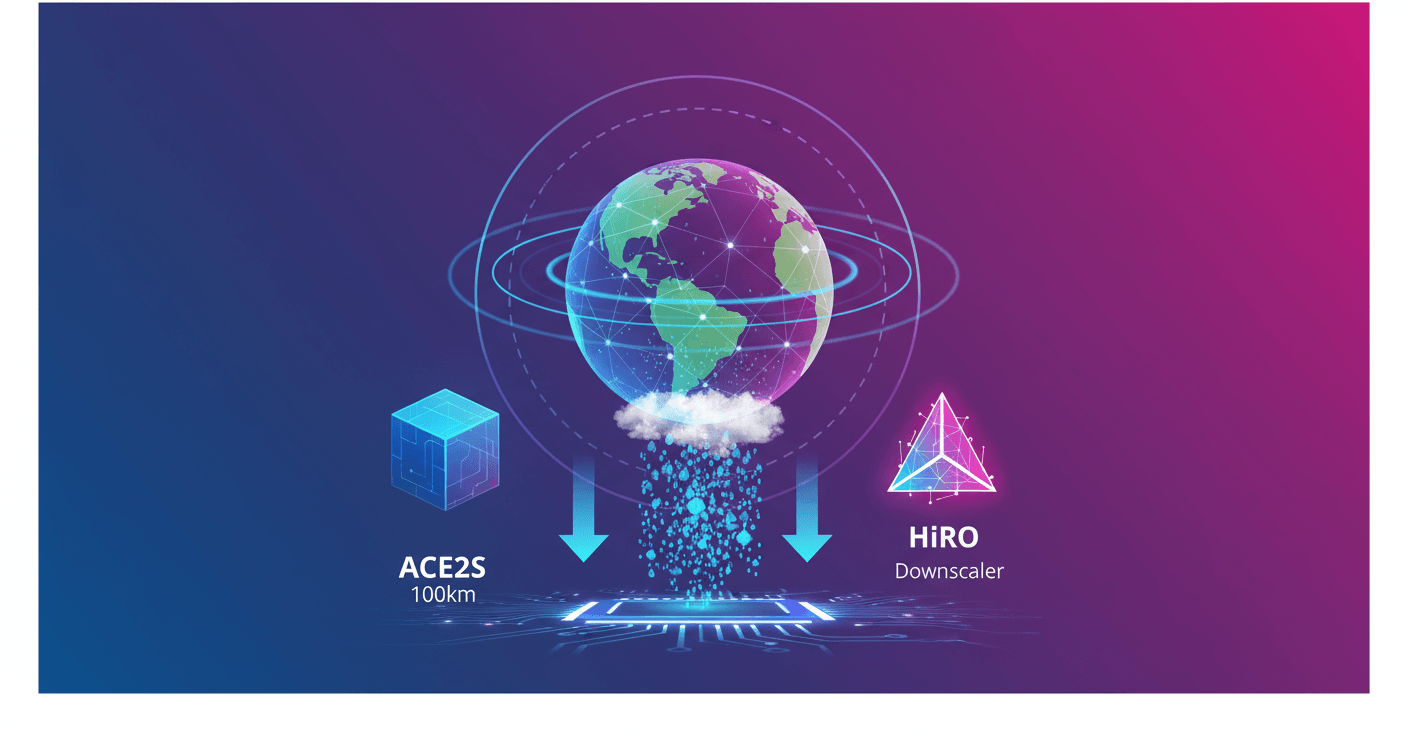
ACE2S: a stochastic climate emulator that produces global conditions at100 kmin 6-hour steps.HiRO: a downscaler that transforms coarse precipitation and wind fields to3 km, reconstructing the structure of individual storms.
Both are probabilistic, which lets you generate ensembles to quantify uncertainty at both meteorological time scales and storm scales.
How it works (more technical)
ACE2S (Stochastic Climate Model Emulator)
ACE2S is a stochastic variant of the Ai2 emulator. It runs at 100 km and produces global rollouts of temperature, humidity, wind and precipitation every 6 hours. The stochastic component is important because it avoids the excessive smoothness typical of deterministic emulators and preserves precipitation features at the grid-cell scale that physical models exhibit.
In practical terms, ACE2S emulates large-scale atmospheric evolution with enough fidelity to retain signals relevant for extreme climate events.
HiRO (High Resolution Output Downscaler)
HiRO takes the coarse fields from ACE2S and generates 3 km precipitation maps. The downscaling is 32x, which means a broad 100 km cell is transformed into a detailed mesh where tropical cyclones, atmospheric rivers interacting with mountains, and isolated convective storms appear.
Both models are trained on the same 10-year X-SHiELD simulation, so they fit together without additional fine-tuning.
Results and accuracy
HiRO-ACE reproduces the parent model's details from point extremes to long-term means. Some highlighted metrics:
- Reproduces the probability of precipitation rates up to the
99.99percentile globally. - Generates realistic storm structures for tropical cyclones, atmospheric rivers over complex terrain, and intense convective storms.
- For climate applications, it shows low mean-time biases relative to X-SHiELD, with relative errors below
10%in most regions. - Recovers precipitation details in complex topography where variations of a few kilometers can change precipitation by
50%or more.
These results indicate that HiRO-ACE doesn't just paint rainfall at higher resolution; it preserves statistics that matter for risk analysis.
Efficiency and resources
Efficiency is the big practical advantage:
- On an NVIDIA H100 GPU,
ACE2Scan simulate ~1,500years in a day. HiROcan generate one year of3 kmoutputs over a region in roughly45 minutes.
Together, a researcher can produce decades of regional 3 km data in a day, versus months with the original physical simulation. That opens the door to sensitivity analyses, probabilistic studies and ensemble production at local scales that were previously prohibitive in cost and time.
Applications and who can use it
Think of concrete cases:
- Water resource authorities that need to evaluate variability in mountain snow feeding reservoirs.
- Municipal engineers who design drainage systems against extreme precipitation events.
- Insurance companies and risk consultancies that require thousands of local scenarios to assess exposure.
The academic community and government centers already use versions of ACE. With HiRO-ACE, the tool expands toward adaptation professionals and impact assessors who need localized, quantified signals.
Josh Hacker, of Jupiter Intelligence, sums up the opportunity:
This brings the ability to evaluate extremes and their probability at the local level that decision-makers need.
Limitations and technical cautions
There are several important points to consider before integrating HiRO-ACE into operational decisions:
HiRO-ACEemulates a reference model (X-SHiELD). Therefore it inherits the assumptions and biases of that physical model. Emulating is not the same as validating against observations.- Stability outside the training domain and climatic non-stationarity are risks: changes in forcings (for example emissions scenarios) require careful evaluation.
- Evaluation and calibration with local observational data are still advisable for critical applications.
In short, HiRO-ACE extends the reach and speed of climate analyses, but it does not replace the need for physical verification and uncertainty analysis.
Availability and next steps for technical users
The team published the paper on arXiv and made models and code available on open platforms, easing community adoption. For someone developing climate workflows, the practical steps are:
- Test
ACE2Sto generate rapid global rollouts. - Use
HiROfor regional downscaling and produce ensembles. - Validate outputs against local observations or reanalyses before integrating them into risk assessments.
Integrating it with hydrological models, infrastructure models or socioeconomic impact models turns kilometer-scale outputs into concrete decisions.
The ability to generate decades of 3 km data in hours changes the conversation: it's no longer just science for curiosity, but delivering useful information to planners, engineers and policymakers.