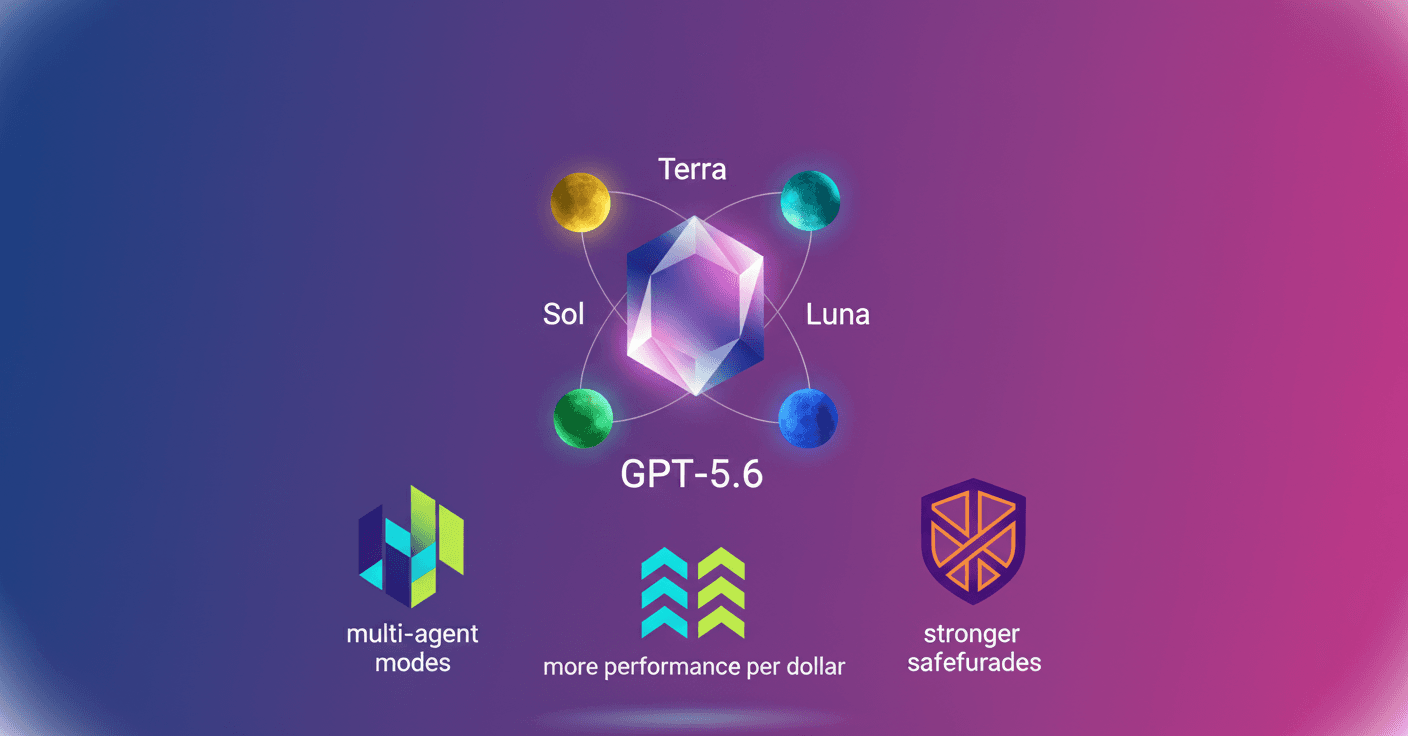
OpenAI introduces the GPT‑5.6 family: Sol, Terra and Luna. What does this mean for you, your team, or your startup? Put simply: more intelligence per dollar, modes that speed up complex work, and a stronger safety layer for sensitive uses.
What GPT‑5.6 brings
The GPT‑5.6 family includes three tiers: Sol (the flagship), Terra (balance between price and performance) and Luna (the most economical). OpenAI says Sol sets a new standard for programming tasks, knowledge work, cybersecurity and science, delivering better results while using fewer tokens and lowering estimated cost.
In practice: more useful work for the same investment, or the same outcome spending less.
GPT‑5.6 also adds effort modes: max for deeper reasoning and ultra for very demanding tasks, which coordinates multiple agents in parallel to finish sooner and with higher quality.
Performance and efficiency (the essentials)
OpenAI publishes comparisons with rivals and previous generations. A few key points:
- Sol reaches around 53 points on evaluations of extended professional workflows, outperforming competitor models by a notable margin.
- In coding, Sol sets a new state of the art on the coding agents index: higher score, fewer output tokens, less time and lower cost versus competitors.
- Terra and Luna are designed to democratize that performance: competitive results at a fraction of frontier-model costs.
What does this do for you? If you are a developer or analyst, expect fewer back-and-forths with the model, fewer tokens spent, and more executable results in less time.
Multi‑agents and effort modes: speeding up the complex
The biggest practical novelty is multi‑agent capability: ultra runs by default with four parallel agents (and options up to 16 in testing), pushing the score‑vs‑latency frontier toward better results in less time.
There is also Programmatic Tool Calling, which lets the model write and run small in‑memory programs to orchestrate tools, filter intermediate responses and keep only what matters. The result: fewer rounds of back-and-forth and compatibility with Zero Data Retention flows where applicable.
Design, creativity and knowledge work
GPT‑5.6 improves judgment in design: with high‑level instructions it can create coherent, polished interfaces, presentations and visualizations. It reads templates and reference files (for example, Slide Master) and applies styles faithfully.
In office tools (Slack, Notion, Google Drive, Microsoft 365) it turns messy context into shareable outputs: reports, editable presentations, financial models and more.
Safety, access and controls
OpenAI emphasizes a stronger safeguards stack:
- Extensive evaluations before release: human red teaming and large‑scale automated tests (they mention hundreds of thousands of GPU hours for automated testing).
- Layers: protections built into the model + real‑time checks + account‑level monitoring and control.
- A reasoning monitor that reviews the conversation for risk, instead of relying only on rigid classifiers.
There is also verified access for sensitive defensive cybersecurity uses (Trusted Access for Cyber). Individuals can request trusted access and organizations can register teams; those who want continued access to advanced cyber capabilities will need to enable Advanced Account Security.
OpenAI acknowledges that domains like biology and cybersecurity are dual‑use. The stated intent: allow legitimate defensive work while limiting abuse, approaching conservatively at first and iterating based on real‑world use.
Science, research and internal adoption
OpenAI says GPT‑5.6 speeds up internal research: more inference tokens for developers, greater agentic use and improvements in tasks like debugging research systems, optimizing kernels and running experiments.
For research teams and startups this means less friction in experimental cycles and more practical help for tasks that used to consume a lot of human time.
Pricing, availability and plans
The family ships today in ChatGPT, Codex and the API, with global gradual rollout over 24 hours. Price per 1M tokens:
- Sol: $5 input / $30 output
- Terra: $2.50 input / $15 output
- Luna: $1 input / $6 output
Plans and access:
- In chat: Plus, Pro, Business and Enterprise get access to Sol at higher effort tiers. Pro and Enterprise can choose Sol Pro for complex work.
- ChatGPT Work and Codex: Free/Go users receive Terra; paid plans can choose among Sol, Terra and Luna and adjust effort.
- API: Sol, Terra and Luna available; multi‑agent beta and Programmatic Tool Calling available in the Responses API.
They also introduce more predictable cache handling (30 minutes minimum and specific fees for cache reads/writes).
Final reflection
GPT‑5.6 is not just a numbers upgrade: it aims to make AI more practical, cheaper and more integrated into real workflows. For professionals and teams that translates into less friction and more ready‑to‑use results; for the security and biology communities it means stricter controls and verified paths for sensitive work.
Does this mean AI does everything now? No. It means you can delegate more parts of complex work with better guarantees, but it also means you should think about controls, ethics and how to use the tool in each context.