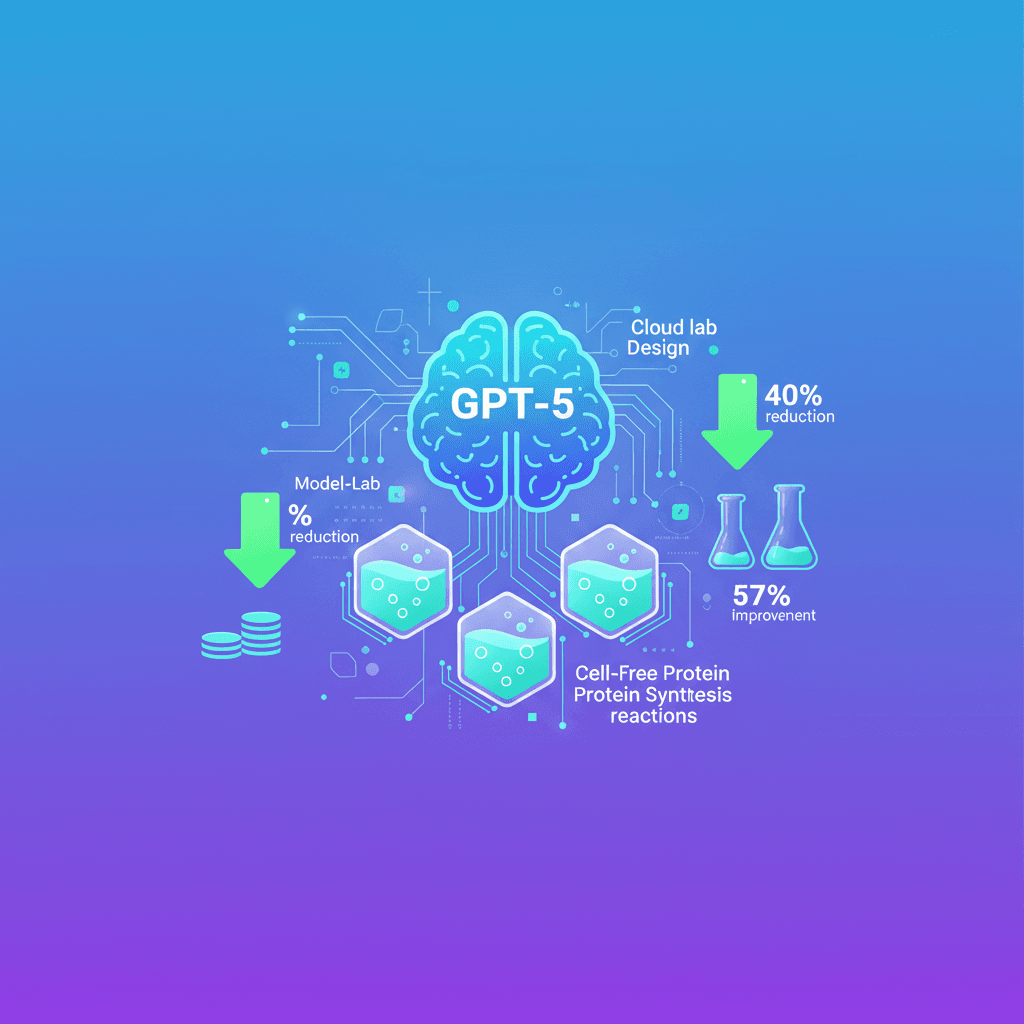
OpenAI presented an experiment where GPT-5 connects to an automated lab to optimize cell-free protein production. Sounds like science fiction? It’s practical reality: the model designed and refined thousands of experiments that robots executed, and in just a few rounds it managed to lower protein production costs significantly.
What GPT-5 did and why it matters
In collaboration with Ginkgo Bioworks, GPT-5 was integrated with a cloud lab: an environment where robots run biology protocols controlled by software and return data. The system followed a closed loop: the model proposed experiments, the lab ran them, the results came back to the model, and it designed the next batch.
Why does this change the game? Because many improvements in biology need fast, large-scale iteration. When you can test thousands of combinations in days instead of dozens in weeks, you find solutions that aren’t visible from the human workbench.
How the looped lab worked
- GPT-5 had access to a computer, a browser and relevant literature to get informed.
- Strict programmatic validations were added to ensure every experiment was physically executable by the automation. That avoided so-called “paper experiments” that can’t be carried out in practice.
- In six rounds more than 36,000 unique reactions were executed across 580 automated plates.
The process took two months to reach a new state of the art in low-cost cell-free protein synthesis (CFPS), with measurable impact from the third round of experimentation.
Key results
GPT-5 achieved a 40% reduction in protein production cost and a 57% improvement in reagent cost in the tested system.
Some concrete findings:
- It identified low-cost reagent combinations that hadn’t been tested before in that setup.
- It proposed more robust formulations for typical automated lab conditions, like low oxygen and microplate volumes.
- Small tweaks in buffer, energy regeneration and polyamines turned out to have a large cost-relative impact.
The cost breakdown also showed that the expensive inputs in CFPS are the cell lysate and DNA, so improving yield per unit of those inputs is the lever with the most effect.
Limitations and precautions
Not everything is solved. The experiment used a specific protein, sfGFP, and a single CFPS system. That means generalizing to other proteins or platforms still needs to be demonstrated.
Execution required human oversight for reagent handling and protocol improvements. GPT-5 designed and interpreted experiments, but hands-on lab work still needed experienced operators.
OpenAI also emphasizes risk assessment and biosafety. When models interact with automated labs, there are potential implications that require safety frameworks and ongoing mitigations.
What this means for science and industry
Think about it: cheaper proteins speed up prototyping, lower diagnostic costs, make industrial enzymes cheaper and can reduce prices of protein-based products. How much is it worth to be able to test ten times more ideas in the same time? A lot. That jump in iteration usually translates directly into faster discovery.
The practical lesson is that models and labs complement each other: the model generates and prioritizes hypotheses; the lab verifies and refines them. Together they can turn promising ideas into reproducible results faster.
Final reflection
We’re not seeing a total replacement of human lab work, but an expansion of what teams can explore. GPT-5 showed that, when well integrated and regulated, a model can scale experimentation and find optimization paths hard to see by intuition.
There’s still work to do on generalization, safety and oversight, but the experiment points a clear direction: closing the loop between computational design and experimental testing accelerates real advances in biology.
Original source
https://openai.com/index/gpt-5-lowers-protein-synthesis-cost