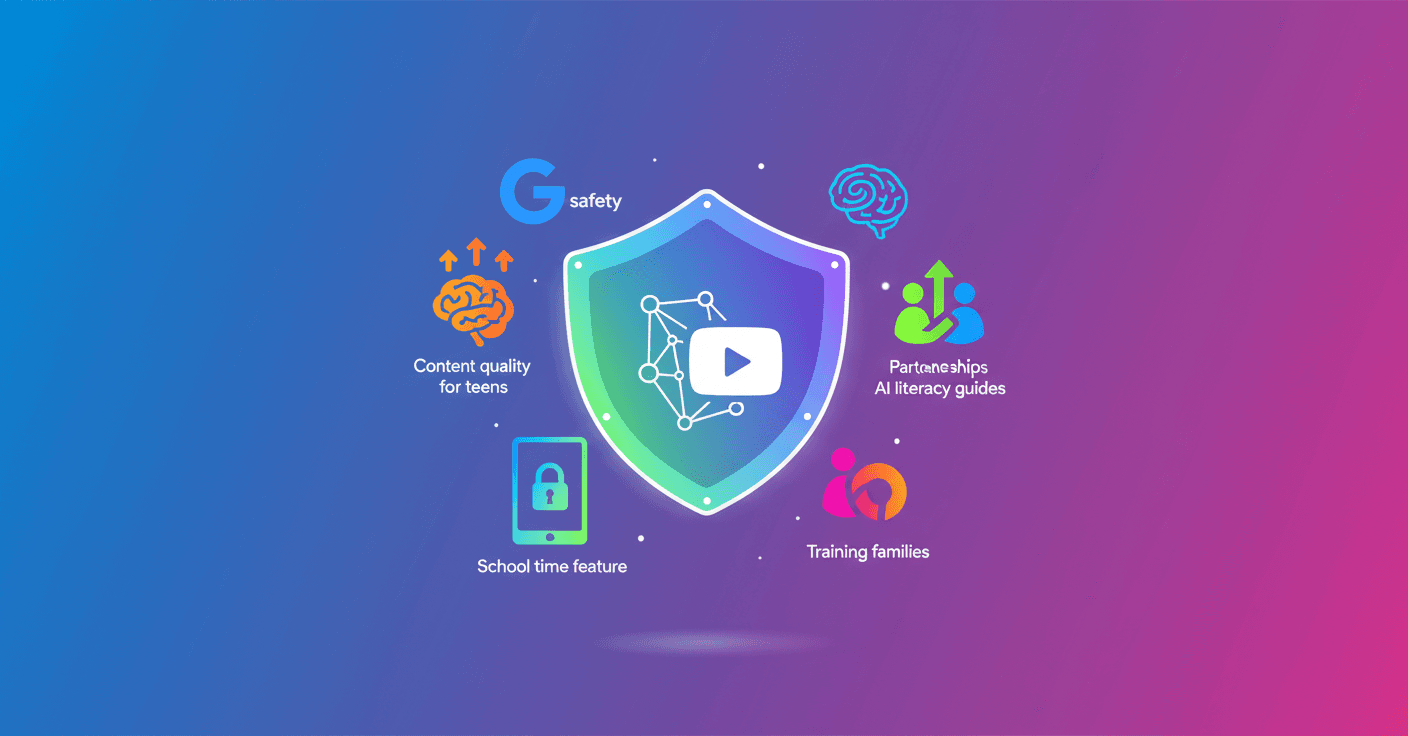
Google and YouTube have spent more than a decade building tools and protections designed for kids, teens, and their families. For Safer Internet Day 2026, the company is rolling out updates meant to make parental controls easier for you, reduce school-time distractions, and promote more enriching content and AI education.
Controles parentales más sencillos y centrados en la familia
Can you imagine managing your kids’ controls from one place? That’s exactly what Family Link improves: parents can now handle devices from a single page, see a usage summary per device, and adjust time limits from a consolidated screen for managing screen time.
On YouTube, the sign-up experience for kids’ accounts is updated so creating a supervised account and switching between profiles is easier in the mobile app. You can set how much time is spent on Shorts, and soon you’ll be able to set that timer to zero if you prefer. Supervised accounts can also set personalized Bedtime and Take a Break reminders, on top of protections that are already turned on by default.
YouTube also uses age estimation via machine learning to try to surface the right experience for a user’s age, limits potentially problematic recommendations if they repeat, and enables Take a Break and Bedtime reminders by default for users under 18. Uploads from creators aged 13 to 17 are private by default.
Mantener el tiempo escolar realmente para la escuela
The School time feature is coming to Android phones and tablets. What does it do? It reduces distractions by scheduling limited functionality and silencing notifications during class hours. If there are holidays, free days, or recess, parents can pause or tweak the settings so the schedule fits.
You choose which apps are silenced or restricted and can see which apps your child uses inside and outside School time. It’s a practical way to keep focus in class without completely locking the device.
Contenido que aporta y educación digital con IA
YouTube introduces quality principles for teen content and a creators’ guide that explains what kinds of material are more enriching and age-appropriate. This builds on the children’s principles launched five years ago, and now aims to promote higher-quality videos in recommendations for teenagers.
They’re keeping partnerships with creators and quality programs, like Sesame Street, to offer family-friendly and educational content.
In education, Google expands Be Internet Awesome with an AI literacy guide for teachers of grades 2–8, including downloadable lesson plans and activities designed to introduce basic AI concepts in an engaging way. They also announced a Guided Learning mode in Gemini, which acts as a learning companion: instead of giving quick answers, it encourages inquiry with open questions and exercises to dive deeper into topics.
Alianzas y formación a escala global
In 2025, partner organizations trained more than 60,000 caregivers, educators, and parents in online safety across countries like the United States, Brazil, India, Mexico, the United Kingdom, and Spain. Now Google is expanding those collaborations with organizations such as Parent Teachers Association, National Center for Families and Learning, Education for Sharing, National Cybersecurity Alliance, UpEducators, Fundación ANAR, and SaferNet.
The goal: train 200,000 families and professionals on tools and best practices so children and teens can browse more safely and with better critical thinking.
And what does this mean for you? Less friction when setting up controls, more support for educators, and a clear focus on content and resources that help kids learn online without giving up protection.
Fuente original
https://blog.google/innovation-and-ai/technology/safety-security/safer-internet-day-2026-kids-teens