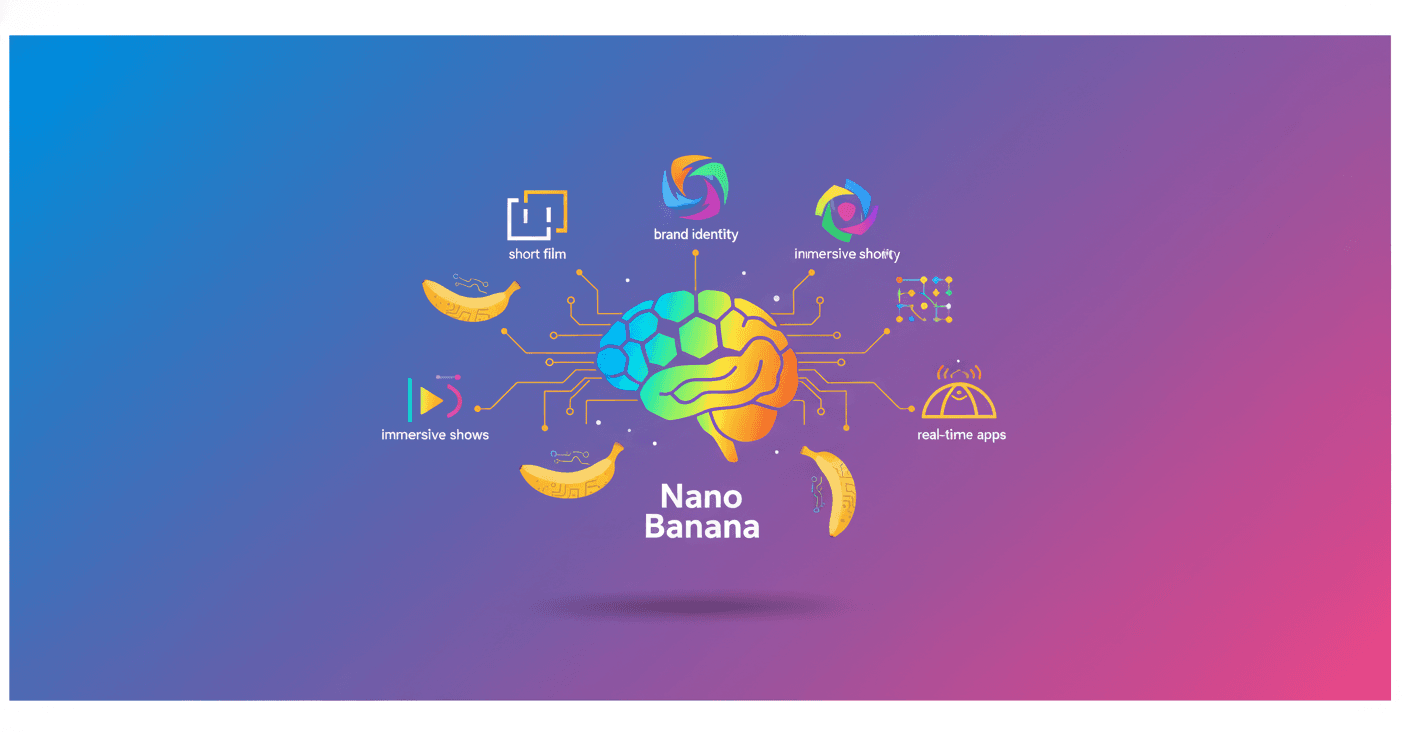
Google I/O 2026 didn't just showcase advances in artificial intelligence; it was also built with those same tools. What does that mean in practice? That the models and platforms we saw on stage were used to create film, visual identity, interactive experiences and even pop-up cafés in real time.
How they took AI from the stage to production
The team set out to use the very systems they were announcing publicly to design and produce the event. Instead of only talking about technical capability, the idea was to show usefulness: speed up prototypes, free creative time for the team and keep human intent at the center of the process.
When AI is applied well, the event runs by itself and the audience stops thinking about the tech behind it. That was the opportunity they wanted to show.
AI x Film: "TPU Training Day" and the mix of handmade and generative
The short film "TPU Training Day", also called Timmy TPU, began with plain craft: cardboard puppets and traditional animation. What was the starting question? Can we capture the warmth of handcrafted work and let AI elevate it without erasing the human touch?
To achieve that they used a chain of tools: puppetry capture and basic 3D animation, then Nano Banana to generate stylized images from the initial frames. Google AI Studio let them test batches of frames and keep pixel-by-pixel consistency. Finally, Gemini Omni and experimental models integrated base and style to reach a cinematic result that preserves tiny human imperfections—the ones that make puppet animation endearing.
AI x Visual design: I/O 2026 brand identity
The palette ended up being a four-color gradient with overlapping transparencies and interlaced icons. To get there they fed Gemini models with past brand guides and summaries of previous I/Os. The first results weren't enough, so they ran micro-experiments: they fed outputs back into Nano Banana, tweaked icon styles and combined flat 2D with textured 3D transforms.
The process shows something useful: AI speeds up visual exploration, but the team decides, fine-tunes and maintains final coherence.
AI x Immersive experiences: generative music and playable worlds
In the pre-show there were several creative pieces:
-
Jellectronica: they translated jellyfish movement into sound. They trained a
YOLO8in Google Colab, ran it on the Coral NPU to track motion and turned that data into music with Lyria 3 Pro and Google Flow Music. More jellyfish in an area meant more prominent bass. It's a clear example of sensors, models and musical synthesis working together. -
Infinite Scaler: a game where players generate levels as they play. The flow was:
Nano Bananagenerates sprite sheets from prompts and references, then the system infers normal maps and textures to map into 3D inside WebGL. Google Antigravity and AI Studio were used for prototyping and production; the game's music was created with Lyria 3.
These examples show how to move from generative 2D to playable 3D environments without massive pipelines.
AI x Products and services: Antigravity Coffee Co. and real-time apps
At the pop-up café they used Flutter, the agent platform Gemini Enterprise Agent Platform and Google Antigravity to create adaptive interfaces. With A2UI and Firebase they generated UIs that change in real time based on user interaction. The same backend handled model reasoning and content generation so a single codebase delivered a smooth experience across devices.
The takeaway is practical: AI can replace static forms with interfaces that adapt and reason, accelerating development and improving user experience.
AI x Creativity and small details that connect with the audience
Small objects in the I/O experience also went through AI:
-
Speaker title cards: combining
Gemini Omni,Google FlowandNano Banana Prothey generated assets, animations and compositions that blend realistic movement with fantastic elements (for example, a presenter riding a digital dinosaur). -
Custom stickers: a mini-app let you capture prompts in 20 seconds using an Android bot. Prompts were combined with
Nano Bananaand Gemini to create unique designs that were printed instantly. Result: stickers ranging from a golden I/O waffle to more surreal concepts.
What lesson is left for those who build with AI?
The most interesting thing isn't the model showcase, but how they were integrated into real workflows. A few clear ideas:
- AI speeds up exploration and production, but it doesn't replace human intent.
- Testing and feeding outputs back is key to move from experimental to consistent.
- Sensors, models and execution tools on hardware (like Coral NPU) enable live experiences without unacceptable latency.
In the end, watching I/O 2026 is seeing AI as a practical tool that multiplies creativity and gives you back time for what only people do best.
Original source
https://blog.google/innovation-and-ai/technology/ai/io-2026-google-ai