The fight against online fraud is no longer just a warning message: it's a daily operation that combines artificial intelligence, user tools and cooperation between companies and authorities. How does Google protect you today and what can you do to reduce risk? I'll explain it in a practical way and without jargon.
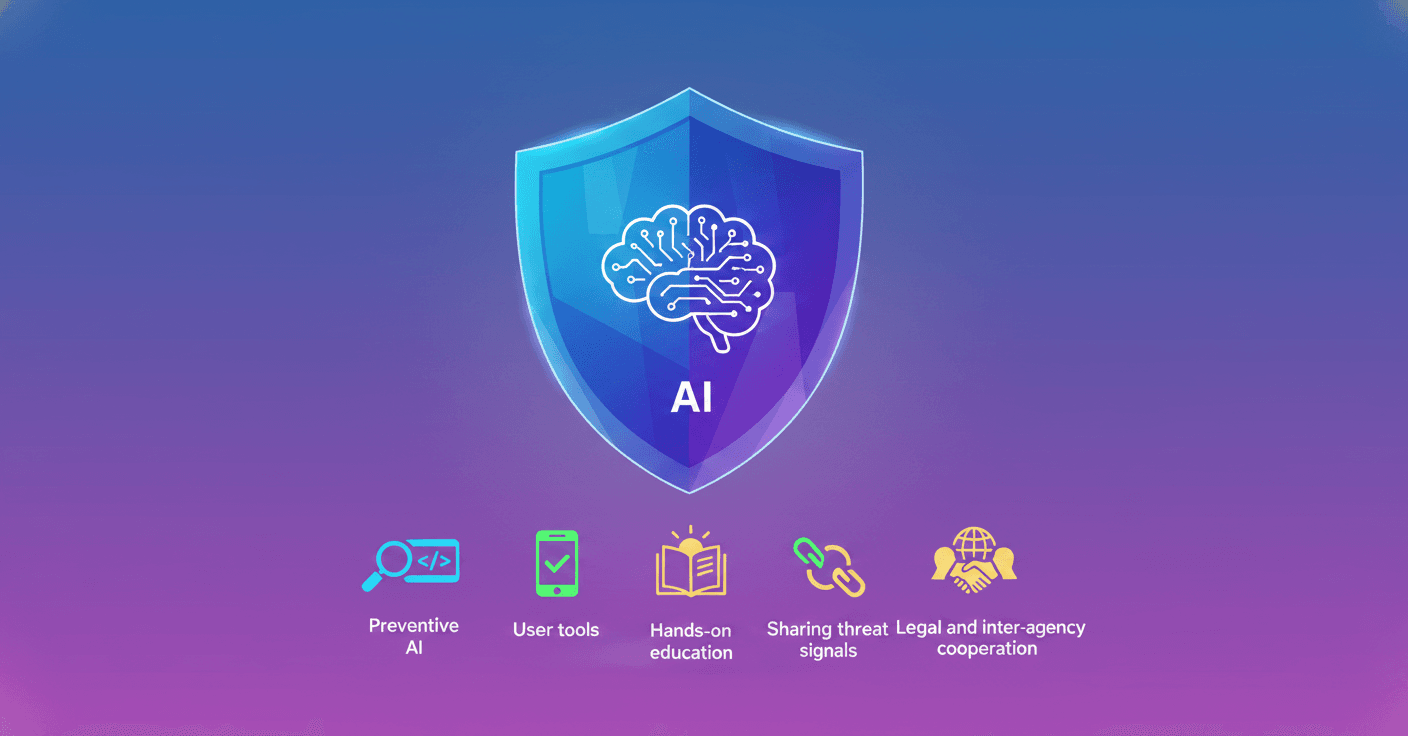
5 key measures to curb scams and protect you
Google presents five fronts of action to reduce the harm scammers cause. This isn't science fiction: these are measures applied right now in products you probably use every day.
- Use AI as a first line of defense
The same technology bad actors use for harmful purposes is also used to block them. Before a scam reaches you, automated systems are already working:
- Gmail blocks more than 99.9% of spam, phishing and malware—about 15 billion unwanted emails per day.
- Chrome predicts and blocks dangerous sites in real time; Search filters out hundreds of millions of spam pages daily to keep results about 99% free of spam.
- In 2025, systems detected over 99% of ads that violated policies before you saw them, and blocked or removed more than 8.3 billion ads, including 602 million tied to scams.
- On your phone, local AI powers the
Scam Detectionfeature in Phone by Google, which alerts you in real time to conversational patterns typical of scammers.
- Tools that empower you
Automatic defenses are great, but you also need control. Google offers easy tools so you can strengthen your security yourself:
Security Checkupguides you to enable protections like Passkeys and Two-Step Verification.- With
Circle to Searchon Android you can press and hold the home button and circle a suspicious message; the AI assesses whether it’s likely a scam and gives guidance. - If you don't have Circle, you can take a screenshot and use Google Lens to investigate links or messages.
- Education to build resilience
What's the best weapon against scams? Applied knowledge. Google bets on learning by doing:
- The
Be Scam Readyprogram uses interactive simulations so you recognize real scammer tactics. This hands-on approach proves more effective than purely informational campaigns. Be Scam Readyis already available in English, Portuguese, Thai and Traditional Chinese, and will arrive soon in French, Spanish and Arabic.- After a $5 million commitment from Google.org at the previous summit, organizations like the Internet Society and Oxford Information Labs are scaling community training with the goal of protecting over 7 million vulnerable people.
- Google also publishes alerts about emerging trends, for example job-offer scams or fake delivery notifications.
- Sharing threat data to attack the problem at its root
Scammers operate across multiple platforms and countries, so sharing threat signals between companies and authorities is key:
- The Global Signal Exchange (GSE) acts as a global hub that gathers threat data. Google is a founding partner and both contributes and consumes unique ecosystem intelligence.
- AI models analyze these signals to uncover hidden patterns that help investigations and enforcement actions.
- The GSE stores more than 1.2 billion signals and is already showing real impact in disrupting criminal operations.
- Collaboration to dismantle criminal networks
Eliminating fraud can't be done by a single company. It takes joint action:
- Google cooperates with agencies like the UK’s National Crime Agency; shared signals via the GSE helped detect and dismantle a fraud network linked to West Africa.
- The company is a signatory of the Industry Accord Against Online Scams and Fraud, an agreement to share expertise and resources across the industry.
- There are also direct legal actions: lawsuits against scam operations like Lighthouse, a phishing network that was shut down after the suit, and actions against operators of the BadBox botnet.
These measures show that fighting scams is ongoing work: technology, education, shared data and legal action act together.
What can you do today?
Small gestures make a difference: enable two-step verification, review Security Checkup, use Passkeys when you can and be wary of messages that ask for money or personal data urgently. Unsure? Investigate with Circle to Search or Google Lens before replying.
Technology doesn't replace human judgment, but it amplifies it. If AI blocks most attacks, your attention stops the few that get through from affecting you.
Final reflection
Fighting fraud is a race between defenders and attackers. The good news is that today we have AI applied to security, educational initiatives and cooperation networks that are producing concrete results. It's not perfect, but it's real and useful: protection is built between companies, authorities and informed users.
Original source
https://blog.google/innovation-and-ai/technology/safety-security/scams-fraud-protection