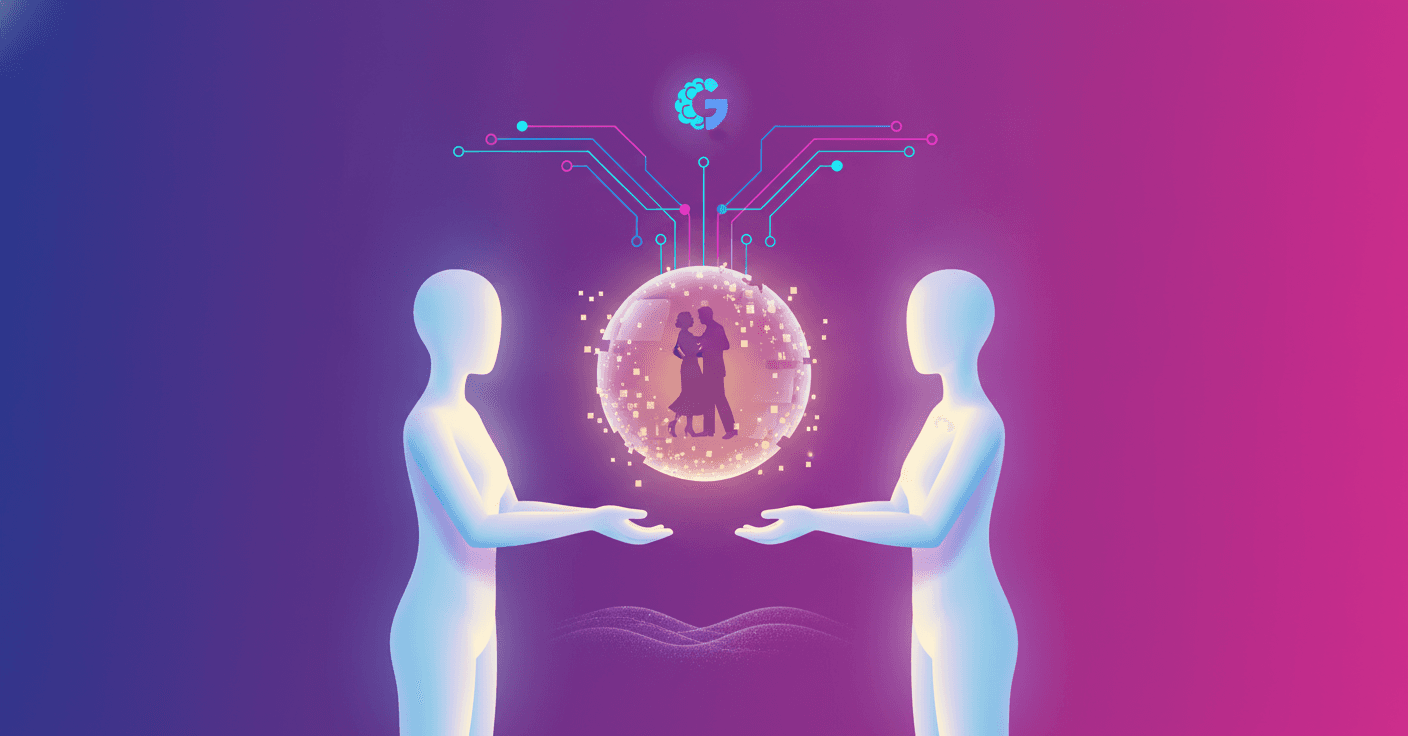
Can artificial intelligence help recover a memory that was never photographed? That’s the question behind Love, Rendered, a documentary short that reconstructs the day Burt and Ethelle Shatz met more than 70 years ago in a student residence in Cleveland.
The couple has spent more than seven decades together, but Burt lives with cognitive decline that has begun to erase some moments from their story. The encounter that started their relationship was never captured in images: it survived only in their memories.
A Love Story in the Face of Memory Loss
The film was directed by Oscar-nominated filmmaker Liz Garbus and produced alongside Dan Cogan and Darren Aronofsky. The project emerged from a collaboration between Google DeepMind and Primordial Soup, Aronofsky’s creative initiative.
The team became interested in the relationship between the senses and memory. A song, a photograph, or a familiar voice can awaken emotions even when other memories seem to have faded. This idea connects to reminiscence therapy, a practice that uses familiar stimuli to spark conversations and strengthen emotional connections.
But what happens when that important memory has no image to bring it back? In Burt and Ethelle’s case, the answer was to build a visual representation with the help of artificial intelligence—without allowing the technology to take control of the story.
AI as a Tool, Not the Protagonist
To recreate that lost moment, the filmmakers worked directly with Ethelle. She reviewed the results and corrected details such as the shape of a staircase or the design of a shoe heel. Her participation was essential: the technology could generate images, but she was the one who knew the scene’s emotional and visual truth.
The process had two main components:
- Photo restoration: Generative models recovered and colorized old black-and-white photographs of Burt and Ethelle. These images served as references to preserve their features and appearance.
- Posture and performance control: Motion-capture models analyzed the couple’s current gestures, such as the tilt of Burt’s head, his pauses while speaking, and the small wrinkles around his eyes. Those traits were then transferred to younger representations of both of them.
The result combines the reconstructed past with signals from the present. In this way, the recreation does not try to produce a perfect copy of a recording that never existed. Instead, it creates a scene that preserves the essence of what the couple remembers.
Artificial intelligence can fill in visual gaps, but the meaning of those gaps still depends on people.
When Technology Also Touches Personal Life
The project’s technical lead explained that memory loss is also part of his family story. His grandfather suffered a stroke and, during his final years, confused his age and his memories. During one of their last visits, he thought his grandson was still in college and was delighted that he was about to graduate.
That experience led the team to try the same tools with family photographs. Restoring images of his parents when they were young and animating them made it possible to see how experimental technology could become a form of emotional connection.
The scene raises a possibility that feels close to home for many families: restoring damaged photographs, bringing old portraits to life, or creating new ways to talk about people who can no longer tell their stories clearly. The goal is not to replace memories, but to give them a starting point.
Restoring Family Photos with Gemini
Google also points out that you can restore old photographs from the Gemini app. To do it, upload an image and write an instruction like this:
Can you restore and colorize this photograph? Preserve the people’s appearance, expression, and posture.
It’s a good idea to review the result carefully. A generative tool can invent details, change faces, or alter elements it cannot identify correctly. That’s why the people who know the story should take part in the review, just as Ethelle did during the documentary’s production.
Love, Rendered shows an application of AI that has less to do with productivity and more to do with memory, family, and grief. The machine provides restoration, movement, and reconstruction; people provide context, judgment, and affection. And isn’t it precisely that combination that turns a generated image into something truly meaningful?
Original Source
https://blog.google/innovation-and-ai/technology/ai/love-rendered-film