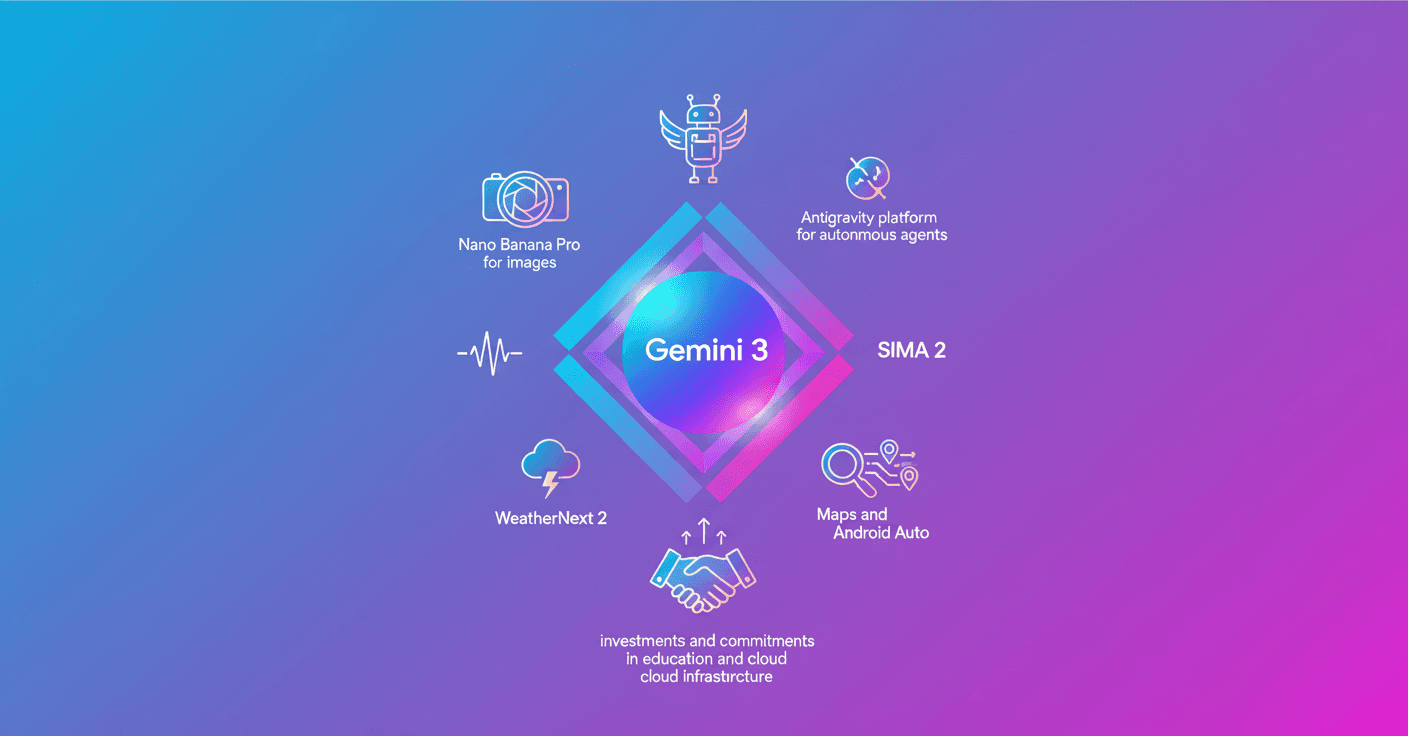
In November Google rolled out a wave of AI updates ranging from creative models to developer platforms. What ties them together? Making AI more useful, multimodal, and ready to plug into real tasks: searching, creating, driving and even planning your next trip.
The essentials of November
Google introduced Gemini 3, its bet on a more powerful, multimodal AI. According to the company, this model improves visual and textual understanding and boosts more agent-like experiences (meaning it can plan and carry out tasks). Does it help you day-to-day? Google has integrated it into the Gemini app and Search (AI Mode) to deliver deeper answers and interactive tools.
-
Gemini 3 in Search: available to Pro and Ultra subscribers in nearly 120 countries in English. It offers dynamic visual layouts, simulations and interactive tools based on your query.
-
Nano Banana Pro: an image model built on
Gemini 3aimed at studio-quality visuals. If you’re a creator or work in visual marketing, Nano Banana Pro gives you more control and better fidelity than the original. -
Google Antigravity: a platform to build autonomous agents. It’s not just a code editor; it proposes an agent-first flow so agents can plan, execute and verify complex tasks. It’s in public preview for developers to try.
-
Gemini in Maps and Android Auto: Google is moving toward conversational, hands-free navigation. Imagine asking for directions by voice, reporting traffic or getting guidance based on landmarks like restaurants instead of just distances. Handy, right?
-
SIMA 2: described as a step toward AGI for its ability to act in virtual worlds, follow instructions and improve over time. It’s shaping up as an interactive companion inside simulated environments.
-
WeatherNext 2: a weather model that makes forecasts up to 8x faster and with resolutions down to 1 hour. It’s already being used to support decisions at weather agencies.
-
AlphaFold at five years: Google highlights the ongoing impact of AlphaFold after solving protein structure prediction — a milestone with major scientific and social effects.
-
Improvements in Search for travel and shopping: new planning tools (Canvas in AI Mode) and conversational shopping features that can organize options, check inventories and, in some cases, complete purchases via agents.
-
AI for education: a $30 million investment in learning announced at a London forum, plus tools in NotebookLM to create flashcards and quizzes.
-
Gemini Live: tips for using more natural voice conversations, from adjusting speaking speed to practicing languages or interview scenarios.
-
Infrastructure investment: Google announced $40 billion in Texas for AI and cloud, part of a global investment wave with workforce training initiatives.
What does this mean for you?
Are you a creator? Nano Banana Pro and Gemini 3 offer more professional images and richer flows for editing and generating content.
Are you a developer? Antigravity is interesting if you want to build agents that don’t just respond but act and verify results. It’s a clear push toward agentic experiences.
Do you use Google daily? You’ll notice changes in Search, Maps and Android Auto aimed at making AI feel more like a natural assistant: from planning a trip to finding a product and finishing the purchase.
Work in science or government? Tools like WeatherNext 2 and AlphaFold’s advances show concrete applications where AI speeds up scientific and operational decisions.
Practical tips to get started today
-
If you have a Google AI Pro or Ultra subscription, try
Thinking with 3 Proin AI Mode to explore the new reasoning capabilities. -
If you’re into image creation, compare Nano Banana (fast and fun) with Nano Banana Pro (studio quality) to see which fits your workflow.
-
Developers: request Antigravity preview access and try building a small agent to automate a repetitive task on your team.
-
Students and teachers: use NotebookLM to generate flashcards and quick tests; it’s a practical way to bring AI into daily learning.
Reflection
What Google presented in November aren’t empty promises — they’re pieces meant to make AI more present in concrete tasks: creating, searching, driving and learning. The big question? How do we manage privacy, fairness and safety as these tools gain autonomy. Technology moves fast; our job is to use it wisely so it truly helps most people.
Original source
https://blog.google/technology/ai/google-ai-updates-november-2025