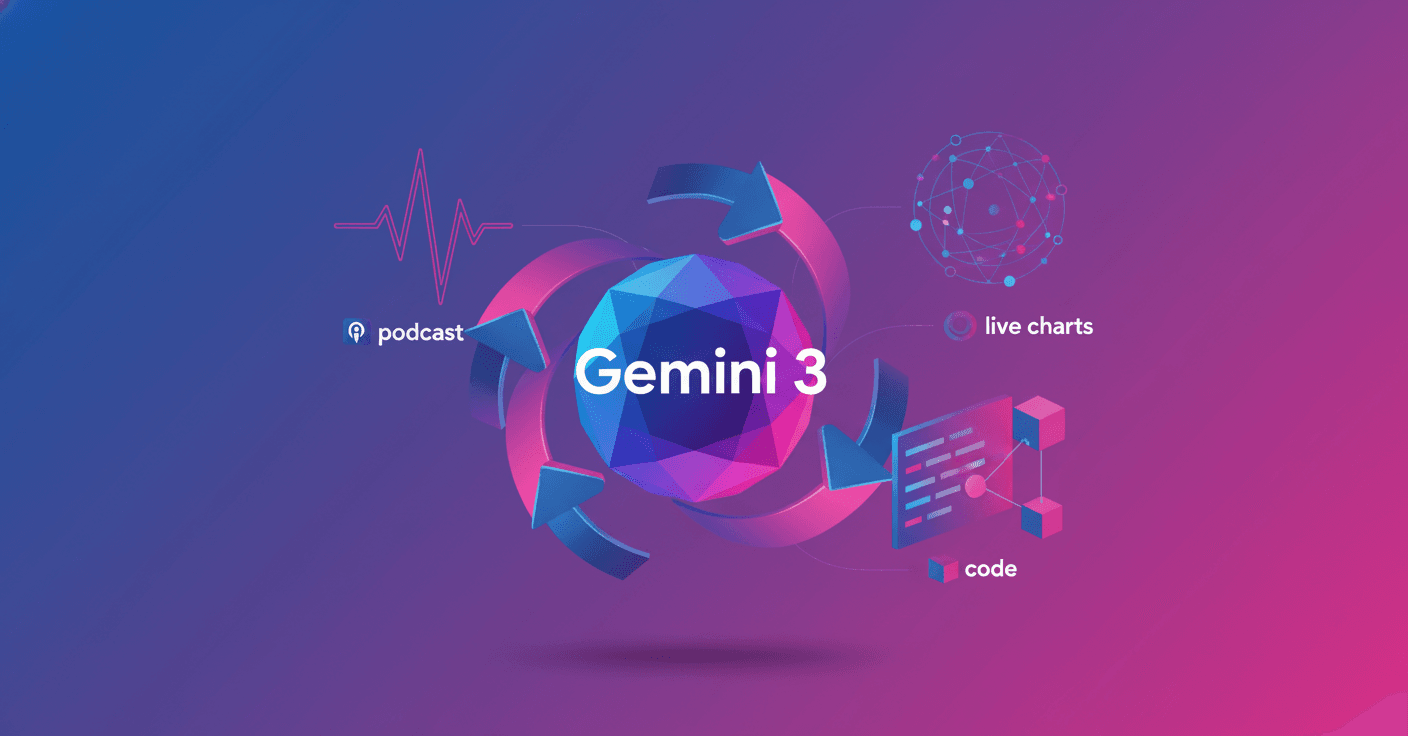
Google released a new episode of the podcast Google AI: Release Notes that explains how they’re integrating their most advanced models directly into Search. Host Logan Kilpatrick talks with Robby Stein and Rhiannon Bell about how Gemini 3 answers complex questions using advanced reasoning and coding abilities, from physics simulations to live charts.
What does the episode cover?
The episode gets straight to the point: Google isn't just adding longer answers, they're adding features that create and execute complex solutions within Search. They talk about concrete cases where Gemini 3 generates physical simulations, produces dynamic charts, and writes code to solve problems that used to need multiple tools.
Google integrates its cutting-edge models directly into Search to offer richer answers and interactive tools to millions of users.
They also explain the technical and product work behind this: how they make sure results are valid, how they handle latency so the experience stays smooth, and which safety tests and evaluations are run before a wide rollout.
What does this change for you?
Can you imagine asking Search to build a simulation for a college assignment or to create a live chart from your own data? That's closer than you think. For everyday users it means more useful answers; for professionals, the chance to prototype ideas without leaving the search page.
There are legitimate questions: will it always be reliable? What about privacy and fact-checking? The guests point out that deployments include evaluation and safeguards, but they also remind you that no AI is infallible: human verification remains key.
The technical stuff, explained without complications
No need to get lost in jargon to get the gist: Gemini 3 combines better reasoning and programming skills to turn a search request into an actionable result. That means optimizing models for quick replies and designing interfaces that show complex outputs (simulations, charts, code snippets) clearly.
If you're wondering how they do this at scale: it's engineering to keep latency low, broad testing for safety, and evaluation systems that measure usefulness and truthfulness before features reach millions.
How to watch or listen to the episode
You can watch the episode directly on the official post, or listen on platforms like Apple Podcasts or Spotify if you'd rather have audio while you do other things.
This move confirms something we've been seeing for years: search is shifting from just links and summaries to a tool that does work for you. Are you ready to ask Search to do more than find information?
Original source
https://blog.google/technology/ai/release-notes-podcast-search