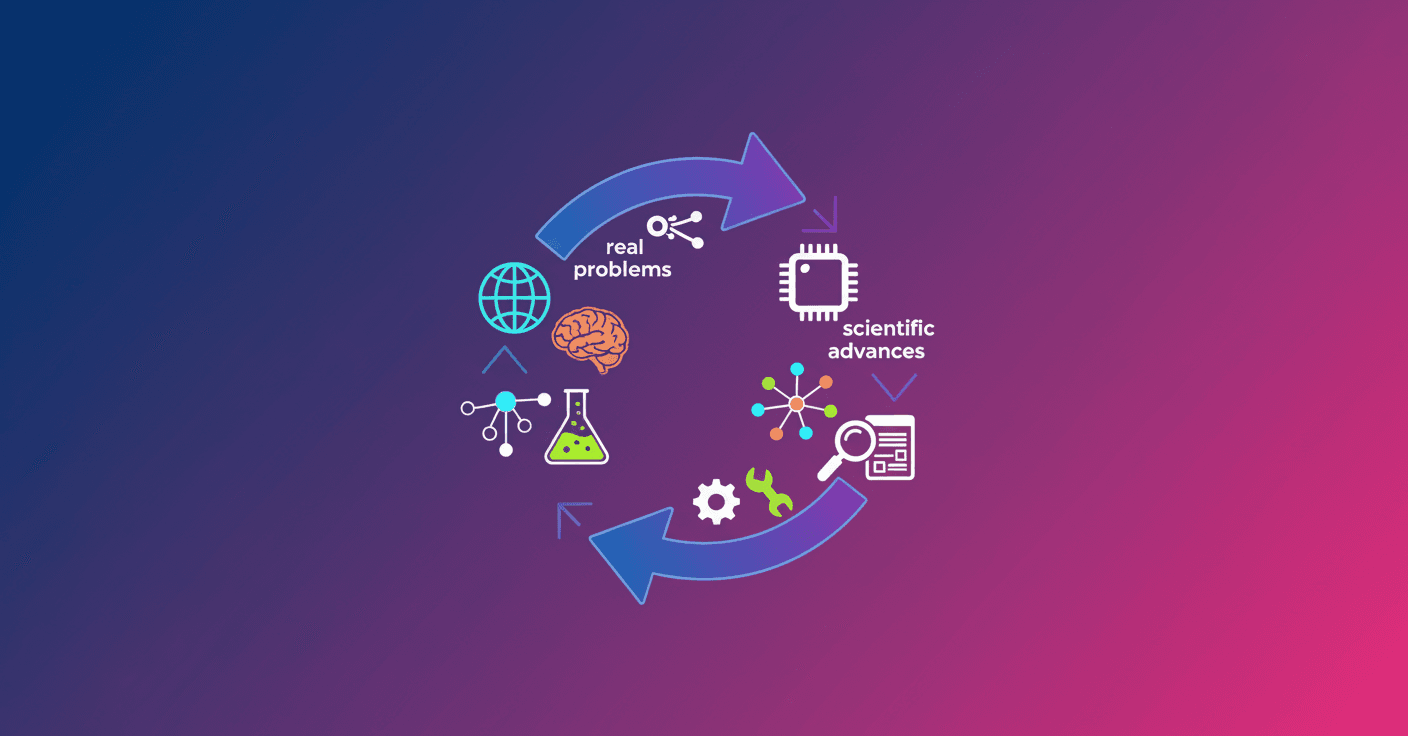
Last week, at the Research@Poland event, Google showed how its AI research connects to real-world problems. Yossi Matias, VP and Head of Google Research, presented the magic cycle, the idea that practical challenges guide fundamental research and that scientific advances come back to solve concrete problems.
Research@Poland brought the community together
Hundreds of researchers, academics, policymakers and partners gathered to explore how to keep that cycle alive. What's the common thread in all the conversations? collaboration. From deploying tools like Google Earth AI for public health and disaster response, to advancing brain mapping and responsible AI education, cooperation was the key piece.
"Collaboration drives the cycle where real problems generate research and that research goes back to serve people."
The demo booths weren't just showy: they were bridges from the lab to the street. Seeing prototypes in action helps you understand limitations, risks and implementation priorities much faster than any paper.
The magic cycle: what it means technically
The magic cycle is simple in idea and complex in execution. Technically, it involves an iterative flow where:
- Real-world problems are identified with relevant data and metrics.
- Models and methods are developed (for example deep networks, multimodal models, or self-supervised learning approaches) tailored to those problems.
- Controlled prototypes are deployed to gather real feedback.
- That feedback feeds back into research to improve models, datasets and practices.
This approach requires infrastructure for experimentation at scale, curated datasets, reproducible pipelines and robust validation and ethics practices.
Notable technical examples from the event
-
Google Earth AI: uses geospatial models trained with satellite imagery, sensor data and sociodemographic layers. Technically, it combines computer vision techniques for change detection with models that incorporate time series to forecast public health risks or map damage after disasters.
-
AI Co-Scientist: the concept of a virtual collaborator for scientists involves combining information retrieval, generative models finely tuned on scientific literature and a human verification loop. Typical architectures include document retrieval modules, language models for synthesis and interpretation layers for reproducibility.
-
Brain mapping: methods were presented that integrate multimodal recordings and deep learning to improve the resolution and interpretation of brain activity. The technical key is aligning temporal and spatial scales and generating representations that researchers can use for hypotheses and experiments.
-
AI literacy: there's technical work behind educational materials. It's not just pedagogical design, but creating didactic datasets, simulators and explainable tools that let you measure understanding and risks across age groups.
Why does this matter to you?
If you're a researcher, entrepreneur or policymaker, seeing this kind of meeting shows where to invest time and resources: projects with real data and local partners tend to generate more robust and responsible solutions. If you're simply curious about how technology impacts your daily life, here's a clear map: from faster emergency responses to tools that help scientists discover sooner.
Collaboration is not optional. It's how a technical idea becomes a useful, responsible service. That's why seeing Polish researchers, academics and policymakers working with Google matters: it defines priorities, risks and governance for real deployments.
Google and its partners showed that applied and fundamental research can feed each other if you design proper feedback cycles, clear metrics and implementation pathways that consider ethics and transparency.
Original source
https://blog.google/technology/research/ai-collaboration-poland-2025