Google is expanding its artificial intelligence and economics research program with new experts in innovation, employment, productivity, and growth. The company wants to understand not only who uses its AI tools, but also how they are changing businesses, jobs, and everyday life.
From Measuring Use to Understanding Impact
Google recently introduced AI & Economy ATLAS v1.0, an open-access, interactive platform that shows how people use its artificial intelligence tools at work and in their daily activities.
But knowing how many people use a technology is only the beginning. The more important question is: what happens after AI reaches an organization or a job?
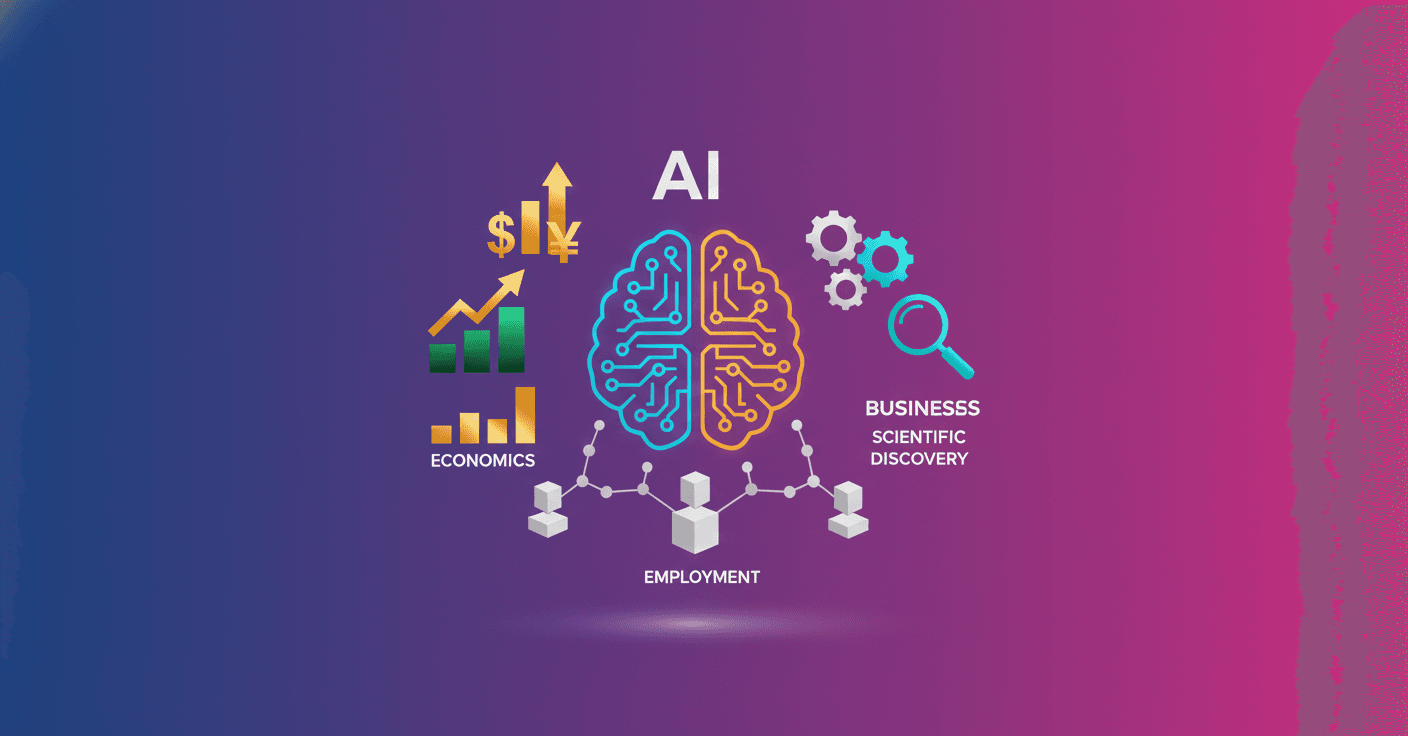
The research program will study that transition in real time, with special attention to four areas:
- The future of work.
- Productivity and economic growth.
- The spread of technology across different countries and regions.
- AI’s impact on scientific discoveries.
The idea is to combine detailed data on how these tools are used with rigorous economic analysis. Put simply, Google wants to observe what is happening while also understanding why it is happening.
Economists and Specialists Join the Program
To expand its scientific capacity, Google has brought in academic advisers, visiting researchers, and new directors for its AI and economics program.
Philippe Aghion Joins as an Academic Adviser
Philippe Aghion, winner of the 2025 Nobel Prize in Economics and a professor at INSEAD and the Collège de France, is joining the group of academic advisers. His work has focused on how innovation drives growth and on the concept of creative destruction—the process through which new technologies transform or replace previous economic models.
Aghion will work alongside other advisers, including fellow Nobel laureate Michael Spence and British economist Diane Coyle. His goal will be to help study AI’s long-term economic trajectory.
Ajay Agrawal Will Analyze AI and Science
Ajay Agrawal, a professor at the University of Toronto’s Rotman School of Management, is joining as a visiting researcher. He will collaborate with David Autor, an MIT professor and current member of the program.
His research will focus on the relationship between artificial intelligence and science, machine intelligence, and the ways technology can improve social well-being. Can AI speed up discoveries that once took decades? That is one of the questions the team wants to explore.
Two New Directors Will Study Employment and Productivity
Google also announced that Anu Madgavkar and Daniel Rock will join as directors of the AI & Economy Research Program.
Madgavkar spent two decades at the McKinsey Global Institute, where she led international research on labor markets, technology adoption, and economic transformations. At Google, she will study the global expansion of AI, its effect on small businesses, and the ways generative AI is changing work.
Daniel Rock joins from the University of Pennsylvania’s Wharton School. He specializes in AI and employment and has contributed to research on technological transitions. His work will combine usage data from advanced models with economic methods to analyze business productivity, workplace reorganization, and scientific advances.
Madgavkar and Rock will lead the program alongside Alex Imas, director of General Artificial Intelligence Economics at Google DeepMind, and Zanna Iscenko, head of AI and economics in the office of Google’s chief economist.
Research with Practical Consequences
The team’s expansion is not aimed solely at producing academic reports. Google says its research will help update ATLAS and guide decisions by businesses, workers, researchers, and governments.
Key topics will include organizational practices that help make the most of AI, public policies designed to reduce its negative effects, and training programs that enable more people to develop new skills.
The challenge is not only to make AI more powerful, but to ensure that its benefits reach more workers, businesses, and communities.
This approach recognizes something that can sometimes get lost in conversations about artificial intelligence: technology does not transform the economy automatically. Training, organizational culture, public rules, and access to tools matter too.
Google’s program could offer a useful window into that process, although its findings will need to be examined carefully and compared with independent research. To read the publications and explore the global data, the company invites people to visit ai.google/economy.
Original Source
https://blog.google/innovation-and-ai/technology/ai/expanding-ai-economy-research-bench