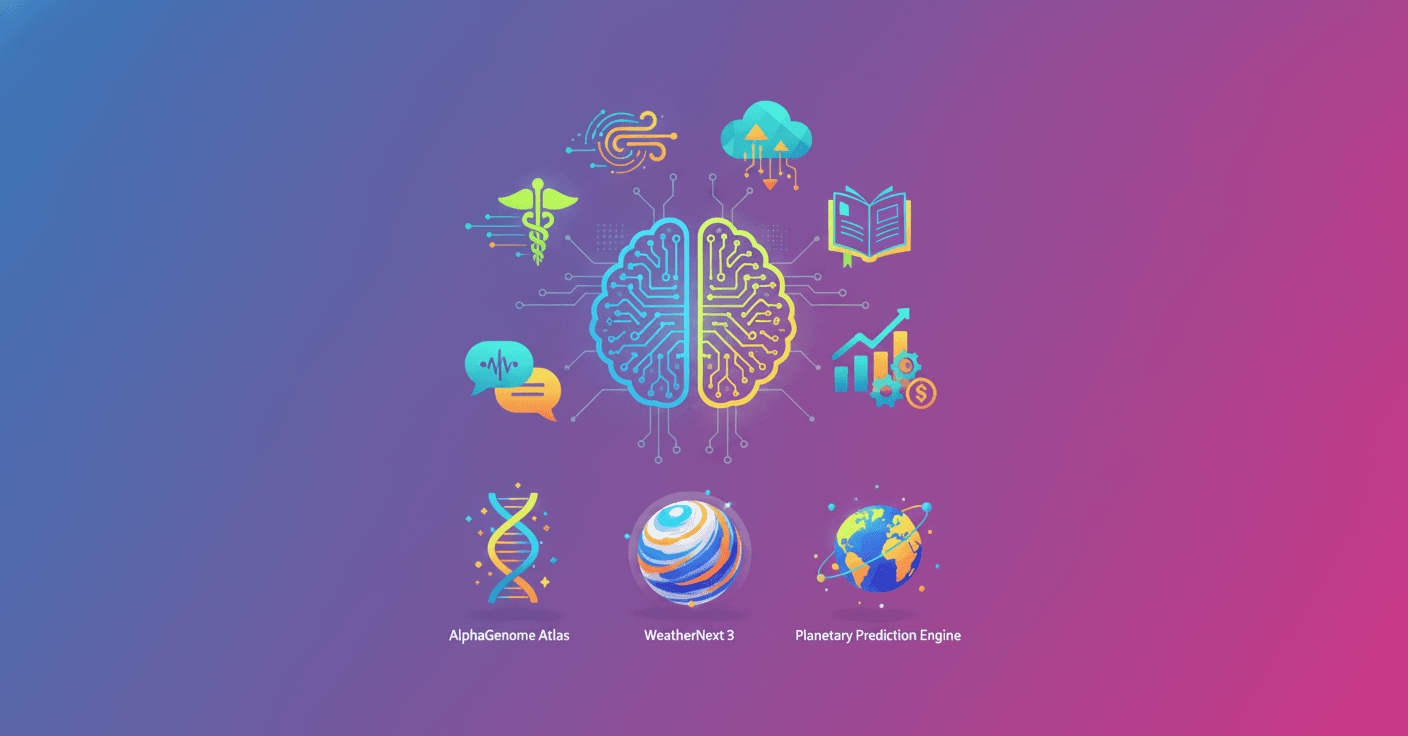
Google presents a broad vision of how artificial intelligence can stop being a futuristic promise and become a tool for solving concrete problems: detecting diseases, anticipating disasters, expanding access to education, and creating economic opportunities.
The company says its AI technologies already reach nearly 300 languages spoken by around 7 billion people, equivalent to 86% of the world's population. It also launched new interactive data through AI & Economy ATLAS, a platform that shows how people use AI at work and in their daily lives.
AI to understand and treat diseases
One of the main areas of focus is biomedical research. Google says AlphaFold has already predicted the structures of approximately 200 million proteins known to science. Around 4 million researchers in 190 countries use these predictions to study diseases and speed up drug development.
Now, the company is expanding that work with AlphaGenome Atlas, a project that maps the 9 billion possible single-letter changes in the human genome. The tool aims to help scientists understand how genetic variations change cell behavior and may contribute to disease.
The idea is not for AI to replace the researcher, but to allow them to explore more possibilities in less time.
Google also mentions advances in the early detection of cancer. In a study with Imperial College London and the UK's public health system, an AI tool identified 25% of breast cancers that had not initially been detected in mammograms of 175,000 women.
In other areas, its models have been used to analyze chest X-rays related to tuberculosis, detect the disease through cough sounds, and support more than 1.15 million diabetic retinopathy screenings. The announced goal is to expand these efforts to reach 6 million screenings over the next decade.
The company is also researching how smartphones and wearable devices can help detect early signs of cardiovascular disease, hypertension, insulin resistance, and other health problems.
Predictions to confront natural disasters
AI is also helping anticipate extreme weather events. Google introduced WeatherNext 3, its most advanced weather model, which the company says improves precipitation forecast accuracy by 50% at least one day in advance.
The system combines real-time satellite observations with AI models to produce high-resolution forecasts every hour, without relying on enormous supercomputing capacity. This could be especially important for regions that have historically had limited access to detailed weather predictions.
The Flood Hub platform already provides information about river and flash floods in areas where around 2 billion people live across more than 150 countries. In India, its 2025 monsoon forecasts provided useful information for approximately 38 million farmers.
Google is also working on detecting wildfires. Its tools have helped predict fire boundaries in the United States and 33 other countries, while the FireSat project aims to use a satellite constellation to identify fires too small to be detected by current systems.
Another project, called Planetary Prediction Engine, brings together data on global health, food security, and socioeconomic conditions. According to Google, the system anticipated 83% of the new outbreak hotspots in the Democratic Republic of the Congo and doubled the accuracy of food security predictions in districts of Nigeria.
Education and economic opportunities
In education, Google argues that AI can personalize learning, translate content, and explain complex topics according to each student's needs. Tools such as Guided Learning aim to provide step-by-step support, while teachers could use AI to research, prepare lessons, and reduce administrative tasks.
But here, an important question arises: how can we prevent technology from ultimately weakening learning instead of strengthening it?
Google acknowledges risks related to the accuracy of responses, safety, plagiarism, the loss of critical thinking, and excessive dependence. For that reason, it says it is working with ISTE+ASCD to provide AI literacy training to around 6 million educators in the United States, with teachers responsible for the direction and AI serving as an assistant.
For small businesses, AI can help design marketing campaigns, analyze regional sales, and create new products or services. However, the company warns that economic benefits are not guaranteed.
The labor market will likely experience three changes: some jobs will decline, others will grow, and many will change because AI will take over part of their tasks. Google says it has invested more than $1 billion in training initiatives and helped more than 100 million people develop digital and AI skills.
More languages and accessibility
Language expansion is another central part of this strategy. Google says its products already support nearly 300 languages and help more than 1 billion people translate approximately 1 trillion words each month. Its goal is to reach the world's 1,000 most widely spoken languages.
The challenge is not simply translating words. A single language can have dozens of dialects, with differences in pronunciation, vocabulary, and context. That is why the company participates in projects such as Project Vaani, which aims to open voice and image datasets for 109 languages in India.
It is also working with African universities and organizations to create open data for 27 languages spoken by more than 100 million people. In accessibility, Google is developing models capable of converting sign language into text to facilitate communication and dictation.
Responsibility cannot be left aside
Google recognizes that applying AI in science and healthcare involves particular risks. These include the potential misuse of knowledge related to chemicals, biology, radiology, and nuclear technology. There is also the opposite risk: failing to use AI in communities where it could provide real benefits, ultimately widening existing inequalities.
That is why the company emphasizes collaboration with universities, governments, national laboratories, nongovernmental organizations, foundations, and local partners. According to its data, Google has allocated more than $1 billion to over 1,700 research institutions since 2006.
The promise is enormous, but it is not automatic. An AI that predicts a flood does not save lives on its own: accessible alerts, prepared authorities, and communities with the resources to respond are also necessary. In the same way, a medical model can speed up a diagnosis, but it must be integrated with professionals, clinical evidence, and patient data protection.
Google's vision is for AI to accelerate a positive cycle between scientific discovery and new technologies. For that cycle to truly benefit society, it will need to be measurable, responsible, and accessible to more people—not just those who already have technological infrastructure and knowledge.
Original source
https://blog.google/innovation-and-ai/technology/ai/ai-applications-science-people