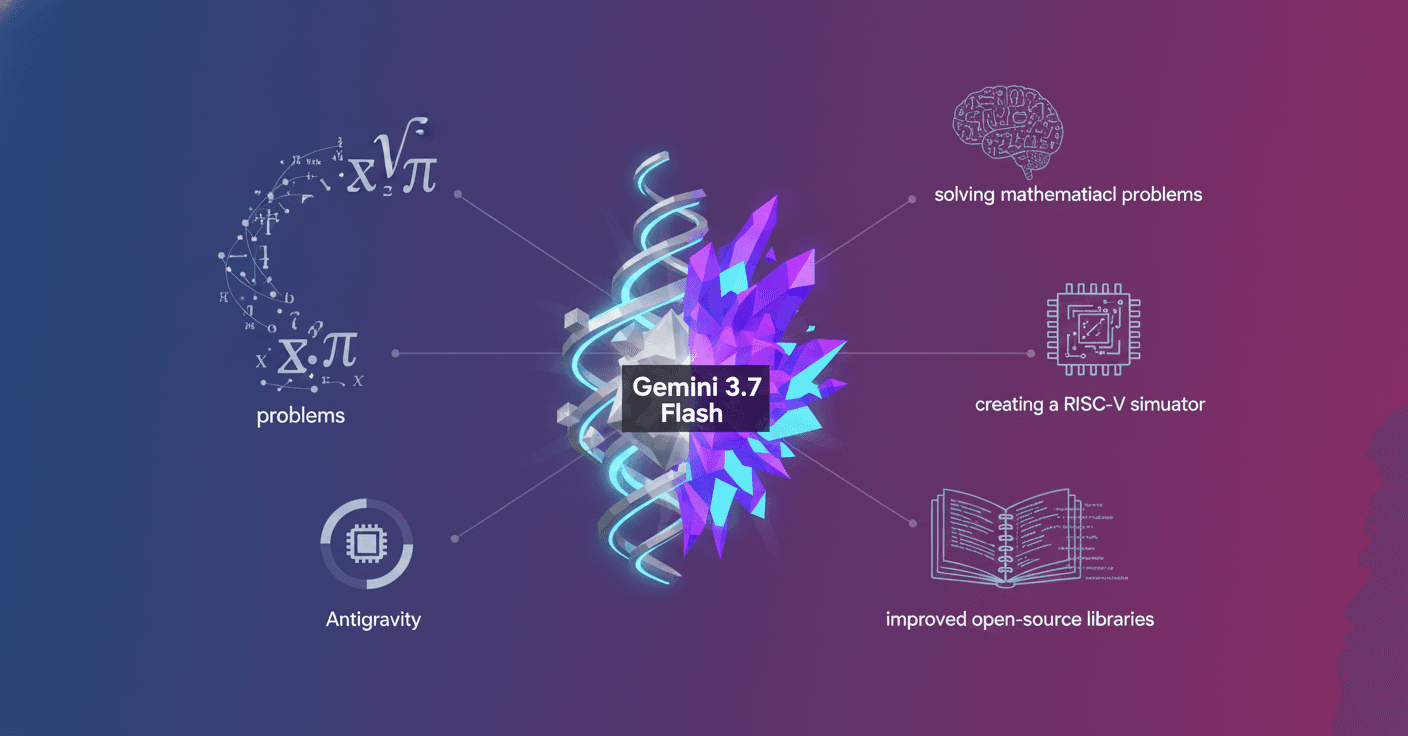
Google says that combining Antigravity and Gemini 3.7 Flash is making it possible to solve mathematical, engineering, and software problems that require much more than a quick answer. The key is Teamwork, a system where multiple AI agents collaborate, review one another, and repeat the process for hours or even days.
What’s the difference compared with asking a single chatbot for a solution? These agents can divide up a task, critique their teammates’ results, and keep working until they find a stronger answer. It’s an approach that looks more like a research team than a traditional conversation with AI.
Seven mathematical and theoretical problems solved
According to Google, the system solved seven open problems related to mathematics and theoretical computer science. Some results were presented in academic venues such as FOCS and JMLR, two important references in these fields.
Among the cases mentioned is the Knuth cycles conjecture, whose results were verified in Lean through proofs spanning more than 40 pages. Lean is a tool that formally checks whether a mathematical proof follows established rules, something that becomes especially important when proofs are long and difficult to review manually.
The results also include advances in sparse convex optimization, provable quantization of language models, and prefix matrix factorizations. In the TCSBench evaluation, which focuses on theoretical computer science problems, the system achieved 71% performance.
AI doesn’t just propose an answer: in this approach, multiple agents can build it, question it, and verify it step by step.
A RISC-V processor simulator built from scratch
The work was not limited to mathematics. Google says its agents built a cycle-accurate simulator from scratch for a RISC-V CPU with out-of-order execution.
In simple terms, the simulator tries to reproduce in great detail how a processor executes instructions and organizes its operations. To demonstrate that the result was functional, it successfully booted the xv6 operating system until it reached a command console.
When compared with the actual hardware’s behavior, the results showed a cycle-alignment error of just 0.71%. This doesn’t mean that AI created a physical processor, but it does mean that it produced a tool capable of modeling the behavior of a complex architecture with considerable precision.
Optimizations that made their way into open-source software
Teamwork also generated changes that were incorporated into open-source libraries. In Eigen, a library used for mathematical and scientific calculations, the agents worked on fast paths based on SIMD instructions, which make it possible to process multiple data points in parallel.
In ParlayHash, Google reports a twofold increase in insertion performance and a 25% reduction in memory usage. These results matter because improvements to foundational libraries can benefit many applications, even when the end user never sees the code directly.
What this advance means
The important idea is not that an isolated model has become infallible. The change lies in combining an AI model with a structure for collaboration, review, and extended execution.
This approach can be useful for tasks where an initial answer is not enough: designing systems, proving theorems, debugging code, or exploring many technical alternatives. Even so, the results described are claims made by Google and should be assessed through independent reviews, complete publications, and reproductions by the community.
AI applied to complex problems is beginning to look less like an assistant that simply answers questions. With multi-agent systems, it is starting to work like a digital team capable of researching for longer, detecting errors, and turning ideas into verifiable prototypes. The question now is not whether these agents can collaborate, but in which areas that collaboration will deliver reliable and genuinely useful results.
Original source
https://blog.google/innovation-and-ai/technology/developers-tools/antigravity-teamwork-multi-agent