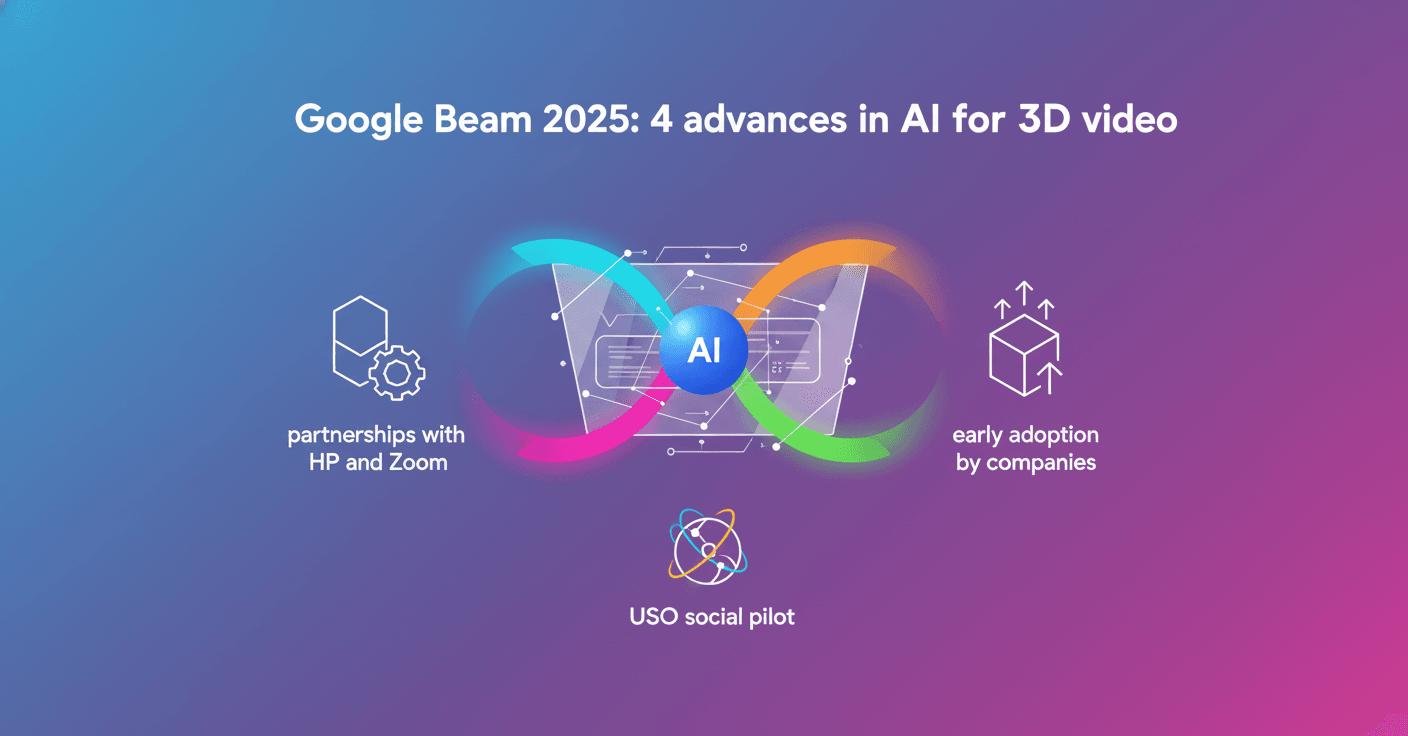
In 2025 Google turned what looked like science fiction into a product: Beam, an AI-powered platform for realistic 3D video. Can you imagine connecting with someone and feeling like you’re in the same room even if they’re miles away? That’s exactly the promise Google showed this year.
Google Beam in 2025: four key advances
1. From Project Starline to Beam: unveiling at I/O
At I/O, Sundar Pichai showed how Project Starline evolved into Google Beam. The novelty isn’t just the hardware; it’s the AI models that transform 2D video streams into near-instant 3D experiences. Google talked about capabilities that go beyond simple reframing: volumetric reconstruction, depth perception, and synchronization between audio and facial motion to boost the sense of presence.
From a technical perspective, this usually leans on techniques like multiview reconstruction, robust monocular depth estimation, and approaches related to NeRF for scene representation. In production, those models need optimizations: quantization, pruning, and inference compilers to keep latency low in real time.
2. Partnerships with industry leaders and enterprise products
Beam didn’t stay as a demo: it showed up at InfoComm 2025 as HP Dimension with Google Beam, a product aimed at businesses. It earned recognition and was highlighted for its impact on remote experience. Also, the collaboration with Zoom to integrate Beam into their software points to a practical distribution strategy: bringing 3D to workflows you already use.
In practice that means working with distribution partners like Diversified and AVI-SPL, and facing logistical technical challenges: signaling protocol interoperability, compatibility with existing codecs, and audio–video sync across heterogeneous systems.
3. Early adoption in offices and concrete use cases
Companies like Bain, Duolingo, Salesforce, and banks started piloting Beam. Google reported that internal test participants prefer Beam over traditional video calls and that 90% felt the experience was like being in the same space.
In internal tests, 90% of evaluators said Beam makes it feel like they are in the same room.
The use cases where Beam shines are practical: job interviews, mentoring, collaboration for distributed teams, and high-stakes conversations. Technically, these scenarios demand low latency, high-fidelity facial expression capture, and robustness under varying network conditions. To achieve that you often combine on-device models with edge or cloud inference, balancing privacy and performance.
4. Social pilot: Beam reaches USO centers
Beam didn’t stay only in enterprise; Google announced a pilot with the USO to install devices in centers that help service members connect with their families. It’s a clear reminder: technology has real human impact when it addresses emotional and social needs.
Technically this raises considerations too: secure communications, image privacy, and availability in locations with limited connectivity. Solutions typically include end-to-end encryption, adaptive bandwidth handling, and degraded modes that prioritize audio when the network can’t support full 3D reconstruction.
Technical and ethical implications
Beam pushes several technical limits: real-time inference of heavy models, multimodal synchronization, and latency management within human tolerance. But it also brings ethical questions we can’t dodge: consent for 3D captures, storage of volumetric representations, and biases in models that interpret facial expressions.
If you’re evaluating Beam or similar technologies, focus on five things: end-to-end latency, perceptual quality (not just PSNR), data privacy and governance, compatibility with existing infrastructure, and user experience on real networks.
Google Beam isn’t just a visual experiment; it’s a combination of advances in models, optimization, and industrial partnerships that aim to change how we collaborate remotely. Are we ready for virtual meetings that feel more human? Early adoption and social pilots suggest the answer might be yes—provided we pair innovation with solid technical and ethical practices.
Original source
https://blog.google/technology/research/google-beam-2025-moments